

Published: Updated: Brian Bennet 15 min read


10 IT Due Diligence Questions PE Firms Should Ask Before an AcquisitionThe ink is dry, the press release is out, and leadership raises a glass to a successful merger or acquisition (M&A). For CEOs and business owners, this means new revenue, new capabilities, and a stronger competitive advantage. But to attackers, especially when private equity backing is involved, that same announcement signals a higher-value target with more money in motion, more systems in flux, and more opportunities to exploit the chaos.
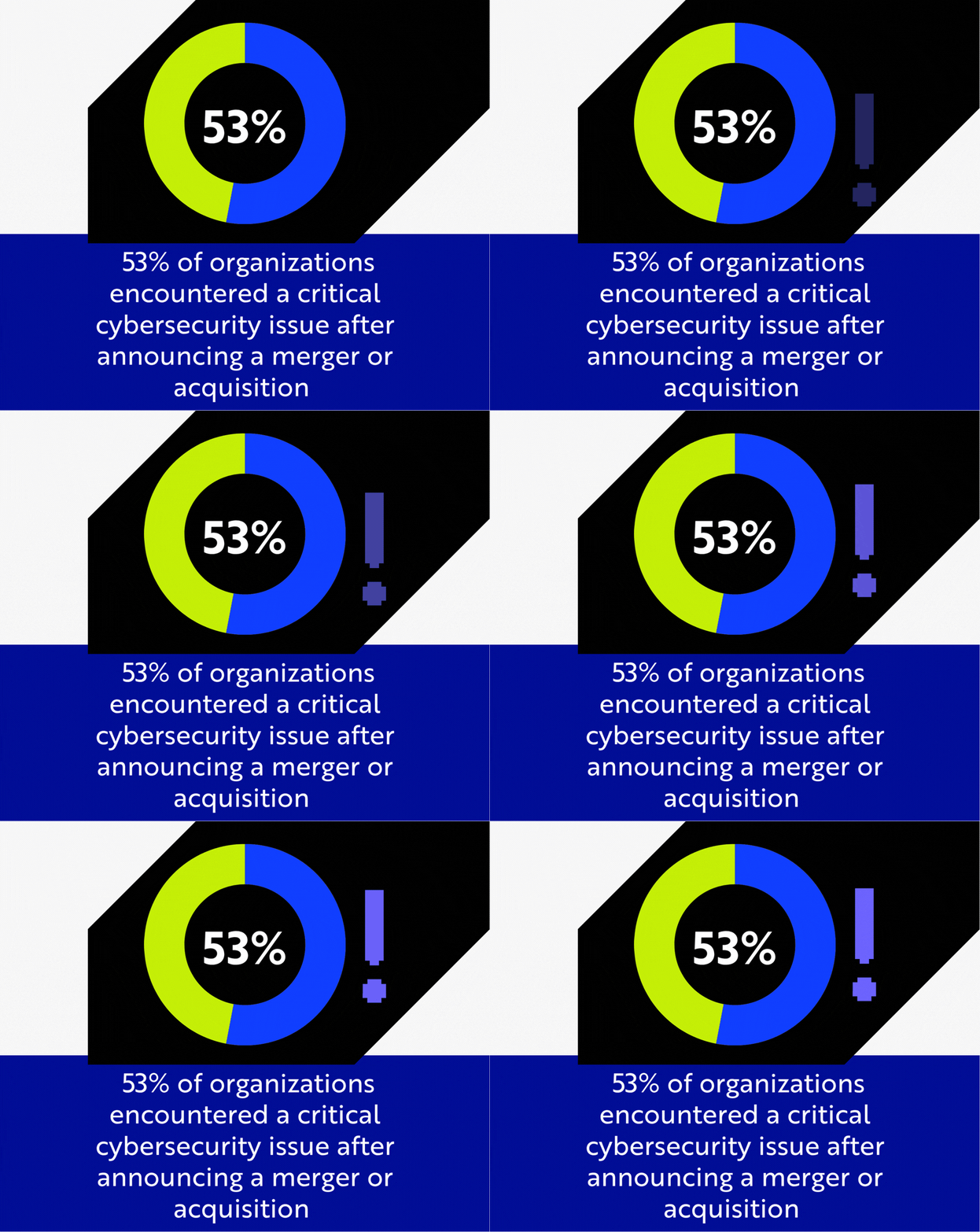
Deloitte cites that 53% of organizations encountered a critical cybersecurity issue after announcing a merger or acquisition. That makes M&A cybersecurity risk more than a technical concern, making it a direct business and financial threat. A cyberattack during this period can disrupt integration, expose inherited vulnerabilities, and potentially sink the entire deal.
This article breaks down why an M&A transaction can create a high-risk environment, one where organizations become more vulnerable to catastrophic cyberattacks. We also cover the biggest cybersecurity risks CEOs should understand, why cyber due diligence matters, and the steps leaders can take to protect a growing organization before attackers exploit the transition.
In this article:
-
The $5 Million Shortcut: How an M&A Cyberattack Can Damage Deal Value
-
M&A Cybersecurity Risk Questions Every CEO Should Ask Before Closing a Deal
The $5 Million Shortcut: How an M&A Cyberattack Can Damage Deal Value
Cybercrime is a highly organized, heavily commercialized industry. Modern threat actors operate like corporate entities, complete with research departments and revenue targets. They track financial news and follow private equity investment trends. To attackers, an M&A announcement signals a company with more financial leverage, tighter operational pressure, and a transition period full of moving parts.
When there is a tight timeline to close an acquisition, it is incredibly tempting to approach cybersecurity like just another administrative checklist. But treating technical due diligence as an afterthought is a dangerous shortcut, especially when PwC reports that only 14% of organizations experience success with their M&A deal.
Cybersecurity can directly influence whether a deal protects value or inherits risk, because one hidden breach, unpatched system, or unmanaged access path can turn integration into an expensive disruption. Deloitte warns that overlooking cybersecurity during M&A can cost organizations an average of $5 million in damages.
A Clean Balance Sheet Doesn’t Mean a Clean Network
The acquired company you are buying may look immaculate on a financial spreadsheet. Beneath the surface, however, they may operate on a foundation of severe IT vulnerabilities. As the purchasing company, you absorb every bad security habit, weak password, and unpatched server the target company possesses.
The Biggest M&A Cybersecurity Risks CEOs Should Watch Out For
Inherited IT exposure comes in several dangerous forms:
Legacy Systems
Legacy system risk is common in acquired companies, especially in industries that depend on specialized applications or equipment. These systems may be difficult to patch, expensive to replace, or tied to critical operations. This makes them easy targets for attackers because they lack modern controls.
Shadow IT
Employees at the acquired company may be using third-party apps, cloud storage, personal devices, or AI tools without IT approval or oversight. This shadow technology bypasses security protocols, creates major visibility gaps, and increases the risk that sensitive data flows into unmanaged public platforms.
Unknown Assets
Unknown assets may include legacy infrastructure, abandoned cloud accounts, unmanaged endpoints, orphaned devices, or vendor-managed systems. If the business does not know an asset exists, it cannot secure it. Thus, creating many persistent blind spots with their own attack surface. Continuous discovery of every system a business owns is how those forgotten assets get found before an attacker finds them.
Over-Permissioned Access
During post-merger integration, employees from both sides of the acquisition need to collaborate quickly. In the rush to "just make it work," access rules go lax. IT teams, overwhelmed by helpdesk tickets, onboarding requests, and complex migration tasks, begin granting blanket administrative privileges. Suddenly, no one truly knows who should have access to what, creating massive vulnerabilities if one of those accounts is compromised.
Misaligned Security Policies
One company may strictly enforce zero trust architecture. The other may only use it for email. One may have strong endpoint protection. The other may rely on basic antivirus. One may have tested backups. The other may assume backups work. When policies do not align, attackers find the weakest link.
Third-Party Vendors
M&A often expands the vendor ecosystem. New software platforms, consultants, cloud tools, and contractors enter the picture. Each of these connections represents a potential supply-chain vulnerability that the acquiring company has not vetted.
Compliance Failures
If you acquire a company that handles protected health information (PHI) or controlled unclassified information (CUI), you also inherit its regulatory posture. If its systems fall short of HIPAA, CMMC, SEC guidelines, or SOC 2 requirements, the deal can create immediate compliance exposure. If a breach occurs on the acquired network, that exposure can trigger costly audits, disrupt operations, and hit the balance sheet hard with expensive fines.
When Inherited IT Exposure Becomes a Dealbreaker
Threats from inherited risk can sit undetected inside an acquired company’s environment for weeks or months before anyone sees the signs. By the time the deal is moving forward, the attacker may already have access to sensitive data and critical systems. Research shows that 73% of dealmakers say an undisclosed breach is a dealbreaker, which means skipping IT due diligence can put the entire transaction at risk.
Related Article: 10 IT Due Diligence Questions PE Firms Should Ask Before an Acquisition
Proof that Cyber Due Diligence Pays Off
Consider a manufacturing company with a billion-dollar supply chain that acquired a smaller business. Before integrating both environments, the company brought in cybersecurity leadership and prioritized forensic review, and it paid off. They uncovered an attacker who had been sitting inside the acquired company’s OT systems for months. Because they caught the breach before the environments were connected, the company avoided spreading the compromise across its broader operations and kept the growth strategy intact.
Post-Merger Incident Response: The Danger of the DFIR Gap
Another major M&A cybersecurity risk is the DFIR gap. Cybercriminals know the M&A transition period is chaotic. IT teams are stretched thin, systems are in flux, and leadership is focused on financials, people, and operational continuity. That chaos creates ideal conditions for attackers to hide.
When two distinct networks merge, the baseline of normal network activity completely disappears. Massive data transfers look like routine cloud migrations instead of malicious data exfiltration. Strange administrative logins look like new employees accessing systems instead of a hacker’s lateral movement across the environment.
The noise generated by the integration provides the perfect cover for malicious activity. By the time the security team realizes a breach has occurred, the attackers have already secured deep footholds across both networks.
277 Days in the Dark
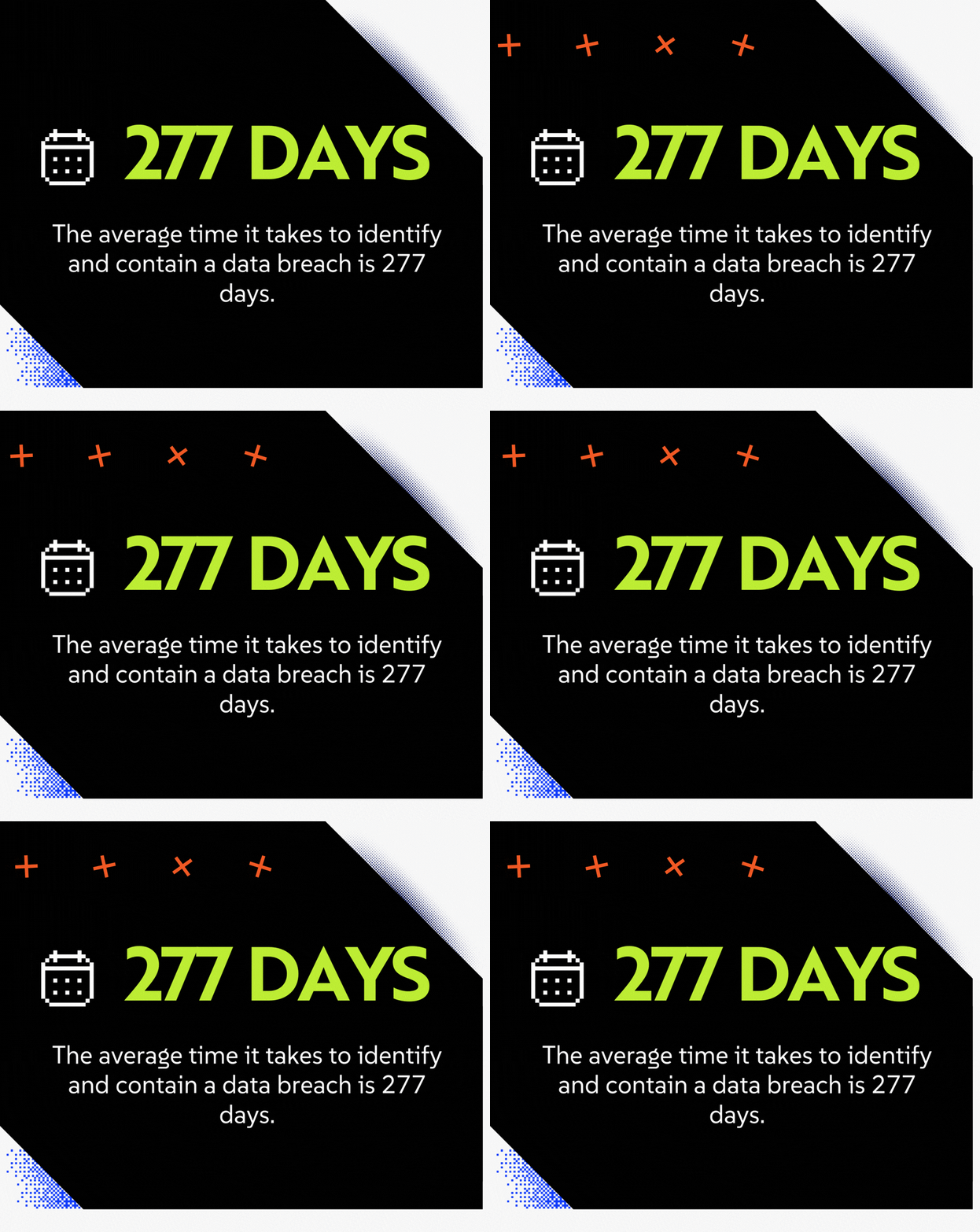
The longer teams spend sorting through M&A complexity, the more time adversaries have to expand access. IBM’s Cost of a Data Breach Report 2025 found that organizations without modern MDR take an average of 277 days to identify and contain a breach. In an M&A environment, that delay becomes even more dangerous because the business is already operating in a high-stakes environment.
It’s also why detection and breach containment alone are not enough. Alerts may show that something suspicious happened, but they don’t tell the full story. To close the DFIR gap, teams need context, logs, forensic investigation, and clear response authority to determine whether unusual activity is normal integration work or a sign of compromise.
Enforce Your Security Baseline to Protect Deal Value
M&A cybersecurity risk requires board-level prioritization. CEOs and business owners cannot afford to wait until networks physically merge to understand their risk exposure. Deloitte’s 2026 notes that identifying and managing cyber exposure before closing an M&A deal is becoming more relevant as acquirers seek to protect value.
How to Lock Down the Acquired Network from Day One
Mitigating inherited exposure requires a methodical, uncompromising approach to IT due diligence. A strategic integration plan must:
- Assume compromise: Treat the newly acquired network as a hostile environment. Do not bridge networks, establish VPN tunnels, or share active directories until completing a comprehensive penetration test and vulnerability scan.
- Establish immediate visibility: Deploy endpoint detection and response (EDR) tools across all newly acquired assets immediately. Strong security requires absolute visibility into what is happening on every endpoint, laptop, and server.
- Enforce zero trust architecture: Rebuild access controls from the ground up. Employees should only have the access required to perform their specific job functions. Never grant blanket administrative rights for the sake of convenience.
- Modernize rapidly: Identify and decommission high-risk legacy systems immediately. Bring the acquired company up to the primary security baseline on a compressed timeline.
- Unify the security culture: Launch aggressive, M&A-specific security awareness training for all employees to combat the inevitable surge in phishing attempts.
A Practical M&A Cybersecurity Checklist for CEOs
CEOs do not need to manage every technical detail, but they do need to pressure-test the assumptions behind the deal.
Here are the cybersecurity questions CEOs should ask before an acquisition:
- Has cyber due diligence been performed?
- Do we know the target’s critical systems and data?
- Are there known vulnerabilities or prior incidents?
- Are compliance obligations understood?
- Are third-party vendors and access paths documented?
- Are backups tested and recoverable?
During integration:
- Who owns cybersecurity decisions?
- Are access permissions being reviewed before systems connect?
- Is MFA enforced across both environments?
- Are logs centralized and retained?
- Are security tools covering the integrated environment?
- Is the incident response plan updated for the merged organization?
After integration:
- Have temporary permissions been removed?
- Have duplicate tools and vendors been rationalized?
- Have high-risk legacy systems been isolated or modernized?
- Has a post-integration risk assessment been completed?
- Has the business updated and tested its incident response and continuity plans?
These questions help shift M&A cybersecurity from reactive cleanup to proactive risk management. But they also raise a bigger issue: whether your internal IT team has the bandwidth, visibility, and authority to manage the complexity of an M&A deal.
Secure the M&A Transition with Strategic IT Partnership
PwC found that 60% of leaders list cybersecurity investment as one of their top three strategic priorities, while only 6% of organizations feel fully prepared across all major cyber vulnerability areas.
A managed IT and security partner who specializes in mergers and acquisitions helps bring structure to that process. Instead of reacting to issues as they arise, an MSP coordinates integration with security in mind from the start. That includes mapping assets across both organizations, aligning access controls, standardizing security policies, and ensuring monitoring and logging are consistent across the combined environment.
Let a vCISO Handle the Heavy Lifting of Cyber Due Diligence
Additionally, an IT integration partner will provide vCISO guidance. A vCISO provides leadership during a high-risk, high-pressure period, translating complex integration steps into a clear, multi-year roadmap. They handle all parts of an M&A technology integration, including cyber due diligence support, user migration, vendor consolidation, and unifying disparate security policies.
This removes the administrative weight from the CEO’s shoulders, allowing them to focus on cultural alignment and growth. By centralizing security governance, the partnership ensures that every integration step protects the deal’s long-term value and prevents operational disruption.
Build a Repeatable M&A Security Playbook
Treating M&A cybersecurity as an ad hoc project is a mistake. True due diligence requires a repeatable framework designed to protect business continuity, deal velocity, and customer trust across every acquisition you make. Continuous threat exposure management gives that framework a structure that keeps running after the deal closes, so inherited risks keep getting found and fixed instead of surfacing once during due diligence.
CompassMSP helps organizations navigate M&A with clearer visibility, stronger control, and end-to-end IT integration support. Through managed IT, cybersecurity, forensic-led response, and strategic vCISO guidance, CompassMSP helps identify inherited risk and secure integration points before exposure becomes a business problem. Because CompassMSP operates with a private-equity-backed model, we bring the repeatable playbook, mature processes, and scalable platforms needed to integrate acquisitions cleanly and securely.
Before you connect the networks, reach out to CompassMSP to secure your next acquisition before hidden exposure becomes inherited risk.

Brian Bennet
Brian is a Security Architect at CompassMSP and military combat veteran with 22 years of IT experience spanning the public sector, government contracting, managed services, and executive cybersecurity leadership. He has served as an Information Systems Security Manager for a global aerospace company—where he secured classified and unclassified assets under NISPOM, NIST, and ITAR frameworks and established a classified asset security program from conception through ATO—as well as a vCIO and CISO/vCISO, guiding organizations ranging from 10 to over 1,000 employees through security strategy, framework implementation, audits, and incident response engagements including ransomware events. Brian holds certifications from ISC2, Cisco, Microsoft, VMware, and CompTIA, and draws on his progression from hands-on engineering to the C-suite to drive meaningful security conversations.