

Go Back Up
healthcare-hipaa-hitrust-ebook

HEALTHCARE EBOOK

HIPAA vs HITRUST: The Complete Guide to Compliance for Healthcare SMBs

Protect ePHI, prove security maturity, and turn compliance into a competitive advantage. A practical guide to HIPAA and HITRUST for mid-sized healthcare leaders, not just IT.
  • 15+ page guide • HIPAA & HITRUST explained • The 7-pillar security playbook
Next Section
light-emergency-on-sharp-solid-full
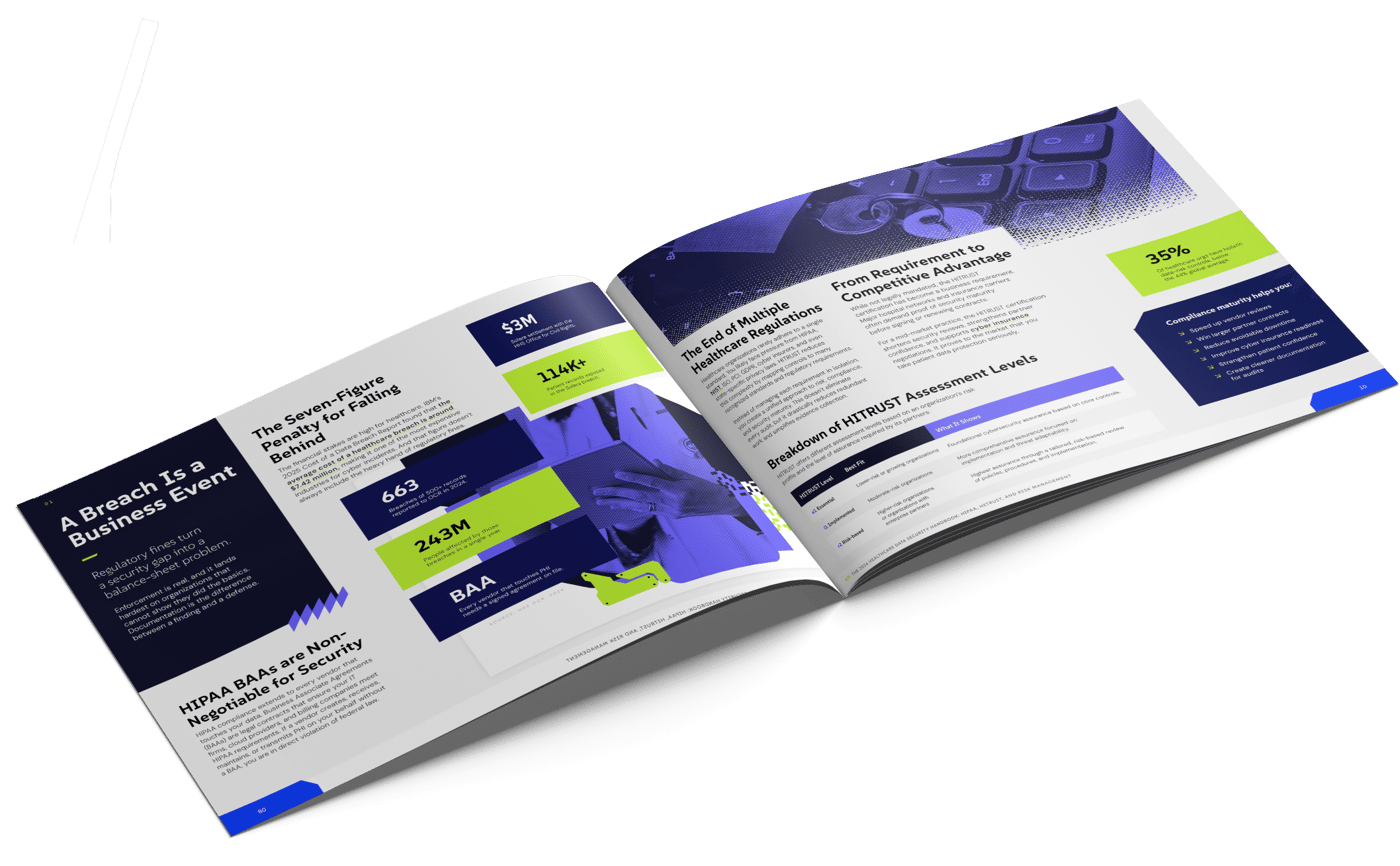
$7.42M Average cost of a healthcare data breach
IBM Cost of a Data Breach, 2025

Average cost of a healthcare data breach
IBM Cost of a Data Breach, 2025

shield-exclamation
92% Of healthcare orgs faced a cyberattack last year
Ponemon / Proofpoint, 2024

Of healthcare orgs faced a cyberattack last year
Ponemon / Proofpoint, 2024

bell-set-timer
663 Breaches of 500+ records reported to OCR in 2024
HHS OCR, 2024

Breaches of 500+ records reported to OCR in 2024
HHS OCR, 2024

healthcare-hipaa-hitrust-01

KEY TAKEAWAYS

HIPAA Sets the Baseline.
HITRUST Proves the Maturity.

HIPAA defines the legal floor for protecting patient data, but compliance alone does not prove your security controls work under pressure. HITRUST gives healthcare organizations a structured way to demonstrate security maturity, reduce partner friction, and turn compliance into a business advantage.

  • HIPAA is the federal law that sets the baseline for protecting patient data. HITRUST is the framework that proves your security controls work.

  • HIPAA is required for covered entities and business associates. HITRUST is voluntary, but partners and payers increasingly demand it before signing contracts.

  • The average healthcare data breach costs $7.42 million. A formal framework like HITRUST can cut that by $2.2 million or more.

  • Compliance is a business advantage, not just a checkbox. Maturity shortens security reviews, wins enterprise deals, and protects valuation.

  • Strong healthcare security follows seven pillars: identity, endpoint, email, network, backup, monitoring, and governance.
How does the HIPAA Privacy Rule control PHI?

The Privacy Rule governs how healthcare organizations use and disclose protected health information. It also gives patients rights over their own records, including the ability to access their information, request corrections, and understand how their data is being handled.

What does the HIPAA Security Rule require?

The Security Rule focuses specifically on electronic protected health information. It requires administrative, physical, and technical safeguards that protect the confidentiality, integrity, and availability of ePHI across systems, devices, workflows, vendors, and users.

What happens after a breach of 500 or more records?

When a breach occurs, healthcare organizations must act quickly to determine notification obligations. Breaches involving 500 or more individuals require notice to affected patients, the HHS Office for Civil Rights, and the media, creating regulatory pressure and reputational risk at the same time.

How does HITRUST prove security maturity?

HITRUST gives healthcare organizations a structured framework for proving security maturity through independent validation. It maps to multiple standards, including HIPAA, NIST, ISO, PCI, and GDPR, helping organizations reduce duplicate compliance work and give partners stronger evidence of risk management.

HIPAA vs. HITRUST, side by side.

Compliance and credibility are not the same thing.

One is the rulebook written by the government. The other is the evidence compiled by a certified third party to prove you followed it. Increasingly, the proof is what closes the deal.

HIPAA vs HITRUST comparison for healthcare organizations

Attribute HIPAA HITRUST
What it is Federal law and regulatory framework Cybersecurity and risk management framework
Required? Required for covered entities and business associates Voluntary, unless a partner or contract requires it
Enforced by HHS Office for Civil Rights Independent assessment and certification process
Focus Privacy, security, and breach notification for PHI Control maturity, risk management, and assurance
Compliance obligation Certification or assessment report Independent assessment and certification process
Best use Establishing the legal baseline Proving maturity to partners, payers, and customers
hitrust-hipaa-compliance-peek-2

Turn healthcare compliance pressure into a clear security plan.

The full guide includes all seven security pillars, HIPAA vs. HITRUST comparison details, proposed Security Rule updates, the Telescope Health case study, and leadership-ready compliance FAQs.

03 The Business Case

Compliance maturity is a sales asset.

Patients, partners, and payers want proof. Maturity shortens security reviews, wins larger contracts, and protects valuation. It pays for itself before a breach, not after.
chart-line-up-sharp-solid-full
50% Of health plan execs prioritize cybersecurity above other upgrades. Deloitte

Of health plan execs prioritize cybersecurity above other upgrades. Deloitte

pie-chart
35% Of healthcare orgs have holistic data-risk controls, below the 44% global average. PwC

Of healthcare orgs have holistic data-risk controls, below the 44% global average. PwC

hands-holding-dollar
$2.2M+ Potential breach-cost reduction with a formal framework like HITRUST. HITRUST Alliance

Potential breach-cost reduction with a formal framework like HITRUST. HITRUST Alliance

04 The Playbook

The 7-pillar healthcare security playbook.

You do not need every control at once. You need the right controls in the right order. Start with the first two pillars here, then download the full guide for all seven implementation checklists.

PILLAR 01

Identity & Access

  • Require MFA for email, EHR, remote access, admin, and cloud.

  • Enforce role-based access to only what each job requires.

  • Review privileged administrative accounts regularly.

  • Remove access immediately when roles change or end.

  • Monitor all systems for suspicious login activity.

PILLAR 02

Endpoint & Device

  • Deploy EDR, anti-malware, and strict encryption.

  • Keep devices patched and operating systems updated.

  • Apply strict controls for laptops, mobile devices, and removable media.

  • Pay special attention to shared clinical workstations.

  • Document and isolate legacy systems that cannot support modern tools.

03

Email & Phishing

Reduce the risk of inbox-driven attacks before they reach patient systems.

In the full guide

04

Network & Cloud

Create clear boundaries around ePHI, clinical systems, cloud access , and everyday systems.

In the full guide

05

Backup & Recovery

Protect critical systems with tested recovery plans, not hopeful backups when downtime hits.

In the full guide

06-07

IR & Governance

Connect 24/7 visibility, incident response, risk analysis, and audit-ready documentation.

In the full guide

telescope-image-case-study

Customer Success Story

Telescope Health Delivers Better Patient Outcomes with Managed IT Services for Healthcare

100% Telescope Health became HITRUST certified and HIPAA compliant with a more secure, scalable IT environment.

Telescope Health became HITRUST certified and HIPAA compliant with a more secure, scalable IT environment.

-80% Telescope Health reduced IT infrastructure outages by 80%, helping improve reliability across daily operations.

Telescope Health reduced IT infrastructure outages by 80%, helping improve reliability across daily operations.

+90% Telescope Health saved more than 90% of the time previously spent managing IT, giving the team more room to focus on patient care and growth.

Telescope Health saved more than 90% of the time previously spent managing IT, giving the team more room to focus on patient care and growth.

Download Your Copy

Free Download

Get the Complete HIPAA & HITRUST Guide

You have seen the why. The full guide gives you the how, in a format you can share with your board and your team.

hitrust-hipaa-compliance-peek


15+ pages • PDF

Designed for healthcare leaders 

Build your healthcare security plan around seven core controls.

The full guide breaks down the seven security pillars every healthcare organization should understand: identity, endpoint, email, network, backup, monitoring, and governance. Each section includes practical implementation steps that help protect patient data, reduce downtime risk, and give leaders clearer proof of compliance readiness.

See where HIPAA ends, and HITRUST begins.

HIPAA sets the legal baseline for protecting PHI and ePHI. HITRUST helps prove that your controls are mature, tested, and ready for partner scrutiny. The guide also explains HITRUST e1, i1, and r2 assessment levels so leaders can match the right path to their risk profile, contract requirements, and growth plans.

Prepare for the next phase of HIPAA security expectations.

The proposed HIPAA Security Rule updates point toward stronger, more specific cybersecurity requirements for healthcare organizations. The guide outlines what leaders should start preparing for now, including asset inventories, network maps, MFA, encryption, vulnerability testing, annual audits, incident response planning, and stronger documentation.

Learn how Telescope Health turned IT risk into momentum.

The full case study shows how Telescope Health moved from compliance gaps, recurring downtime, and security concerns to a more mature IT environment built for patient care, HITRUST readiness, and long-term growth.

Give leadership clearer answers to healthcare compliance questions.

The guide closes with executive-ready answers to common questions about HIPAA, HITRUST, ePHI, business associates, breach notification, proposed rule changes, and healthcare security governance. Use it to align leadership before compliance pressure becomes a fire drill.

Next Section

THE FINE PRINT NEWSLETTER

Too busy to panic over a surprise audit?

Subscribe to The Fine Print for the compliance updates your business cannot afford to miss. We translate the legalese, so you stay out of trouble.

FAQs

Answers to HIPAA, HITRUST, + Healthcare Questions

Healthcare compliance gets complicated fast. These answers clarify what leaders need to know about HIPAA, HITRUST, ePHI, business associates, breach notification, and security maturity before audits, contracts, or partner reviews create pressure.

What is the difference between HIPAA and HITRUST?

HIPAA is a federal law that sets the baseline for protecting protected health information, including ePHI. HITRUST is a cybersecurity and risk management framework that helps healthcare organizations prove their controls are mature, tested, and aligned to multiple standards. HIPAA defines the obligation. HITRUST helps prove the organization can meet that obligation.HIPAA defines the obligation. HITRUST helps prove the organization can meet that obligation.

Is HITRUST required for healthcare organizations?

HITRUST is not legally required by the federal government. However, hospitals, payers, enterprise healthcare networks, and business partners may require HITRUST certification before they sign or renew contracts. For growing healthcare organizations, HITRUST can become the proof point that keeps deals moving.

Does HIPAA compliance mean a healthcare organization is secure?

HIPAA compliance does not automatically mean a healthcare organization is secure. HIPAA helps establish required safeguards, but security depends on how those safeguards work in daily operations. A secure healthcare environment needs monitoring, tested backups, strong access controls, vendor oversight, incident response, and continuous improvement.

What is ePHI?

ePHI stands for electronic protected health information. It includes PHI that is created, received, maintained, or transmitted electronically. ePHI can live in EHR systems, billing platforms, patient portals, email, cloud storage, mobile devices, file shares, backups, spreadsheets, and legacy databases.

What is PHI under HIPAA?

PHI means protected health information. It includes identifiable health data connected to a person’s condition, care, treatment, payment, insurance, or medical history. PHI can appear in clinical records, billing systems, scheduling tools, intake forms, emails, patient portals, call recordings, and vendor platforms.

What is the difference between a covered entity and a business associate?

A covered entity is a healthcare provider, health plan, or healthcare clearinghouse that handles PHI. A business associate is a vendor that creates, receives, maintains, or transmits PHI on behalf of a covered entity. IT providers, cloud platforms, billing companies, software vendors, and consultants can all become business associates when patient data is involved.

What is a Business Associate Agreement?

A Business Associate Agreement, often called a BAA, is a contract that requires a vendor to follow HIPAA requirements when that vendor handles PHI. If an IT firm, cloud provider, billing company, or software partner touches patient data without a signed BAA, the healthcare organization may be out of compliance.

Who enforces HIPAA?

HIPAA is enforced by the HHS Office for Civil Rights, also known as OCR. OCR investigates complaints, reviews breach reports, and issues penalties when covered entities or business associates fail to protect PHI or ePHI. Enforcement often focuses on whether the organization can prove risk analysis, safeguards, policies, and response procedures are in place.

What is the difference between HHS and OCR?

The Department of Health and Human Services, or HHS, is the larger federal agency responsible for healthcare, public health, and human services programs. The Office for Civil Rights, or OCR, is the office within HHS that enforces HIPAA Privacy, Security, and Breach Notification Rules.

What are the three HIPAA Security Rule safeguards?

The HIPAA Security Rule requires administrative, physical, and technical safeguards to protect ePHI. Administrative safeguards include policies, training, and risk analysis. Physical safeguards protect facilities, workstations, and hardware. Technical safeguards include access controls, encryption, audit logs, and authentication.

What is changing under the proposed HIPAA Security Rule updates?

The proposed HIPAA Security Rule updates point toward stronger, more specific cybersecurity expectations for ePHI. Healthcare organizations should prepare for requirements around written policies, asset inventories, network maps, risk analysis, MFA, encryption, vulnerability testing, backup and recovery, incident response planning, and annual compliance reviews.

What are the HITRUST e1, i1, and r2 assessment levels?

HITRUST e1 is best for lower-risk or growing organizations that need foundational assurance. HITRUST i1 is designed for organizations that need stronger implementation assurance and threat-adaptive controls. HITRUST r2 provides the highest assurance through a tailored, risk-based review for higher-risk organizations or organizations with enterprise partner requirements.

How can healthcare SMBs prepare for HITRUST certification?

Healthcare SMBs should start by identifying where PHI and ePHI live, who has access, and which vendors touch patient data. Then, leaders should assess current controls against HITRUST requirements, close gaps in access control, 24/7 monitoring, incident response, backups, vendor management, and documentation, and build an evidence trail before the formal assessment begins.

Why do healthcare organizations need a vCISO for HIPAA and HITRUST?

A vCISO gives healthcare leaders strategic security guidance without the cost of a full-time executive hire. They help connect technical controls to governance. For healthcare organizations, that means stronger HIPAA alignment, HITRUST readiness, and a clearer roadmap for reducing risk.

Featured Resources

Stay sharp. Stay secure.

Explore expert insights, practical tips, and real-world advice from our blog curated to help you make smarter tech decisions.
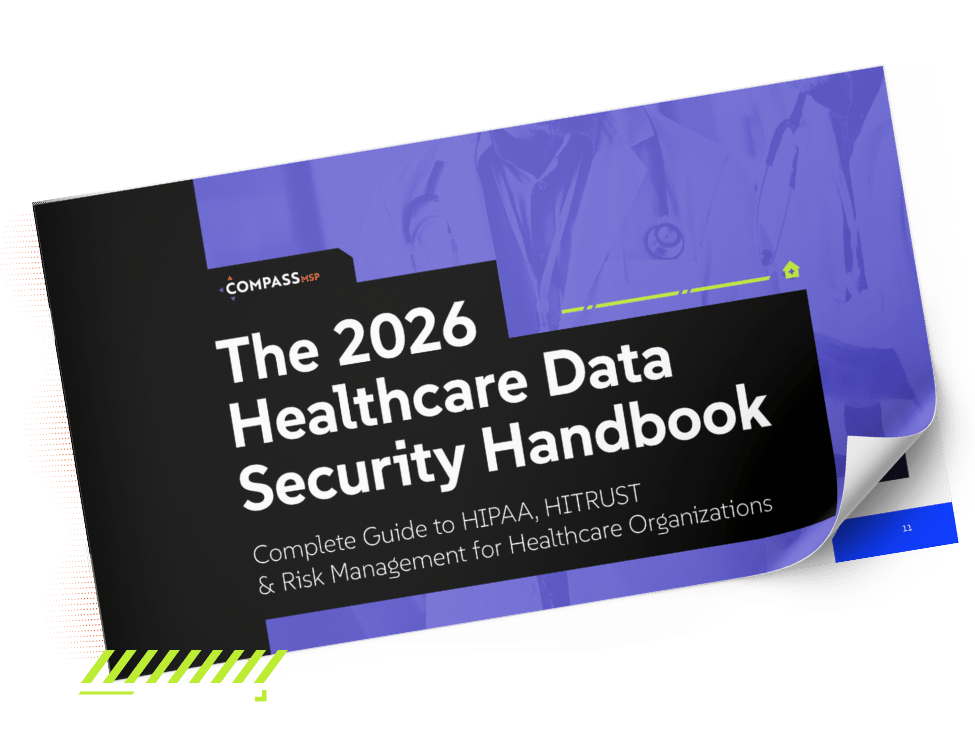
The 2026 Healthcare Data Security Handbook

Cybersecurity eBooks Healthcare

The 2026 Healthcare Data Security Handbook

Protect ePHI, prove security maturity, and turn compliance into a competitive advantage. A practical guide to HIPAA and HITRUST for mid-sized healthcare leaders, not just IT.
7 Things Healthcare Leaders Need to Know About HIPAA vs HITRUST

Healthcare Articles 6 min read

7 Things Healthcare Leaders Need to Know About HIPAA vs HITRUST

Explore the critical differences between HIPAA compliance and HITRUST certification, explaining how small to mid-sized healthcare organizations can protect patient data, ensure clinical uptime, and gain a competitive advantage through verified cybersecurity maturity.
Franke Tobey Jones Achieves Uptime and Growth with Retirement Community IT Services

Compliance & Risk IT Modernization Cloud & Infrastructure Healthcare Case Studies

Franke Tobey Jones Achieves Uptime and Growth with Retirement Community IT Services

Franke Tobey Jones modernized its IT infrastructure with CompassMSP, achieving reliable connectivity, enhanced security, and continuous HIPAA compliance for optimal resident care and future growth.