Go Back Up

What We Do

CMMC Services for Defense Contractors

Readiness is a documentation and evidence problem before it is a technology problem. These are the pieces of work that take an organization from uncertain to assessable, and Compass performs all of them.
check

CMMC Applicability Review

Which of your contracts carry which clauses, whether you hold CUI or only Federal Contract Information, and what level a requiring activity can specify today.

check

Scope & CUI Boundary Definition

Data identification first, then a boundary you can defend, with the enclave option costed against the full-environment option before any remediation starts.

check

Readiness & Gap Assessment

All 110 NIST SP 800-171 Rev 2 requirements assessed against the 800-171A objectives, with point values, evidence requirements, and POA&M eligibility.

check

SPRS Score Calculation & Submission

We calculate the score with you and document the basis, because an inflated score carries False Claims Act exposure.

check

System Security Plan Authorship

We write it against your assessed environment. It cannot be deferred to a POA&M, so it gets built early and maintained.

check

Security Policy & Procedure Development

Policies tied to the controls they govern and the evidence they produce, rather than a binder nobody operates from.

check

Control Implementation & Remediation

Sequenced by point value and by what a POA&M will not accept, so the work that qualifies you happens first.

check

POA&M Development & Closeout Tracking

Built within the scoring rules and tracked against the 180-day closeout window so conditional status does not lapse.

check

Evidence Management & Assessment Rehearsal

Evidence mapped to the objectives it answers, then a full examination rehearsal including interview practice with your team.

check

C3PAO Selection & Certification Support

We help you shortlist an independent assessor, prepare the in-brief, and stay with you through the examination from your side of the table.

check

Security Awareness Training

Awareness and role-based training that satisfies the requirement and produces the completion records an assessor will ask for.

check

Ongoing Compliance Management

Annual affirmation, control monitoring, evidence refresh, and executive reporting, run inside the managed relationship.


CMMC Readiness Check

Find Your CMMC Starting Point

Understand where your organization may stand and what to do next.

Not sure whether CMMC applies, where CUI may live, or what your next step should be? Answer a few quick questions about your contracts, scope, and readiness stage to get a clearer path forward before remediation begins with no commitment.

How the Work Runs

The Compass CMMC Readiness Path

Five stages, each producing a document you can hand to an assessor, a prime, or your own board. Scope comes first because it governs the cost of everything after it.
01

Weeks 1-2

Abstract Shape 01 Purple

Applicability & Scope

We determine which contracts carry which clauses, whether you hold CUI or only Federal Contract Information, and what level applies. Then we draw the boundary and model the enclave option against the full-environment option, so the cost of the program is a decision rather than a surprise.

  • You receive: a contract and clause register, a CUI data inventory, a scoping decision with cost comparison.

02

Weeks 3-6

Abstract Shape 01 Purple

Gap Assessment Against All 110 Requirements

Each requirement is assessed against the NIST SP 800-171A objectives rather than a yes-or-no checklist, because that is how an assessor will examine it. Findings carry the point value, the evidence that would satisfy the objective, and whether the requirement is POA&M eligible.

  • You receive: a scored gap assessment, your SPRS score with its calculation basis, and a POA&M eligibility map.

03

Weeks 4-10

Abstract Shape 01 Purple

Documentation & Remediation

The System Security Plan is authored first, since it cannot be deferred. Policies and procedures follow the controls they govern rather than sitting in a binder. Remediation is sequenced by point value and by the six POA&M exclusions, so the work that qualifies you for a POA&M happens before the work that can sit on one.

  • You receive: a System Security Plan, the policy and procedure set, a sequenced POA&M, and implemented controls.

04

Weeks 8-14

Abstract Shape 01 Purple

Evidence & Assessment Rehearsal

Evidence is organized to the assessment objectives it answers, so an assessor is not hunting through a shared drive. We then run the examination with your team in the room, including interview practice, because most findings come from an answer no one had rehearsed rather than from a missing control.

  • You receive: a mapped evidence package, a rehearsal findings report, and a remediation list before anyone external sees the environment.

05

Ongoing

Abstract Shape 01 Purple

Certification Support + Continuous Evidence

We help you select an independent C3PAO, prepare the in-brief, and support you through the examination. After it, compliance decays quietly as staff and systems change, so annual affirmation sits on a managed calendar, POA&M closeout is tracked against the 180-day window, and control monitoring runs through the same security operations that protect the environment.

  • You receive: assessor coordination, affirmation management, closeout tracking, refreshed evidence, and executive reporting you can defend.


seamless-comms-02

CMMC STRATEGY SESSION

Start With Scope Before You Start Remediation

CMMC readiness gets messy when organizations jump straight into policies, tools, or technical fixes before confirming what actually applies. In a 30-minute working session, CompassMSP helps you clarify your CMMC starting point, including possible CUI exposure, NIST SP 800-171 gaps, remediation priorities, and the next steps needed to move toward audit readiness. It is designed to help your team avoid overscoping, reduce guesswork, and focus the budget on the fixes that matter most.
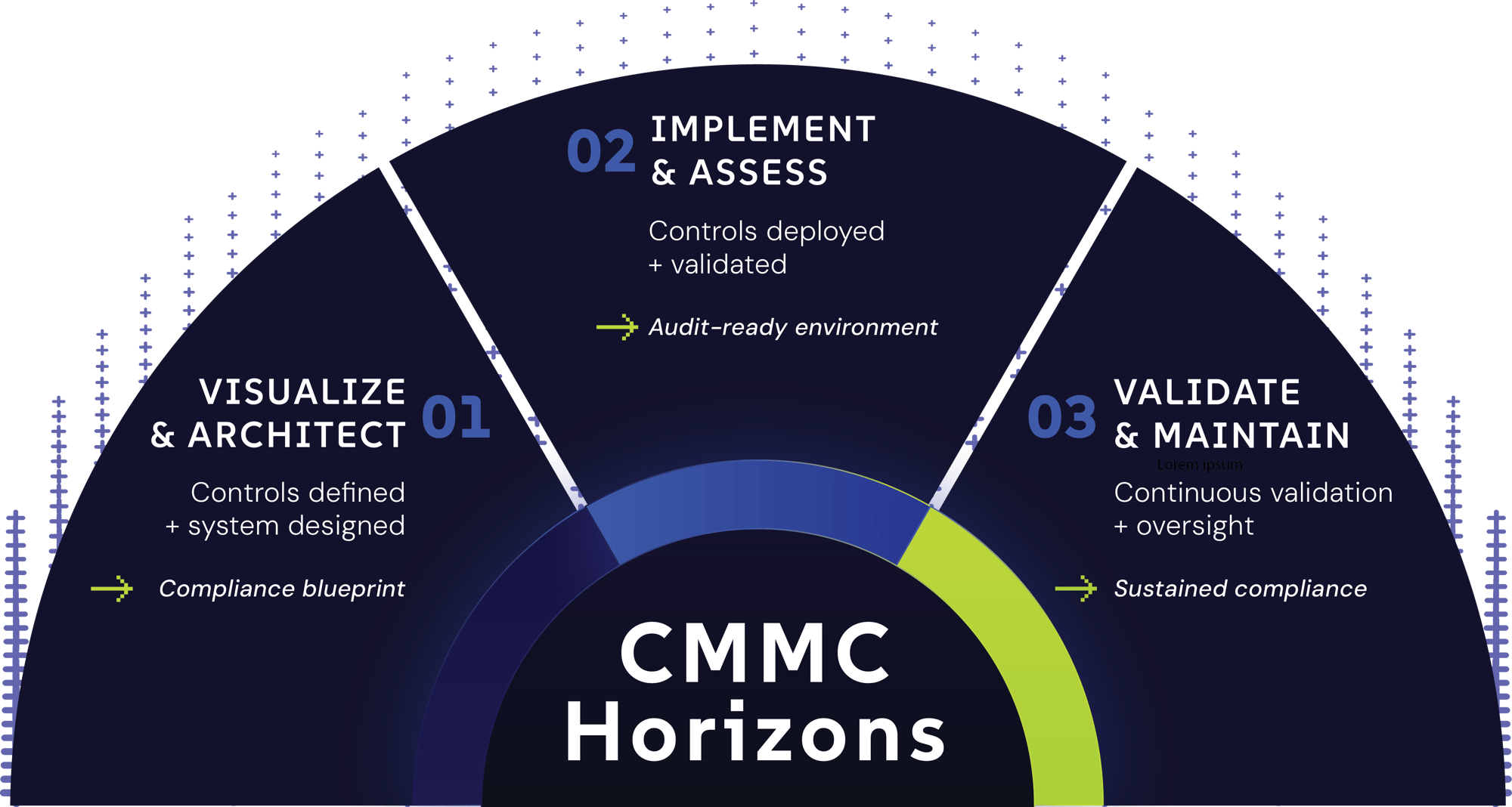
CompassMSP_CMMC-Horizons

The Compass Approach: Structured CMMC Readiness

This is where most organizations get stuck.

CMMC determines whether aerospace and defense manufacturers remain eligible for Department of Defense contracts. CompassMSP’s CMMC Jumpstart is a fixed-scope engagement designed to help organizations establish audit readiness with clarity, structure, and control.

This approach translates CMMC and  NIST 800-171 requirements into concrete actions, aligned documentation, and validated controls without unnecessary complexity or long-term lock-in.

Horizon 1: Visualize & Architect

Before anything gets deployed, we get clear on what matters.

We define what needs to be protected, how it moves, and where your environment begins and ends. Then we design the system around that reality.

This is where most providers rush. We don’t.

Because if the architecture is wrong, everything after it is expensive to fix.

What This Looks Like

  • Map how CUI actually moves through your business
  • Define clear system boundaries and enclave design
  • Translate CMMC and NIST 800-171 into real, usable requirements
  • Align the design to how your team actually works

Outcome
A clear, defensible blueprint. No guesswork. No overengineering. Just a system designed to meet CMMC from the start.

Horizon 2: Implement & Assess

Now we build it. Then we prove it.

This is where design turns into reality. Controls get deployed, systems get hardened, and documentation gets built to reflect how everything actually operates.

Then we assess it the way an auditor will.

Not in theory. Not in a spreadsheet. In the real environment.

What This Looks Like

  • Deploy and configure required controls
  • Build and secure the CUI enclave
  • Develop SSPs, POA&Ms, and supporting documentation
  • Validate controls against CMMC expectations

Outcome
An environment that is not just implemented, but validated. Backed by evidence. Ready to stand up to scrutiny.

Horizon 3: Validate & Maintain

Getting compliant is one thing. Staying that way is another.

Environments change. Teams evolve. Risk doesn’t sit still.

We keep everything aligned so readiness doesn’t degrade over time.

What This Looks Like

  • Ongoing validation and internal pre-assessments
  • Continuous alignment of documentation and evidence
  • Accurate SPRS scoring support
  • Ongoing oversight through vCISO advisory and managed compliance

Outcome
Sustained audit readiness. Less risk. No surprises when it matters most.


cmmc-level-one-two-strategic-choice

CERTIFIED CMMC REGISTERED

Start Your Executive CMMC Level 2 Readiness Checklist

CMMC Phase 1 implementation began in late 2025, and mandatory third-party audits arrive in November 2026. For defense manufacturers, certification is no longer optional; it is your "license to operate" in the Department of Defense (DoD) supply chain. This strategic checklist helps executives identify critical gaps in NIST 800-171 controls, secure the shop floor, and build a defensible System Security Plan (SSP) that protects long-term contract eligibility.

Buyer Criteria

How to Evaluate a CMMC Readiness Provider

Use these eight questions on any provider, including us. The answers separate firms that run a documented readiness program from firms that resell tooling and hope the assessor agrees.
Evaluation criteria for CMMC readiness and NIST 800-171 providers. Last reviewed October 8, 2026.
 
What to Ask A Weak Answer What CompassMSP Answers
Are you registered with the Cyber AB, and in what role? Claims CMMC expertise without naming a registration, or blurs RPO and C3PAO. Registered Practitioner Organization. Readiness and certification support, with assessment independence preserved.
How do you establish our CUI boundary? Starts with a tool deployment or a control checklist across the whole environment. Data identification comes first. We define the boundary and then evaluate the enclave and full-environment options, including their cost differences, before remediation begins.
Who writes the System Security Plan? Hands you a template to complete. We author it against your assessed environment. It cannot be deferred to a POA&M, so it is built early and maintained.
Will you rehearse the assessment with us? Delivers a gap report and stops there. We conduct a full examination rehearsal. That includes interview practice so findings surface before an assessor is in the room.
Can you also perform our certification assessment? Says yes or offers a bundled prepare-and-certify package. No. We preserve assessment independence, explain the requirements, and help you select an independent C3PAO.
Who owns our SPRS score and affirmation? Leaves it with the client without providing review or supporting documentation. We calculate the score with you and document its basis. We also keep the affirmation on a managed calendar. The submitted score carries False Claims Act exposure, so accuracy matters.
Is your security operations center in the United States? Describes follow-the-sun coverage without naming locations or confirming who handles the work. Detection, triage, investigation, and containment are performed by a 100% U.S.-based security operations center. U.S. facilities, U.S. personnel, and no offshore SOC.
What happens after we are certified or scored? The project ends at the assessment. Compliance becomes an ongoing managed process. Annual affirmation, POA&M closeout tracking, control monitoring, and evidence refresh continue inside the managed relationship.

cmmc-checklist-hero

Registered Practitioner Organization Certified Expertise for CMMC

We provide the authorized guidance defense contractors need to navigate certification with absolute confidence.

As a Registered Practitioner Organization (RPO) certified by The Cyber AB, we deliver the authorized guidance required to meet official assessor expectations. Our team manages the technical requirements of NIST 800-171 gap assessments and remediation, so your leadership can focus on manufacturing. We translate complex CMMC mandates into a defensible, audit-ready posture that ensures your System Security Plan (SSP) and evidence remain resilient under third-party scrutiny.

Program Status Reference
 

Where the CMMC Program Stands Today

The phased rollout has moved, and much of the published CMMC guidance has not kept up. Here is the current position, dated so you can see when it was last verified. Your obligations ultimately come from the clauses in your solicitation and contract.

Suspended

Paused Pending the Reform Review

  • The November 10, 2026 Phase 2 transition was suspended on July 13, 2026. No replacement date has been announced.
  • New Level 2 C3PAO certification requirements in solicitations are paused. During Phase 1, requiring activities may specify Level 1 or Level 2 self-assessments.
  • Level 3 implementation and waiver procedures associated with the phased rollout are also paused during the review.
In Force

Binding on Contractors Today

  • DFARS 252.204-7012. Contractors handling CUI must implement the 110 requirements in NIST SP 800-171 Revision 2, maintain a System Security Plan, report covered cyber incidents within 72 hours, preserve specified incident data for at least 90 days, and flow applicable requirements down to subcontractors.
  • Level 1 and Level 2 self-assessments. Requiring activities may continue to specify these assessments. Results and affirmations are entered in SPRS, with annual affirmation required to keep the status current.
  • Government-led Medium and High assessments. These assessments may still be conducted using NIST SP 800-171A, with summary scores posted in SPRS.
Why Waiting Still Carries Risk

What Is Still Driving Contractor Timelines

01

Your Prime Contractor

Prime contractors retain flowdown responsibilities regardless of federal phasing. Many have maintained or tightened their supplier cybersecurity requirements, making an approved supplier position a more immediate deadline than federal rulemaking.

02

The False Claims Act

The Civil Cyber-Fraud Initiative can treat inaccurate representations about NIST SP 800-171 implementation as false claims.

Honeywell Aerospace agreed to pay $2,042,518 in September 2026 to resolve allegations involving cybersecurity gaps on one network. The settlement did not require a CMMC certificate, and there was no determination of liability.

03

Assessment Capacity

In July 2026, the Cyber AB reported nearly 2,000 Level 2 Final certifications and 110 authorized C3PAOs. When third-party certification requirements return, assessor availability may quickly become a scheduling constraint.

Secure Your Federal Contract Eligibility.

Your ability to win federal work hinges on your certification status. Whether it's a missing document or an overlooked security control, the risk is real. Choose your path to readiness below to protect your revenue and your future.

Why Compass

Readiness Backed by Operations

Most CMMC consultancies hand you a plan and leave. Most managed providers run your systems without compliance depth. The requirements need both, because evidence comes from how the environment is actually operated day to day.
  • +
    software-updates

    Cyber AB Registered Practitioner Organization

    Registered for readiness and certification support, bound by the Code of Professional Conduct.

  • +
    detect-function

    100% U.S.-based security operations center

    Detection, triage, investigation, and containment performed in U.S. facilities by U.S. personnel. No offshore SOC.

  • +
    stop-guessing-start-strategizing-leaders-guide

    vCISO and security advisory bench

    Executive-level security leadership for board reporting, policy ownership, and audit defense.

  • +
    gap-analysis

    40+ years of combined heritage

    More than 350 professionals supporting regulated organizations nationally.

software-updates detect-function stop-guessing-start-strategizing-leaders-guide gap-analysis

Why Organizations Trust Compass for CMMC

CMMC requires both technical depth and practical judgment. Compass delivers both.

Security-First Foundation

Compliance anchored in real cybersecurity controls, not paperwork alone.

CMMC is more than a documentation exercise; it is a validation of your actual security maturity. We build your compliance program on a foundation of technical excellence, ensuring that your 110 NIST 800-171 controls are fully implemented, functional, and verifiable. By aligning your CMMC requirements with day-to-day security operations, we ensure that your posture is defensible during a third-party assessment and resilient against evolving threats. We move beyond "checkbox compliance" to deliver a security environment that protects your intellectual property and your Department of Defense (DoD) contracts.

Pro-Serve Expertise

Hands-on guidance from vCISO and security advisors who understand audits and assessors.

Navigating the complexities of CMMC requires more than just IT support; it requires executive-level advisory and specialized compliance knowledge. Our vCISOs and security advisors act as your internal advocates, providing the practical judgment needed to translate dense regulatory language into actionable business milestones. As an RPO, our team is authorized to guide you through readiness using practices aligned with assessor expectations, significantly reducing the risk of failed audits or corrective action delays. We provide the high-level oversight necessary to manage your System Security Plan (SSP) and Plan of Action & Milestones (POA&M) with total confidence.

Operational Fit

Programs designed to support contracts without slowing the business down.

We recognize that defense manufacturers must maintain production velocity while meeting strict security mandates. Our approach focuses on "right-sizing" your compliance scope, using techniques like enclave definition and CUI data flow mapping to isolate sensitive information. This strategy prevents the over-engineering of your entire IT environment, allowing your shop floor to remain efficient while your defense-related systems meet Level 2 requirements. We build compliance programs that fit the unique workflow of your industry, ensuring that security supports your people instead of slowing them down.

Single Point of Accountability

One partner responsible for alignment, follow-through, and outcomes.

Fragmented ownership is one of the leading causes of CMMC assessment failure. CompassMSP eliminates this risk by serving as your single integrated partner across IT, cybersecurity, and compliance. We take full responsibility for the alignment of technical controls, policy documentation, and employee training, ensuring no gaps exist between your IT operations and your audit evidence. From the initial gap analysis to the final pre-assessment validation, you have one partner accountable for the success of your certification journey and the protection of your manufacturing legacy.


FEATURED RESOURCES

Practical Guidance for Compliance and Risk

Stay sharp. Stay secure.

Explore articles, guides, checklists, and expert insights that help you understand requirements, reduce risk, prepare for assessments, and maintain compliance.
managed cybersecurity services, managed detection and response, incident response services, MDR provider comparison

Cybersecurity Compliance & Risk 4 min read

Best MDR Providers for Incident Response in 2026

Compare 7 MDR providers for 2026. Evaluate incident response, response authority, SLAs, coverage, and costs with a practical buyer scorecard.
You Were Too Small for Privacy Law. As of January, You Aren't.

Compliance & Risk Articles 8 min read

You Were Too Small for Privacy Law. As of January, You Aren't.

State privacy laws are evolving, impacting small retailers. Learn how to prepare for compliance with new thresholds and avoid costly penalties.
ACM Aerospace Alley - October 29, 2026

Compliance & Risk Events 2 min read

ACM Aerospace Alley - October 29, 2026

Join CompassMSP at the ACM Aerospace Alley Tradeshow to explore cybersecurity solutions for aerospace manufacturers and enhance compliance readiness.
CS5 EAST - October 22-23, 2026

Compliance & Risk Events 2 min read

CS5 EAST - October 22-23, 2026

Join CompassMSP at CS5 East 2026 to learn about CMMC compliance for defense contractors. Visit Booth #16 for insights on cybersecurity and contract readiness.

FAQs

CMMC Compliance for Defense Contractors

A quick guide to how CMMC works, what’s required, and how CompassMSP supports certification readiness.

What Does It Mean to Be CMMC Audit-Ready?

Being audit-ready means your documented environment, implemented controls, and supporting evidence tell the same story.

For Level 2, you should have:

  • A documented and defensible CUI boundary
  • All 110 requirements assessed against the applicable objectives
  • A System Security Plan that matches the environment as implemented
  • Policies and procedures tied to actual operations
  • Evidence mapped to the objectives it supports
  • An accurate SPRS score
  • A compliant POA&M for any eligible open items
  • Employees prepared for assessor interviews

Compass helps organizations connect technical controls, documentation, evidence, and ongoing operations through its Compliance and Risk Management services.

What Does It Mean to Be CMMC Audit-Ready?

Being audit-ready means your documented environment, implemented controls, and supporting evidence tell the same story.

For Level 2, you should have:

  • A documented and defensible CUI boundary
  • All 110 requirements assessed against the applicable objectives
  • A System Security Plan that matches the environment as implemented
  • Policies and procedures tied to actual operations
  • Evidence mapped to the objectives it supports
  • An accurate SPRS score
  • A compliant POA&M for any eligible open items
  • Employees prepared for assessor interviews

Compass helps organizations connect technical controls, documentation, evidence, and ongoing operations through its Compliance and Risk Management services.

Does CompassMSP Support CMMC Certification?

Yes. CompassMSP supports the work required to prepare for certification, including scoping, gap assessment, remediation, System Security Plan development, evidence organization, assessment rehearsal, and C3PAO coordination.

Compass does not perform the independent certification assessment for organizations it has prepared. That assessment must be conducted by an authorized CMMC Third-Party Assessment Organization, or C3PAO, with the required independence preserved.

We can help you identify potential assessors, prepare for the assessment in-brief, support your team during the examination, and track eligible POA&M items through closeout.

Can One Provider Prepare and Certify the Same Organization?

A provider may hold both readiness and assessment credentials, but it cannot prepare and independently assess the same organization within the prohibited period.

32 CFR 170.8 requires the CMMC Accreditation Body to prevent CMMC Ecosystem members from participating in a Level 2 certification assessment when they served as a consultant preparing that organization for a CMMC assessment within the previous three years.

Some firms may provide readiness services to one client and independent assessment services to another. If a provider proposes a bundled prepare-and-certify engagement for your organization, request a written conflict-of-interest review before signing.

How Long Does CMMC Readiness Take?

There is no universal CMMC readiness timeline. The schedule depends primarily on your current control maturity, the size of your CUI boundary, the quality of your documentation, and the amount of remediation required.

An organization with a well-contained CUI enclave, a current System Security Plan, and mature security controls can move faster than one with CUI spread across its entire business environment. Operational technology, unmanaged devices, incomplete asset inventories, and missing evidence can extend the program considerably.

Scoping should happen before scheduling or purchasing tools because the boundary determines how much of the environment must be remediated and assessed. Compass explains this relationship in Where You Store Your CUI Data Matters More Than You Think.

Which CMMC Level Does Our Organization Need?

Your requiring activity specifies the applicable CMMC level based on the information involved in the contract.

Level 1 applies to organizations handling Federal Contract Information. It covers 15 safeguarding requirements and requires an annual self-assessment and affirmation. POA&Ms are not permitted.

Level 2 applies to systems that process, store, or transmit Controlled Unclassified Information. It covers the 110 requirements in NIST SP 800-171 Revision 2. Under the current Phase 1 implementation, a requiring activity may specify a Level 2 self-assessment, with annual affirmation and limited POA&M eligibility.

Level 3 is intended for selected contractors supporting high-priority programs and adds requirements based on NIST SP 800-172. New Level 3 implementation requirements are currently paused during the federal CMMC reform review.

The correct starting point is your solicitation, contract, security classification guidance, and CUI data flow. Your organization does not independently choose its required level.


Can a CMMC-Ready MSP Handle Our Certification?

An MSP can help build and operate a certifiable environment, but only an authorized C3PAO can conduct an independent Level 2 certification assessment.

The phrase “CMMC-compliant MSP” is not a formal certification category. Look for clearly defined responsibilities, experience with NIST SP 800-171, documented security practices, evidence support, and the appropriate Cyber AB role.

An MSP or other external service provider supporting an in-scope environment may also become part of the assessment scope. Its systems, services, and security responsibilities must be documented and evaluated where they affect the protection of CUI.

Explore how Compass combines managed cybersecurity and compliance support.

What Is the Difference Between an RPO and a C3PAO?

A Registered Practitioner Organization, or RPO, provides noncertified CMMC consulting and implementation support. That work can include scoping, gap assessments, System Security Plan development, policy development, remediation, and assessment preparation. CompassMSP is an RPO.

A CMMC Third-Party Assessment Organization, or C3PAO, is authorized to conduct independent Level 2 certification assessments. Its assessment team examines the environment, interviews personnel, tests implementation, reviews evidence, and determines whether the applicable requirements have been met.

The Cyber AB explains these roles through its CMMC Ecosystem.

Which CMMC Requirements Cannot Be Placed on a POA&M?

Under 32 CFR 170.21, the following six Level 2 requirements cannot be placed on a POA&M:

  • AC.L2-3.1.20: Verify and control external connections
  • AC.L2-3.1.22: Control publicly accessible CUI
  • CA.L2-3.12.4: Develop and maintain a System Security Plan
  • PE.L2-3.10.3: Escort visitors and monitor visitor activity
  • PE.L2-3.10.4: Maintain physical access audit logs
  • PE.L2-3.10.5: Control and manage physical access devices

Requirements with a point value greater than one are also generally ineligible. The limited exception is SC.L2-3.13.11 when encryption is implemented but has not been FIPS validated.

A Level 2 POA&M is only permitted when the assessment meets the minimum score threshold established by the regulation. Eligible items must be closed and confirmed through a closeout assessment within 180 days of the Conditional CMMC Status date.

How Does a CUI Enclave Reduce CMMC Compliance Costs?

A CUI enclave confines the storage, processing, and transmission of Controlled Unclassified Information to a defined portion of the environment.

Because CMMC assessment scope follows the systems, people, facilities, and services that handle or protect CUI, a properly designed enclave can reduce the number of assets requiring remediation, documentation, monitoring, and assessment.

The boundary must be technically enforced and supported by accurate data-flow documentation. An informal boundary that cannot be demonstrated may be expanded by the assessor, increasing both cost and complexity.

Read more about CUI enclave ownership, boundaries, and assessment scope.

What Logging and Incident-Data Retention Does DFARS 252.204-7012 Require?

The audit and accountability requirements in NIST SP 800-171 govern which events must be logged, how audit records are protected, how clocks are synchronized, and how activity is reviewed.

The separate 90-day requirement in DFARS 252.204-7012 applies after a covered cyber incident is reported. The contractor must preserve images of known affected systems and relevant monitoring or packet-capture data for at least 90 days after submitting the incident report.

It is not a universal requirement to retain every log for only 90 days. Your logging architecture must support the applicable NIST requirements, investigation needs, contract terms, and evidence expectations across the full in-scope environment.

What Tools Support Continuous CMMC Compliance Monitoring?

Continuous compliance depends on how controls are operated, reviewed, documented, and improved. A compliance platform can organize requirements and evidence, but it cannot create proof that security activities are consistently performed.

A sustainable monitoring program commonly includes:

  • Centralized log collection and review
  • Endpoint, identity, network, and cloud telemetry
  • Vulnerability and configuration monitoring
  • Access reviews
  • Patch and remediation tracking
  • Evidence collection and refresh
  • Documented escalation and response
  • Periodic control reassessment

Compass connects compliance requirements to 24/7 managed detection and response, allowing operational security records to support the evidence an assessor examines.

Does CMMC Apply to Transportation and Logistics Contractors?

CMMC can apply to transportation and logistics contractors when their contracts contain the relevant clauses and their work involves Federal Contract Information or Controlled Unclassified Information.

Depending on the contract and data markings, in-scope information may include movement records, routing information, cargo documentation, technical data, or installation-access information. Telematics platforms, fleet systems, mobile devices, subcontractors, and third-party carriers may affect the assessment boundary when they handle or protect that information.

The specific data and contract determine applicability. Explore managed IT and cybersecurity for logistics and transportation.

What Is the Current Status of the CMMC Program?

CMMC remains paused in Phase 1. The Department of War suspended the planned November 10, 2026 Phase 2 transition on July 13, 2026, and no replacement date has been announced.

During the pause, requiring activities may continue to specify Level 1 or Level 2 self-assessments. NIST SP 800-171 Revision 2 obligations under DFARS 252.204-7012 also remain in force.

The Department of War CIO CMMC program page provides the current federal implementation status. This answer was last verified on October 8, 2026.

Should We Begin CMMC Readiness Work or Wait for a New Phase 2 Date?

Organizations handling CUI should continue working toward full NIST SP 800-171 implementation because the underlying contractual safeguarding requirements remain active.

Prime-contractor requirements, supplier eligibility, SPRS representations, government assessments, and False Claims Act exposure can create consequences before a new Phase 2 date arrives. Waiting may also compress remediation and assessment scheduling once additional certification requirements return.

In July 2026, the Cyber AB reported nearly 2,000 Level 2 Final certifications and 110 authorized C3PAOs. The certification ecosystem remains operational, although future demand could tighten scheduling when broader third-party assessment requirements resume.

If you need to establish your current position, request a CMMC status review.

What Are the False Claims Act Risks of an Inaccurate SPRS Score?

An SPRS score or other compliance representation that overstates implemented cybersecurity controls may create False Claims Act exposure when the representation is material to obtaining or retaining federal payment.

In September 2026, Honeywell Aerospace agreed to pay $2,042,518 to resolve allegations involving noncompliance with NIST SP 800-171 requirements on one network. The settlement resolved allegations, and there was no determination of liability.

In June 2026, LOGZONE agreed to pay $507,144 to resolve allegations involving cybersecurity requirements in two Navy contracts. That matter also concluded without a determination of liability.

Neither action depended on the contractor holding a CMMC certificate. Accurate assessment results, documented scoring decisions, and evidence supporting every claimed implementation status matter now.

What Happens if Our Prime Contractor Requires CMMC Right Now?

Start with the written requirement in your subcontract, purchase order, supplier agreement, or other governing document.

Ask the prime contractor to clarify:

  • Whether the requirement is a federal clause flowdown or a commercial supplier policy
  • Which CMMC level and assessment type it expects
  • Which systems, contracts, or data are covered
  • What evidence it requires
  • The deadline for meeting the requirement
  • Whether an existing self-assessment or certification satisfies it

Prime contractors can maintain supplier cybersecurity requirements that are stricter or faster than the federal implementation schedule. Once incorporated into your agreement, those requirements can affect your eligibility to remain an approved supplier.

Compass can review your clauses, CUI exposure, assessment status, and supporting evidence through a CMMC status review.


Turn CMMC Uncertainty Into a Clear Readiness Plan.

A status review is a conversation, not a project. We look at your contracts, your clauses, and what you can evidence today, then tell you where you actually stand and what a readiness program would involve. If the answer is that you are in reasonable shape, we will say so.

Ready to secure your future? Here is what happens next:

  • Discovery
    We schedule a brief call to understand your pain points.

  • Assessment
    We review your current infrastructure and security posture.

  • Roadmap
    We present a right-sized plan to modernize and secure your business.
Next Section