

Published: Updated: Emily Zaczynski 8 min read


In 2026, a "check-the-box" approach to HIPAA is no longer a safety net; it’s a liability. For mid-sized medical practices and high-growth healthcare startups, the margin for error has vanished. With the average cost of a healthcare data breach now staggering at $10.22 million , security is no longer just an IT line item; it is a core pillar of your business’s valuation and viability.
While HIPAA remains the legal baseline, its inherent vagueness often leaves executives with a false sense of security that crumbles during an audit or an incident. That’s where HITRUST Certification comes in, HITRUST is a solution for leaders who recognize that trust is their most valuable currency. It moves your organization beyond mere "addressable" compliance into a state of validated, measurable resilience. This guide is designed to translate the technical complexities of the HITRUST framework into the strategic insights you need to protect your patients, your reputation, and your bottom line.
What is HITRUST Certification? Understanding the CSF v11.7 Framework
To understand HITRUST, one must first understand the HITRUST Common Security Framework (CSF). Now in version 11.7 (as of late 2025/early 2026), the HITRUST CSF is a "comprehensive" framework that harmonizes multiple compliance standards—including HIPAA, NIST, ISO, and PCI—into a single, actionable roadmap.
The "Assess Once, Report Many" Philosophy
The genius of HITRUST lies in its efficiency. Instead of undergoing separate audits for HIPAA, SOC 2, and NIST, the HITRUST CSF allows an organization to perform a single assessment that maps to all of them. For a startup looking to scale or a clinic managing third-party vendor risks, this eliminates "audit fatigue" and significantly reduces the long-term cost of compliance.
The 2026 Threat-Adaptive Model
The latest iterations of the framework (v11.x) are specifically designed to be "threat-adaptive." This means the HITRUST Certification requirements are updated quarterly to reflect emerging threats like Shadow AI and deepfake-driven phishing—two vectors that saw a 100% increase in healthcare targeting over the last 12 months
HITRUST vs. HIPAA: Why the Distinction Matters to Your Board
A common misconception among healthcare executives is that being "HIPAA compliant" is equivalent to being "HITRUST certified." This is a dangerous fallacy.
- HIPAA is a Law: It is a federal mandate with no official "certification." You are either in compliance or you are not, and usually, you only find out which one it is during an Office for Civil Rights (OCR) audit or following a breach.
- HITRUST is the Proof: HITRUST provides a third-party validated certification. It is the gold standard that tells your patients, your board, and your insurance carriers that a neutral expert has verified your controls.
The Burden of Proof in 2026
In 2026, the legal environment has shifted. When the OCR investigates a breach, they increasingly look for evidence of a recognized security framework. Efficient HIPAA compliance for small clinics is best achieved through HITRUST because it provides the "prescriptive" steps HIPAA lacks. HIPAA might say "use encryption," but HITRUST tells you exactly what type, where to apply it, and how to document it for an auditor.
The Strategic Business Case: Why Small Practices and Startups Need HITRUST
For years, HITRUST was viewed as a "big hospital" requirement. That changed in 2024 and 2025 as major healthcare payers and hospital systems began mandating that all business associates and vendors achieve HITRUST certification to maintain their contracts.
1. Protecting Exit Value and Investment
If you are a medical startup aiming for a Series B round or an acquisition, your Cybersecurity Due Diligence will be rigorous. Investors in 2026 are wary of "compliance debt." A startup that can flash a HITRUST i1 or r2 certification is seen as a lower-risk asset, often commanding a higher valuation because the buyer doesn't have to worry about "skeletons in the closet" data breach post-acquisition.
2. The Cost of Non-Compliance and the "Trust Tax"
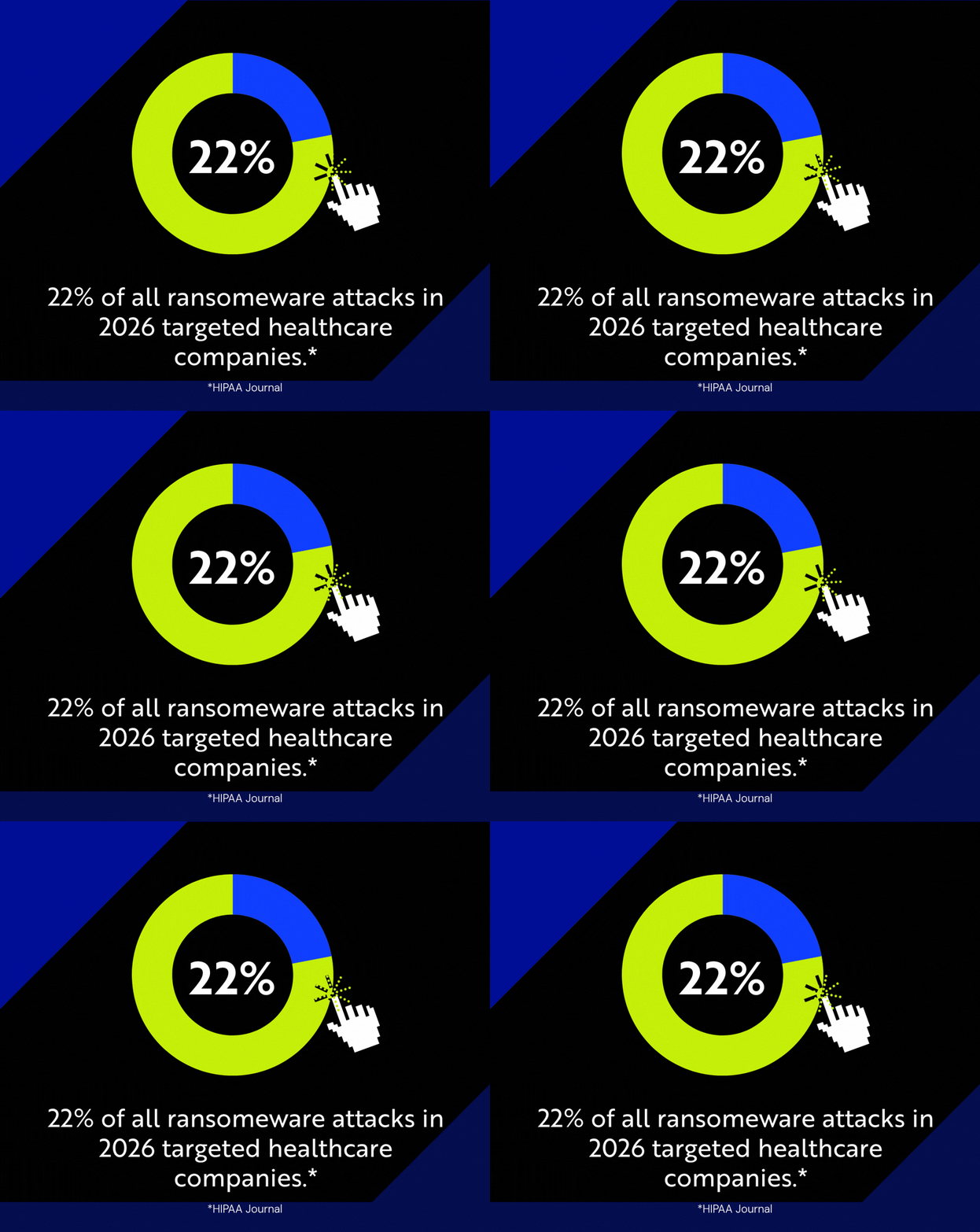
Beyond the record-breaking fines, there is the "Trust Tax." Data from The HIPAA Journal’s 2026 Cybersecurity Analysis indicates that healthcare has officially become the most-targeted industry in the world, accounting for 22% of all global ransomware attacks, more than any other sector.
For a small clinic, the reputational damage is often permanent. Patients in 2026 are tech-savvy; they check the "Wall of Shame" (the OCR breach portal). HITRUST is a marketing tool that builds patient loyalty by demonstrating an elite commitment to privacy.
3. Cyber Insurance Eligibility
The cyber insurance market has hardened. In 2026, insurers are frequently denying coverage or skyrocketing premiums for healthcare entities that cannot demonstrate a formal framework like HITRUST. Achieving certification can lead to significantly lower premiums, often offsetting a portion of the HITRUST Certification cost.
How to Navigate the Three HITRUST Certification Levels
One size does not fit all. HITRUST offers three distinct pathways tailored to your organization's risk profile and size.
HITRUST Certification Tiers: Strategic Comparison
| Certification Level | Strategic Focus | RQMTS | Best For... | Duration |
|---|---|---|---|---|
| e1 (Essentials) | Foundational cybersecurity hygiene and basic threat mitigation. | 44 static controls | Small medical practices or startups that need rapid, entry-level validation. | 1 Year |
| i1 (Implemented) | Industry best practices and "threat-informed" security. | ~219 static controls | Mid-sized clinics/startups handling moderate ePHI volume and seeking moderate assurance. | 1 Year (Rapid recertification available) |
| r2 (Risk-Based) | The "Gold Standard" of comprehensive, risk-based security. | Tailored (Avg. 385-800+ controls) | Large enterprises or startups seeking federal contracts, global scale, or high-risk assurance. | 2 Years (Interim review required at Year 1) |
Let's Break Down the HITRUST Certification Cost
Executives often balk at the price tag, but it must be viewed as an investment in risk mitigation. A HITRUST Certification cost analysis typically involves three buckets:
- HITRUST Fees: These include the "MyCSF" platform subscription (mandatory) and report credits. Expect to spend between $6,000 and $30,000 here, depending on the level (e1 vs. r2).
- External Assessor Fees: You must hire an authorized firm to validate your work. For a small clinic doing an e1, this might range from $25,000 to $50,000. For a startup pursuing r2, these fees can exceed $100,000.
- Internal Effort: This is the "hidden" cost. Your IT Director and staff will spend hundreds of hours gathering evidence. This is where a partner like CompassMSP provides massive ROI by acting as your vCISO and doing the heavy lifting.
- vCISO Strategic Insight: The cost of a breach for a small provider is now averaging over $7 million. The $75,000 investment in HITRUST represents roughly 1% of that risk. In what other part of your business would you decline a 100x risk-mitigation strategy?
Steps to Achieve Efficient HIPAA Compliance for Small Clinics
If you are an IT Director or Executive at a small clinic, the road to HITRUST starts with a Gap Assessment. Do not jump straight into a validated assessment.
- Define Scope: Are you certifying the whole practice or just the EHR environment? Narrowing the scope reduces the HITRUST Certification requirements and the cost.
- Select the Right Level: Start with an e1 or i1. You can always "level up" to an r2 later as your business grows.
- Remediate Gaps: Use the vCISO's roadmap to fix encryption issues, update policies, and implement multi-factor authentication (MFA).
- Evidence Collection: HITRUST requires 90 days of "operational history." You must prove the controls have been working, not just that they exist.
Navigate the Path to HITRUST
Achieving HITRUST certification is a significant milestone, but you don’t have to navigate the complexity alone. At CompassMSP, we believe the best compliance strategies start with a deep understanding of your unique operational goals. Our approach is built on a Discovery and Design model: we start by identifying your specific risk gaps and then engineer a custom roadmap that aligns your security needs with your budget.
Whether you are a startup preparing for your first audit or a growing clinic looking to simplify your compliance overhead, our team of experts provides the hands-on guidance and vCISO leadership needed to turn a daunting requirement into a scalable business advantage.
Build Your Compliance Roadmap with CompassMSP. Learn more about how our specialized healthcare IT teams support your mission through secure, high-performance technology.


Emily Zaczynski
Emily is a vCISO for Compass MSP. She is an experienced compliance professional with 12 years of expertise, including 9 years specializing in insurance compliance. She has a proven track record of ensuring regulatory adherence, mitigating risks, and implementing best practices within dynamic environments.