

Published: Updated: Brian Bennett 13 min read


An alert fires, a device gets isolated, and a suspicious process gets killed. This feels like a win, but then the real questions come. Did the attacker move laterally? Were credentials compromised? And most importantly, who is responsible for figuring that out fast enough to keep the situation from getting worse?
This is where the DFIR gap opens: the delay between threat detection and starting the deeper digital forensics and incident response work needed to understand, contain, and fully remediate the identified threat. Organizations around the world spend millions on advanced security tools and third-party teams, yet major breaches still make headlines.
For IT Directors at small to mid-sized businesses, staying ahead of evolving threats and increasingly complex systems can feel impossible when teams are stuck in daily firefighting mode. The natural response is often to buy another tool or outsource monitoring to a traditional security operations center (SOC), but these solutions only address part of the problem.
What Is the DFIR Gap and Why Does It Cost Millions?
Why The DFIR Gap Is Dangerous for Mid-Market Businesses
How to Close the DFIR Gap with Digital Forensics and Incident Response
Stop Playing Middleman and Outsource Managed Security Services
Ditch the Handoffs and Build Lasting Cyber Resilience
What Is the DFIR Gap and Why Does It Cost Millions?
To understand the DFIR gap in cybersecurity, it helps to look at how traditional security operations work. When an alert appears in an endpoint detection and response (EDR) or security information and event management (SIEM) platform, the initial detection happens.
Something suspicious or harmful has been identified, and that alert usually triggers a response. If the SOC confirms malicious activity, it can isolate the affected machine, contain the endpoint, or kill the malicious process. The immediate threat on that device is stopped.
But what comes next?
When Traditional SOC Models Fail
Once you contain the threat, you must identify the root cause. This requires threat intelligence and deep digital forensics to determine if the threat lurks elsewhere in the network, what an attacker accessed, and most importantly, what they may have left behind that detection logic in the EDR or SIEM does not notice. You also have to uncover the threat vector, how the attacker bypassed defenses, and whether they exfiltrated any data.
The traditional SOC model does not handle this phase. The internal IT team, already drowning in tickets and backlog, lacks specialized forensic skills to investigate. The organization must bring in a separate third-party DFIR team.
This handoff is where the DFIR gap begins. Securing approvals, contacting cyber insurance, onboarding an outside forensics firm, and granting administrative access all take time. In some cases, a full week passes between the initial attack and the start of the forensic response. In cyber warfare, a week is an eternity.
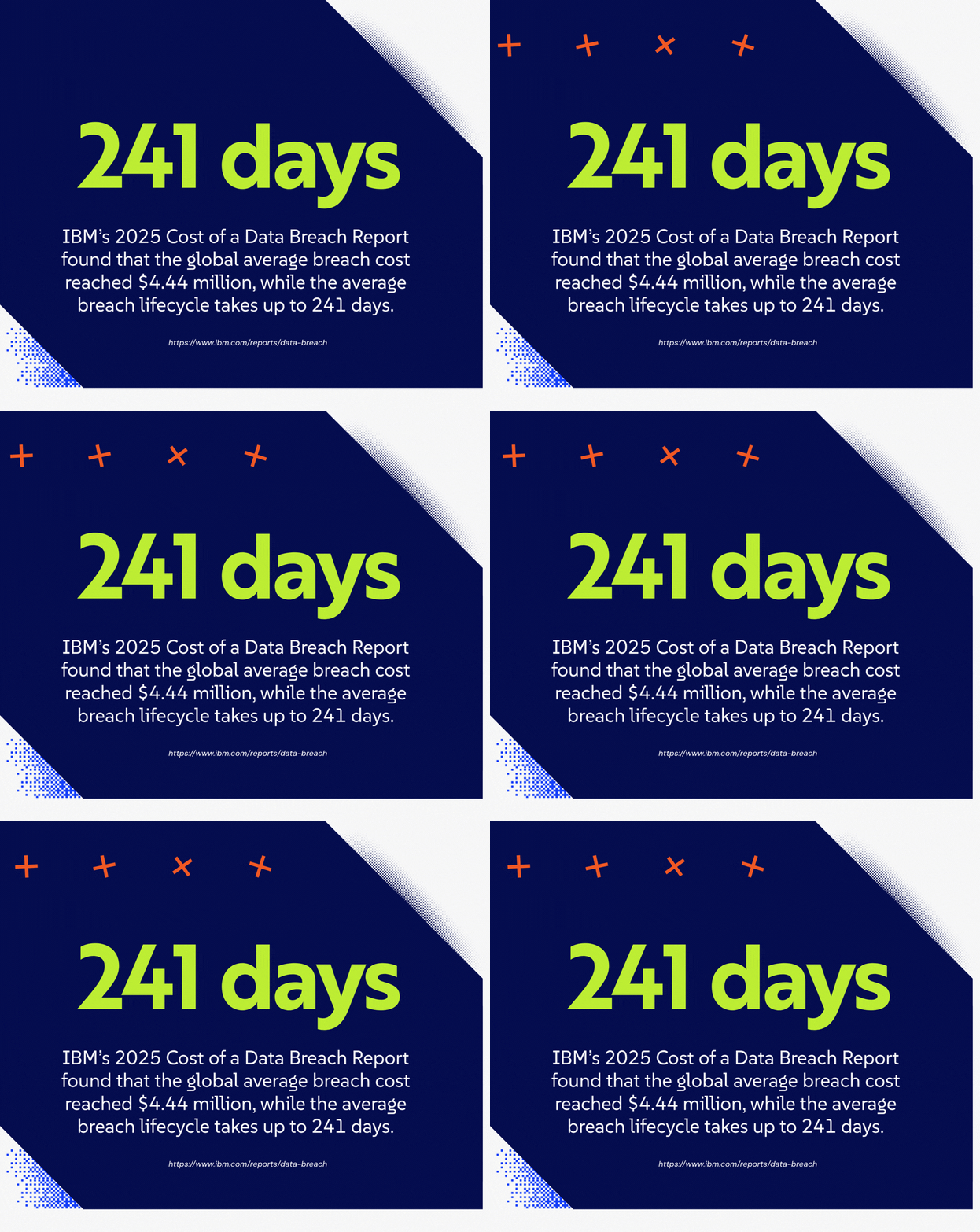
IBM’s 2025 Cost of a Data Breach Report found that the global average breach cost reached $4.44 million, while the average breach lifecycle takes up to 241 days. This is why speed matters.
More Tools Is Not a Cybersecurity Strategy
Tool-first security programs disappoint so many IT leaders. Buying more controls does not automatically create better coordination. In many cases, it creates cybersecurity tool sprawl. IBM reports that organizations manage an average of 83 different security solutions from 29 vendors. When there is a disconnected security stack, the response process usually is too.
The rise of AI only raises the stakes as it expands attack surfaces, yet organizations still lack AI governance policies. In other words, businesses are adding new risk surfaces faster than many operating models can keep up.
Why Alert Fatigue is Really a Remediation Problem
That pressure often pushes companies to add more security tools or outsource Tier 1 SOC monitoring to manage alert volume. Those steps help, but the real key to reducing that volume is full remediation. Without it, the same threats keep resurfacing, creating a costly cycle of repeated alerts, recurring issues, and wasted effort.
The Operational Disconnect: SecOps vs. ITOps
In many environments, security operations (SecOps) and IT operations (ITOps) still exist in separate silos or operate through outsourced vendors. One team sees the threat, another team owns the infrastructure, a third team may own recovery, and a fourth may advise on compliance, legal response, or reporting. That fragmentation creates friction at the exact moment when speed matters most.
Meanwhile, leadership needs answers, users want to know what happened, and the IT Director is stuck in the middle trying to translate across multiple vendors. This is why fragmented response models fail and create a false sense of security. It looks like coverage, but it does not always deliver closure.
Why The DFIR Gap Is Dangerous for Mid-Market Businesses
The DFIR gap is dangerous for businesses because attackers do not stop moving while teams figure out ownership. That DFIR delay creates four serious business problems:
- It creates a bigger opportunity for the attacker.
Dwell time is not just a metric for security reports. IBM’s Cost of a Data Breach Report for 2025 shows that an organization takes an average of 277 days to identify and contain a data breach. During this time, adversaries have more time to expand access, move laterally, and turn one foothold into a broader business event.
- It increases cost.
Every extra day of uncertainty means more labor, more disruption, and more risk to revenue, customer trust, and compliance. The average increase in breach costs is $830,000 for organizations that detect threats late, according to IBM. Delayed incident response gets expensive fast, especially for growing businesses. - It adds pressure to already stretched IT teams.
Forrester found that 77% of technology decision-makers report moderate to extensive technology sprawl, creating more security risk. When a business already juggles too many tools and vendors, incident response is even harder.
The Burnout Cycle for Lean IT Teams Facing Enterprise Threats
Most mid-market IT leaders do not have extra capacity sitting on the bench waiting for a crisis. Small and mid-sized businesses face the same threats as larger enterprises, but with leaner teams and less room for error.
That is why the DFIR gap hits the mid-market so hard. A single serious incident can consume the same people already managing support, infrastructure, cloud, identity, vendors, backups, and projects. Instead of moving the business forward, overworked IT teams get pulled into coordinating the SOC, legal support, forensic specialists, and leadership. That is not resilience. It is burnout disguised as incident response.
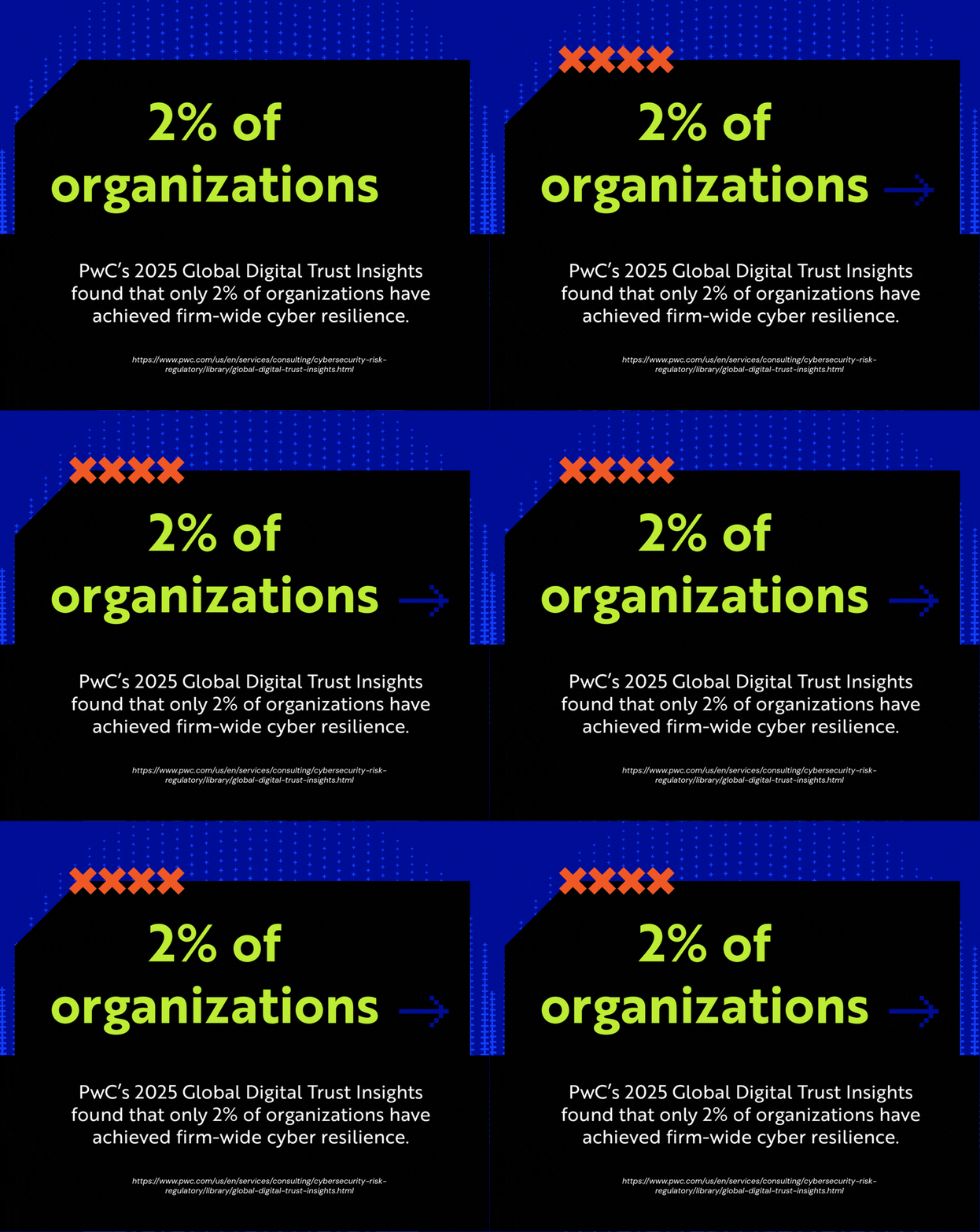
It’s also where cyber resilience starts to break down. PwC’s 2025 Global Digital Trust Insights found that only 2% of organizations have achieved firm-wide cyber resilience. The delay between detection and quick recovery is exactly where mid-sized IT leaders feel the most pressure. They understand the risk, but they lack an operating model that can close the DFIR gap fast enough.
How to Close the DFIR Gap with Digital Forensics and Incident Response
To close the DFIR gap, organizations must stop viewing incident response as a fragmented supply chain. Businesses appear to be catching on, too. IBM says incident response planning is one of the top priorities for security investment.
Here’s how you can embed digital forensics into the daily security continuum:
1. Move forensics closer to detection.
When investigation capabilities sit too far from the first alert, businesses lose valuable time. Teams need immediate access to telemetry, preserved evidence, clear triage workflows, and the ability to move from alert to scoping without a cold handoff.
2. Connect SecOps and ITOps.
Someone still has to clean up systems, rebuild devices, remediate mailboxes, and restore services. A SOC cannot do all of that alone. Closing the gap requires a response model that supports security and IT alignment.
3. Build forensic readiness before an incident.
You cannot investigate what you cannot see. Visibility across endpoints, identities, cloud, and core infrastructure is essential. Logging, access controls, and retention policies need to be in place before an incident happens.
4. Standardize incident response decision-making.
When an incident hits, the business should already know who owns containment, outside notifications, legal escalation, system restoration, user communications, and executive reporting. Speed does not come from improvisation. It comes from governance, defined cybersecurity playbooks, and regular practice.
Benefits of Integrated DFIR Capabilities
When you integrate forensic capabilities directly into the security operations model, the entire paradigm shifts, helping you achieve:
- Immediate Root-Cause Analysis: The moment an EDR tool isolates a threat, the forensic investigation begins automatically. Analysts can quickly trace the threat vector and understand how the attack happened.
- Rapid Containment: Because the investigation happens immediately, teams can define the scope of the breach in hours, not weeks. They can identify which systems are compromised and which are not.
- Actionable Threat Intelligence: Forensics provides the evidence needed to strengthen defenses and reduce the risk of a repeat attack.
As more organizations look to consolidate cybersecurity tools and cut complexity, bringing SOC, DFIR, and IT operations together becomes the best path to build cyber resilience.
Stop Playing Middleman and Outsource Managed Security Services
The internal IT Director is already stretched across multiple fronts: managing cloud migrations, supporting remote workers, maintaining legacy systems, and defending against advanced threats. For many small businesses, there is neither the capacity nor the budget to build a full in-house DFIR function. A traditional MSP or standalone SOC only solves part of the problem.
A managed security services partner helps close the DFIR gap by handling detection, analyst-led investigation, and IT remediation together. That frees the IT Director from acting as the middleman between the SOC, the incident response firm, and internal systems administrators.
Outsourced DFIR support also gives the business access to specialized capabilities, such as malware reverse engineering, digital forensics, and advanced threat hunting, that most mid-sized organizations cannot realistically staff on their own.
vCISO Services That Bring Strategy to Incident Response
Besides extending an internal team’s capabilities, a managed IT partnership brings strategic cybersecurity guidance. If an attack happens, the vCISO sits at the table with the executive team, explaining the operational impact, communicating with cyber insurance providers, and ensuring that regulatory obligations are met.
When a business integrates digital forensics and incident response, the vCISO translates the highly technical data gathered during an event into long-term strategic planning. This lifts a huge burden off the IT Director, allowing them to focus on business initiatives instead of security administration.
Ditch the Handoffs and Build Lasting Cyber Resilience
Addressing the DFIR handoff problem does not require building a giant in-house cyber program. For most small to mid-sized businesses, that is not realistic.
Rather than leaving organizations to stitch together multiple vendors after an alert fires, CompassMSP combines continuous monitoring, incident response, forensic investigation, IT operations support, and advisory vCISO guidance in one model. That integrated approach helps organizations move faster from detection to root-cause analysis, containment, remediation, and resolution.
If you are ready to close the DFIR gap without losing control, reach out to CompassMSP.

Brian Bennett
Brian is a Security Architect at CompassMSP and military combat veteran with 22 years of IT experience spanning the public sector, government contracting, managed services, and executive cybersecurity leadership. He has served as an Information Systems Security Manager for a global aerospace company—where he secured classified and unclassified assets under NISPOM, NIST, and ITAR frameworks and established a classified asset security program from conception through ATO—as well as a vCIO and CISO/vCISO, guiding organizations ranging from 10 to over 1,000 employees through security strategy, framework implementation, audits, and incident response engagements including ransomware events. Brian holds certifications from ISC2, Cisco, Microsoft, VMware, and CompTIA, and draws on his progression from hands-on engineering to the C-suite to drive meaningful security conversations.