

Published: Updated: Paul Breitenbach 13 min read

Business owners face a specific set of anxieties: Will the system hold up during a surge? Is our data safe from the next headline-grabbing ransomware attack? And perhaps most importantly, why does my internal team spend 40 hours a week keeping the lights on instead of focusing on strategic work?
Cloud Computing Benefits for Small Businesses: Less Firefighting, More Growth
1. Predictable IT Spend Without the CapEx Roller Coaster
2. Unmatched Scalability for Growing Organizations
3. Enterprise-Grade Security Without the Enterprise Budget
4. Bulletproof Business Continuity
5. Free Internal IT Team to Focus on Strategic Work
6. Real-Time Teamwork for Top-Tier Talent
7. Reduce IT Overhead with Evergreen Architecture
8. Data Readiness: The Prerequisite for AI and Automation
A Cloud Migration Plan for Busy CEOs
Frequently Asked Questions: Cloud Computing for Small Business Leaders
Cloud Computing Benefits for Small Businesses: Less Firefighting, More Growth
For small to mid-sized businesses, cloud computing is a business continuity tool, a risk reducer, and a force multiplier for lean teams. Cloud adoption also isn’t slowing down either.
Gartner predicts that public cloud spending will exceed $1 trillion by 2027. Budgets follow outcomes. This is where companies are placing long-term bets.
Here are the eight key benefits of cloud computing that CEOs and business owners can use to make smarter decisions for their growing organizations.
1. Predictable IT Spend Without the CapEx Roller Coaster
Traditional IT spending is a cycle of "feast or famine" capital expenditures. You buy a server, it depreciates for five years, and then you face a massive bill to replace it. This model is a nightmare for cash flow management.
Cloud computing shifts the financial burden from capital expenditure (CapEx) to operating expenditure (OpEx).
Cloud vs On-Prem: Stop Paying for Idle Capacity
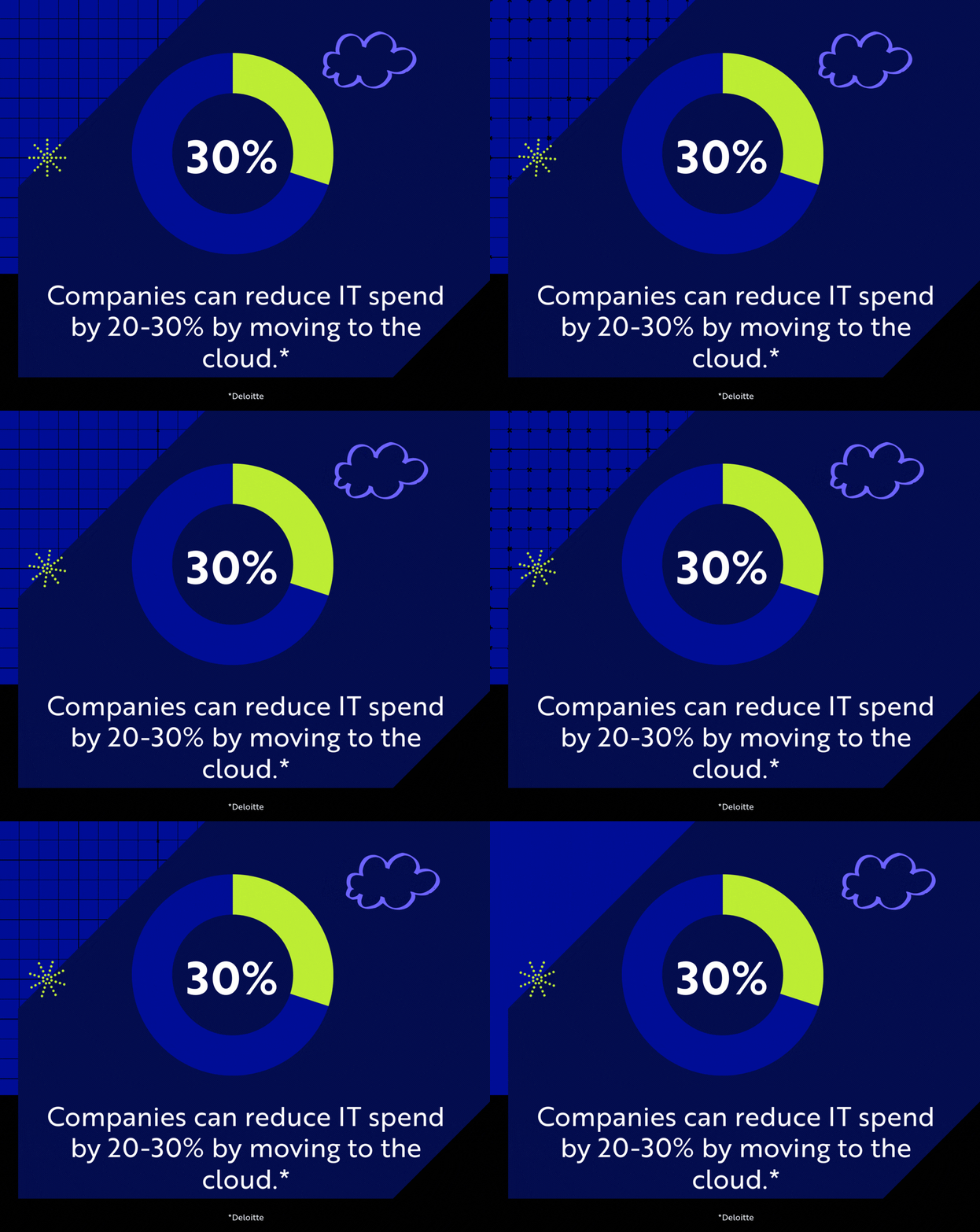
In the cloud, you pay for what you use, when you use it. You no longer over-provision for "just in case" scenarios or pay to power a server room that sits at 20% capacity most of the day. According to Deloitte, companies can reduce IT spend by 20-30% by moving to the cloud, simply by eliminating the need for hardware maintenance, cooling, and physical space.
By moving to a subscription-based model, your monthly IT costs become predictable. This stability allows the finance team to forecast with precision, knowing that a hardware failure in October won't catch the company’s cash flow off guard.
CEO Takeaway: On-prem servers force you to lock up cash in hardware that depreciates every day. The cloud turns technology into a scalable utility, freeing you up to reinvest where it actually generates revenue: your products, your people, and your customers.
2. Unmatched Scalability for Growing Organizations
One of the biggest hurdles for small businesses is hitting the growth ceiling. In an on-prem world, scaling is a slow, physical process. If you land a new contract that requires doubling your team or opening a new branch, you must buy more hardware, wait for shipping, and spend weeks on installation. In the time it takes you to prepare for growth, the market has already moved on.
Cloud Scalability: Break Through the Growth Ceiling
Need to add 50 users tomorrow? It takes a few clicks. Launching a new application to serve a client in another region? You can deploy it across global data centers in minutes. Scaling back after a seasonal peak to protect your margins? You can do that, too. This explains why Gartner predicts that by 2027, more than 70% of organizations will use cloud platforms to accelerate their business initiatives.
By removing the hardware lag, you ensure that your technology never becomes a bottleneck for your sales and operations teams.
Bridging the Gap Between Small Business and Enterprise
The cloud gives a 20-person firm the ability to handle enterprise-level workloads without needing an enterprise-level data center. This allows you to take on larger projects and bigger clients with the confidence that your systems won’t buckle under pressure.
CEO Takeaway: The cloud is a liquid asset that expands and contracts with your revenue. Cloud scalability ensures that when opportunity knocks, you have the immediate capacity to answer it.
3. Enterprise-Grade Security Without the Enterprise Budget
Small businesses are easy targets for cybercriminals. Attackers know that while a Fortune 500 company has a $100M security budget, a small business often relies on an overworked IT manager and a basic firewall. So, when an attacker strikes, the impact of a cyber breach can be costly.
However, when you move to the cloud, the playing field is instantly leveled. You stop trying to build your own defense and instead inherit a fortress.
Inherit a Billion-Dollar Defense
Cloud giants like Microsoft and Amazon spend billions of dollars annually on security in the cloud. When you host your data in an optimized cloud environment, you gain access to controls like encryption, multi-factor authentication (MFA), and advanced threat detection that would be cost-prohibitive to build in-house.
CEO Takeaway: The cloud allows you to lease the most advanced defense system for a predictable monthly fee. It moves your data out of a vulnerable office closet and into a global vault, drastically reducing your personal and professional liability.
4. Bulletproof Business Continuity
Whether there is a power outage, a burst pipe in the server room, or a hardware failure, the downtime can cost you thousands in lost revenue and reputational damage.
Cloud computing breaks that physical dependency, ensuring your operations keep running, regardless of what happens on the ground.
Cloud Disaster Recovery: Built-In Redundancy
Traditional disaster recovery often involves praying the backups work and waiting days for new hardware to arrive. Cloud computing, on the other hand, is built on redundancy. Your data is replicated across multiple, geographically dispersed data centers. If one facility experiences an issue, another takes over instantly.
In fact, research shows that cloud-enabled companies recover from outages four times faster than on-prem companies. The cloud helps you reduce downtime, no matter what happens on the ground.
CEO Takeaway: Your business shouldn't have a single point of failure. On-premise servers make your entire company's productivity hostage to a single building's power supply. The cloud decentralizes your risk, giving you the peace of mind that your revenue stream is protected 24/7.
5. Free Internal IT Team to Focus on Strategic Work
In most small businesses, talented tech people spend their days patching servers, swapping out old hard drives, and troubleshooting local network issues. This is a massive waste of human capital.
Managed Cloud: Stop Wasting Resources on Maintenance
Cloud computing offloads the heavy lifting of infrastructure management to the provider or a strategic partner. This means you are no longer responsible for the physical security, cooling, power, or hardware maintenance of your stack.
This allows your internal team to focus on high-value projects like data analytics, customer experience improvements, and AI integration.
CEO Takeaway: Your internal team’s time is a finite, high-value resource. Every hour they spend maintaining a physical server is an hour they aren't spending on your strategic goals.
6. Real-Time Teamwork for Top-Tier Talent
The work-from-anywhere era is here to stay. Employees expect to access their files and collaborate in real-time from a coffee shop, a home office, or a client site. For a CEO, For a CEO, the challenge is enabling teams in different locations to collaborate smoothly without friction or workarounds.
Remote Work Cloud Solutions
Cloud collaboration tools for businesses like Microsoft 365 and Google Workspace make work portable. They also simplify access management, reduce reliance on VPN spaghetti, and improve continuity when a laptop dies or a device gets replaced.
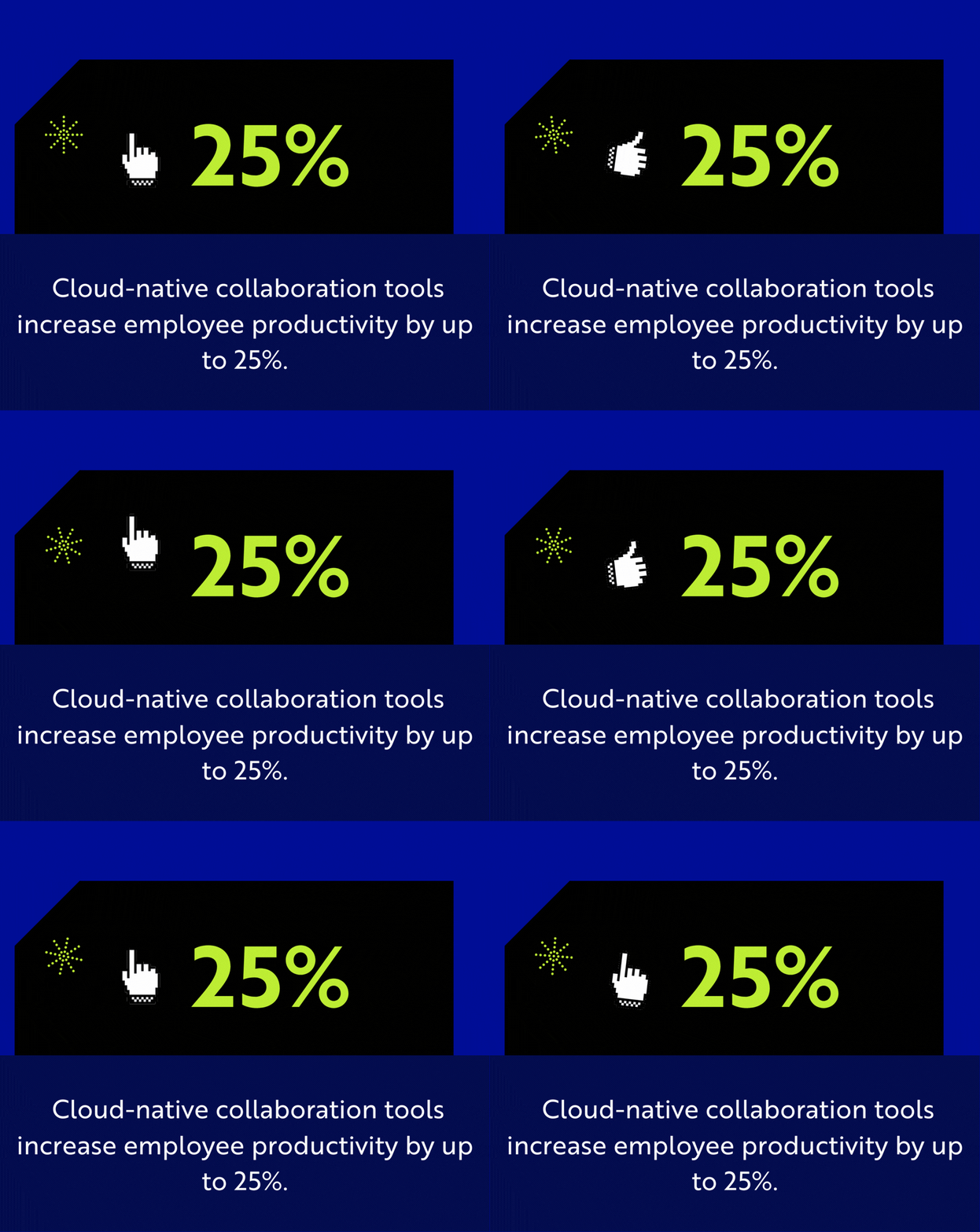
Forrester found that cloud-native collaboration tools increase employee productivity by up to 25%, as teams spend less time searching for information and more time executing on it.
The Cost of Clunky Systems
In a tight labor market, your technology stack is part of your culture. Top-tier talent expects modern tools that help them be more productive.
If a new hire has to wrestle with a decade-old on-premises system, they will likely look for work at a company that offers a smoother, more modern tech experience. And whether you mean it or not, outdated tools can signal that the business is behind the times.
CEO Takeaway: Cloud collaboration eliminates the version-control chaos that kills momentum and ensures your best people spend their time solving business problems. If you want to attract and keep high performers, you must provide a platform that moves as fast as they do.
7. Reduce IT Overhead with Evergreen Architecture
In the traditional IT model, the day you install a piece of hardware or software is the most modern it will ever be. From that point on, it becomes technical debt, preventing you from investing in anything new. Cloud computing replaces this cycle of decay with an evergreen architecture.
Technical Debt: The Silent Growth Killer
In an optimized cloud environment, software updates happen automatically in the background. You always have the latest, most secure, and most efficient version of your tools.
This is where the cloud really earns its keep. It helps prevent technical debt from piling up. McKinsey & Company points out that companies spent 40% of their IT budgets in 2025 on maintaining legacy systems. They end up trapped in a tech-debt cycle, spending to maintain instead of to innovate.
CEO Takeaway: An evergreen environment means your team no longer has to wait for the next upgrade to fix a workflow bottleneck or close a security gap. It also means your business stays efficient without a single dollar of additional capital expenditure.
8. Data Readiness: The Prerequisite for AI and Automation
Many business leaders are eager to implement AI, but they overlook a critical reality: AI and automation don't work on messy foundations. If your data is trapped in disconnected servers, it is essentially invisible to the tools that could change your business.
The Cloud to AI Pipeline
Cloud computing makes it possible to centralize your data, improve governance, and make information usable across the entire business. When you combine this with consistent identity controls and standardized systems, you create a runway that allows AI initiatives to actually take off.
The performance gap between those who have modernized and those who haven't is widening rapidly. According to PwC, there is a major divide between leaders and laggards: 72% of top performers report "all-in cloud adoption" for modernizing their data, compared to only 33% of other companies.
CEO Takeaway: The cloud is the prerequisite for AI value, not the finish line. You cannot build a high-performance AI strategy on top of legacy architecture.
A Cloud Migration Plan for Busy CEOs
The benefits of the cloud are clear, but the migration process can be daunting for a busy CEO. Cloud migrations are tricky because you can’t afford downtime, missteps, or security gaps.
A strategic partner helps you translate cloud goals into a practical roadmap, from what to move first, how to govern data, how to standardize identity and access, and how to keep security and costs under control as you scale.
CompassMSP helps growing businesses migrate to the cloud with a practical plan, bringing the right mix of cloud expertise, security oversight, and ongoing optimization to keep performance high and risk low after the move.
Connect with our team to learn how we can help you build a cloud strategy that aligns with your business goals and budget.

Paul Breitenbach
With nearly 20 years of experience designing enterprise-grade IT solutions, Paul specializes in supporting organizations that cannot afford downtime. Before becoming our CIO, he served as CIO of WorldwideIT, a Compass company, where he led large-scale infrastructure, cloud, and security initiatives for highly regulated industries.