

Published: Updated: Paul Breitenbach 11 min read

CFOs and COOs feel pressure from every direction, especially in small to mid-sized businesses, where every dollar and decision carries more weight. Tariffs disrupt supply chains, inflation squeezes margins, and the directive from the board is clear: do more with less.
In this economic climate, technology is seen as a runaway train of expenses. Software subscriptions multiply, hardware fails at the worst possible moment, and security threats loom as a constant risk. Without a roadmap, IT spending becomes reactive, erratic, and inherently wasteful.
However, IT doesn't have to be a financial "black box." An annual technology plan can turn IT from a chaotic cost center into a predictable, optimized asset. In this article, we break down how to align your technology spend with business goals, gain clear visibility into where your money is going, understand what’s driving costs, and uncover opportunities to eliminate waste.
Plan It or Pay for It: Why Every Growing Business Needs an Annual Technology Plan
The Invisible IT Spend That Costs You the Most
From Surprise Bills to Predictable IT Costs
ROI Through Vendor Consolidation: Why One Bill Beats Ten
Security Strategy That Protects Your Business and Your Budget
The IT Financial Planning Checklist Every CFO and COO Needs
Managed Services vs. In-House IT Costs: A Better Financial Model
Ask a CIO: IT Cost Optimization for Small Businesses
Plan It or Pay for It: Why Every Growing Business Needs an Annual Technology Plan
An annual technology plan is a yearly roadmap that aligns every dollar of IT spend with specific business outcomes. For small and growing businesses, where budgets are tighter and every investment matters, that connection is especially critical.
Many leaders mistake "budgeting" for "planning." If the IT strategy consists of looking at last year’s spend and adding five percent for inflation, that isn't a plan; it is a guess. An annual technology plan moves away from ad-hoc spending and "break-fix" mentalities. It focuses on predictability, alignment, and total visibility into performance.
The stakes of failing to plan are high. According to Gartner, organizations that lack a disciplined approach to IT financial management see their budgets bloated by as much as 20% due to unplanned upgrades and emergency support costs. True planning replaces those x"fire drills" with forecasting and prioritization.
The Invisible IT Spend That Costs You the Most
When a business operates without an annual technology plan, money leaks out of the organization in ways that don't always show up as a single line item. These "hidden costs" are the primary drivers of budget overruns.
Redundant Tools and License Sprawl
In the rush to support remote work or new projects, many companies have accumulated "SaaS sprawl." This happens when different departments buy overlapping tools.
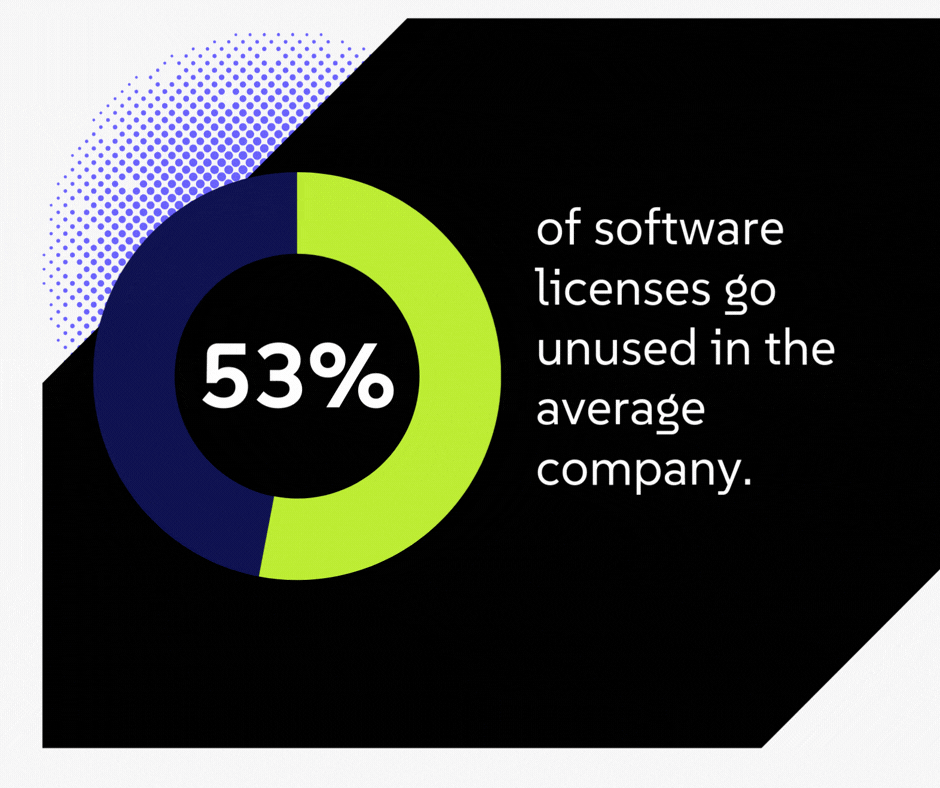
You might pay for three different video conferencing platforms or two different cloud storage providers. You’re not alone either. Research shows that the average organization only utilizes 47% of its licenses, leaving the remaining 53% unused.
The Reactive Support Trap
Reactive support is the most expensive way to manage IT. When you wait for something to break before fixing it, you aren't just paying for the repair; you are paying for the emergency labor rates and the catastrophic cost of downtime. Planned maintenance is a fraction of the cost of an emergency "after-hours" fix.
When systems fail, emergency fixes and after-hours work are expensive. Not to mention, the cost of downtime can be catastrophic. For example, research shows that unplanned downtime costs industrial manufacturers an estimated $50 billion annually.
Vendor Sprawl and Administrative Drag
Every vendor in the IT stack represents an invoice to process, a contract to manage, and a relationship to maintain. If a company has ten different vendors for IT, security, and telecom, the administrative overhead is massive. Deloitte notes that vendor complexity is a leading cause of operational inefficiency, which leads to billing errors and "zombie" subscriptions that continue long after they are needed.
The High Price of Non-Compliance
For a COO, compliance isn't just a legal box to check; it’s a financial risk. Non-compliance with HIPAA, CMMC, or SOC 2 can lead to fines that cost millions. An annual plan ensures that compliance is baked into the infrastructure rather than treated as an expensive, last-minute add-on during audit season.
From Surprise Bills to Predictable IT Costs
For a CFO, the greatest value of an annual technology plan is certainty. It moves the conversation from "How much will IT cost this month?" to "How much will we invest this year?"
IT Budget Forecasting vs. Unexpected Costs
A roadmap allows you to forecast capital expenditures (CapEx) and operating expenses (OpEx) with precision. Instead of a $50,000 server failure in October catching the finance team off guard, the plan identifies that the server is reaching end-of-life and schedules its replacement, or migration to the cloud, well in advance.
Centralized Vendor Strategy
An annual plan makes vendor management intentional. You line up renewals, review contracts together, and negotiate with leverage instead of scrambling at the last minute.
That structure reduces volatility. According to Forrester, nearly half of organizations overshoot or undershoot their tech budgets by 10% or more, often because spending happens reactively. A planned approach reduces that variance and gives leadership more confidence in the numbers.
Tech Stack Rationalization
An annual plan also creates space for tech stack rationalization. Over time, most organizations accumulate overlapping tools, duplicate licenses, and “nice-to-have” software that quietly inflates costs without delivering real value. By regularly reviewing what stays, what goes, and what can be consolidated, you simplify the environment and ensure every platform earns its place.
ROI Through Vendor Consolidation: Why One Bill Beats Ten
One of the most immediate ways to optimize IT costs is through vendor consolidation. In a fragmented model, a business pays retail prices for a dozen different disconnected services. By bringing cybersecurity, IT management, and telecom under one roof, the financial math changes in the business's favor.
How to Make IT Costs Predictable
Consolidating services with a single managed services provider (MSP) allows a business to leverage enterprise-grade tooling without the enterprise-grade overhead. Bundled deals lower the unit cost of licenses and security agents. Furthermore, it slashes administrative labor. Processing one invoice instead of ten reduces the burden on the accounting team and eliminates the finger-pointing that happens when multiple vendors are involved in an outage.
Complexity Kills Momentum
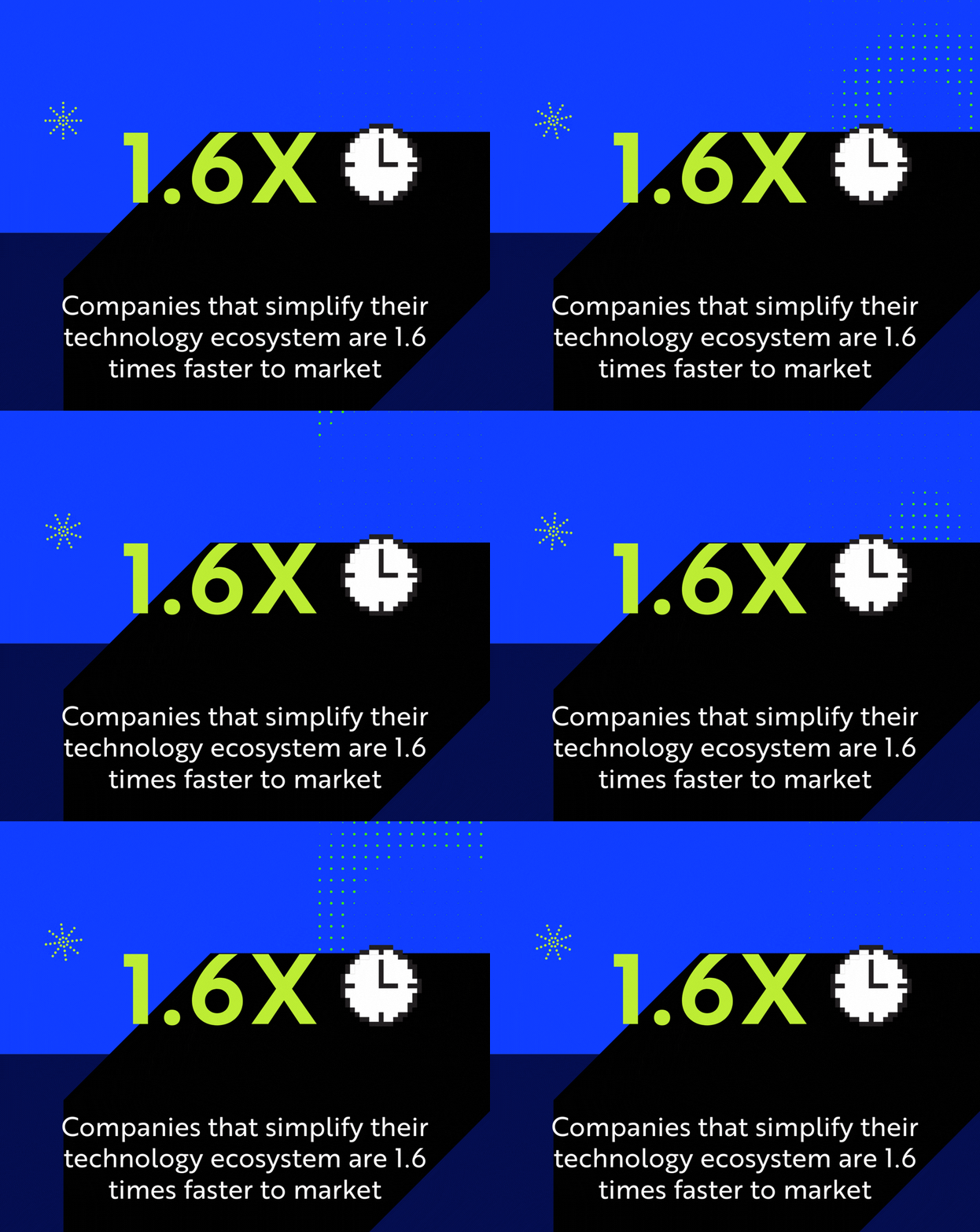
When one partner owns the strategy for IT, security, and telecom, there is a single point of accountability. This leads to faster resolutions and higher uptime. According to PwC, companies that simplify their technology ecosystem through consolidation are 1.6 times faster to market and significantly more innovative, as their leadership teams are no longer bogged down by managing a web of vendors.
Security Strategy That Protects Your Business and Your Budget
For many small to mid-sized businesses, security spend feels like an insurance premium that never stops going up. An annual technology plan reframes security as a strategic risk management tool.
Instead of buying a new "tool of the month" to combat the latest headline-grabbing threat, a plan builds a layered defense. This approach ensures that you aren't over-investing in one area while leaving a massive gap in another.
How to Reduce Cybersecurity Costs with Proactive Planning
Proactive security planning is a massive cost-saver. IBM’s Cost of a Data Breach Report consistently shows that businesses with continuous monitoring and a tested incident response plan reduce the financial impact of a breach by millions of dollars.
By planning for security, you essentially buy down your future risk. You also stay "audit-ready," which reduces the labor costs associated with meeting regulatory requirements or renewing cyber insurance policies.
The IT Financial Planning Checklist Every CFO and COO Needs
A good technology plan should be actionable, not academic. For a CFO or COO, the plan should provide a clear executive summary of the following:
- IT Asset Map: A full inventory of what you own, what you rent, and when it needs to be replaced.
- Security Posture Evaluation: A gap analysis of your current risks vs. industry standards.
- Technology Stack Rationalization: A "keep/cut" list of software subscriptions to eliminate redundancy.
- Telecom Spend Review: An audit of phone systems and data lines to ensure you aren't paying for "ghost" seats.
- License Utilization Assessment: Proof that you only pay for the Microsoft or cloud seats you actually use.
- CapEx vs OpEx Planning: A 12-month calendar of forecasted spend.
- KPI Targets: Measurable goals for system uptime, ticket resolution speed, and compliance readiness.
Managed Services vs. In-House IT Costs: A Better Financial Model
Developing this level of technical and financial detail is difficult to do in-house without a dedicated executive-level IT team. This is where a managed services provider (MSP) acting as a vCIO (Virtual Chief Information Officer) becomes an invaluable partner.
An MSP brings the data, the enterprise-grade tools, and the industry benchmarks that small to mid-sized businesses typically lack. They provide the "Power of One”: one partner, one strategy, and one invoice. This model allows a growing company to access top-tier technical expertise and 24/7 security monitoring without the massive headcount costs.
Make IT Make Financial Sense
Cost optimization gets a lot easier when everything isn’t scattered across five vendors, ten contracts, and a stack of overlapping tools. The real savings happen when your technology and security are streamlined, centralized, and managed as one connected strategy.
That’s where CompassMSP makes a difference. We bring your IT, cybersecurity, cloud, and communications under one roof, so you’re not dealing with a patchwork of IT solutions. By unifying enterprise-grade tools, discounted bulk licensing, and proactive cybersecurity under the guidance of a dedicated vCIO, we help organizations reduce vendor sprawl, strengthen protection, and turn unpredictable IT costs into a steady, predictable investment.
If your goal is to make IT simpler, more efficient, and easier to budget, reach out to our team and we can help you get there.

Paul Breitenbach
With nearly 20 years of experience designing enterprise-grade IT solutions, Paul specializes in supporting organizations that cannot afford downtime. Before becoming our CIO, he served as CIO of WorldwideIT, a Compass company, where he led large-scale infrastructure, cloud, and security initiatives for highly regulated industries.