

Published: Updated: Paul Breitenbach 7 min read


There is a pervasive myth in business management that network performance is a commodity: that if you pay for a 1Gbps fiber circuit, you are guaranteed a "fast" experience.
This is false. Buying more bandwidth to fix a lagging network is like adding lanes to a highway that has a pileup at the off-ramp. It doesn’t matter how wide the road is if the traffic isn't moving.
For the modern small and mid-sized business, the frustration isn't usually a lack of raw speed coming into the building; it is a lack of traffic management inside the building. When your VoIP calls drop or your cloud ERP stutters, the culprit is rarely your ISP. It is often a silent conflict between your firewall, your switches, and unmanaged data streams fighting for priority.
The Cost of Latency: Why Network Hygiene is a C-Level Concern
Diagnosing the Root Causes of Network Degradation
Strategic Remediation: The CompassMSP Framework
Implement Quality of Service (QoS) and Traffic Shaping
The Cost of Latency: Why Network Hygiene is a C-Level Concern
The Unified Advantage: Why One Partner is Better Than Two
Performance is a Competitive Advantage
Frequently Asked Questions About Network Performance & Telecom
The Cost of Latency: Why Network Hygiene is a C-Level Concern
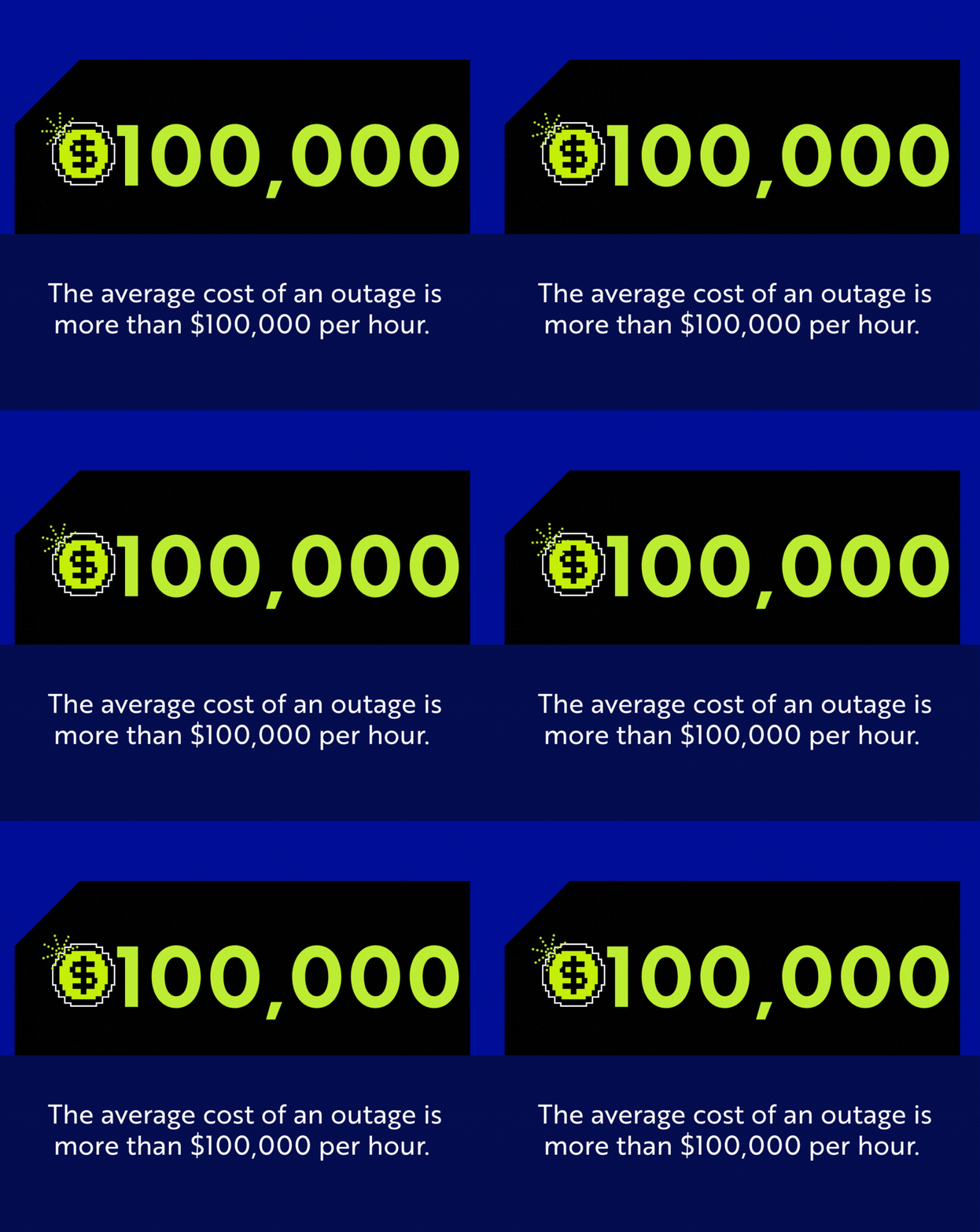
The distinction between "IT issues" and "business issues" has evaporated. According to ITIC’s 2024 Hourly Cost of Downtime Survey, over 90% of organizations report that a single hour of downtime costs more than $300,000. Even for small and mid-sized businesses, the cost of an outage frequently exceeds $100,000 per hour in lost revenue and productivity.
While slow performance isn't a total outage, the "micro-downtime" of waiting for file uploads or reconnecting dropped calls accumulates into significant financial debt.
-
Real-Time Communication: VoIP and Unified Communications (UCaaS) require low latency and low jitter.
-
Cloud Dependency: SaaS platforms (Microsoft 365, Salesforce, QuickBooks Online) treat the internet connection as a system bus.
-
Customer Experience: Your ability to respond to client queries instantly relies on network uptime.
If your network infrastructure was built five years ago, it was likely designed for on-premise servers, not today’s heavy cloud ingress/egress patterns.
Diagnosing the Root Causes of Network Degradation
Before applying fixes, we must distinguish between three distinct performance killers: Bandwidth (capacity), Latency (delay), and Jitter (inconsistency). Most SMBs face issues caused by the latter two, yet they waste budget trying to fix the first.
1. The "Traffic Jam" Effect (Unmanaged Bandwidth)
High bandwidth does not guarantee high performance if the traffic is unmanaged. In a standard SMB network, a guest downloading a 4GB video file competes directly with the CEO’s Zoom call.
-
The Technical Reality: Without Quality of Service (QoS) protocols, your router treats all data packets as equal.
-
The Consequence: Critical business data gets stuck behind bulk, non-urgent traffic, causing "choppy" voice and video.
2. Hardware Bottlenecks at the Edge
A 1GB fiber connection is useless if your firewall or router creates a chokepoint. Many SMBs utilize "Prosumer" (Professional Consumer) grade equipment or legacy firewalls that cannot process encrypted traffic at wire speed.
-
The Technical Reality: Modern web traffic is encrypted (HTTPS). Inspecting this traffic for threats requires significant processing power. Old hardware maxes out its CPU trying to decrypt/encrypt, slowing throughput to a crawl regardless of your ISP speed.
3. Security-Induced Latency
Cyber threats are not just about data theft; they are performance parasites.
-
Botnets and Malware: Infected devices on your network may be silently participating in a DDoS attack or mining cryptocurrency, consuming massive amounts of upstream bandwidth.
-
Inefficient Filtering: Poorly configured security services can add excessive "hops" to your connection, increasing latency.
Strategic Remediation: The CompassMSP Framework
Fixing network performance requires a shift from reactive troubleshooting to proactive architecture.
Implement Quality of Service (QoS) and Traffic Shaping
You do not always need a bigger pipe; you need a smarter traffic cop.
-
Prioritize Real-Time Data: We configure network policies to tag VoIP and Video packets as "High Priority," ensuring they exit the network first.
-
Throttling: We can limit bandwidth for non-essential subnets (e.g., Guest Wi-Fi) to ensure they never consume more than 10-15% of total capacity.
Modernize the Edge Stack
Upgrading to enterprise-grade firewalls and switches is an investment in throughput. CompassMSP recommends Next-Generation Firewalls (NGFW) that utilize ASIC chips dedicated to processing network flows. This ensures that security scanning—Intrusion Prevention Systems (IPS) and Deep Packet Inspection (DPI)—happens at millisecond speeds.
The Unified Advantage: Why One Partner is Better Than Two
Historically, businesses have had to juggle a Managed Service Provider (MSP) for their computers and a separate telecom vendor for their phones and internet circuits. This fragmentation creates a dangerous "accountability gap" where neither vendor has full visibility into the root cause of performance issues.
Consolidating IT and telecom services under CompassMSP removes vendor friction and secures two critical operational advantages.
1. Precision Configuration (Prevention) Network issues are rarely caused by "bad luck"; they are usually caused by misconfiguration. When the same team manages both your business VoIP and your local network, we ensure the environment is architected correctly from day one. We configure your firewalls, switches, and bandwidth management tools to prioritize voice traffic (Quality of Service) specifically for the telecom solutions we deploy. We don't just plug it in; we optimize the business network to support it, preventing latency and jitter before they ever occur.
2. End-to-End Troubleshooting (Resolution) When an outage happens in a split-vendor environment, the "blame game" begins: the ISP blames the firewall, and the IT team blames the carrier. This extends downtime. With CompassMSP, there is no finger-pointing. Because we possess end-to-end visibility—managing the endpoint (laptop), the local network (switch), and the carrier circuit (ISP)—we can isolate and resolve issues instantly. We are uniquely positioned to prevent network downtime because we control every variable in the equation.
The Role of Observability: Proactive Monitoring vs. Reactive Panic
You cannot optimize what you do not measure. A "slow network" is subjective; packet loss percentages are objective.
CompassMSP deploys advanced Remote Monitoring and Management (RMM) tools that visualize network health 24/7.
-
Threshold Alerting: We know if bandwidth utilization spikes above 90% before you feel the slowdown.
-
Jitter Tracking: We monitor the specific metrics that kill VoIP call quality, allowing us to reroute traffic before a call drops.
Performance is a Competitive Advantage
In a digital-first economy, your network speed determines your business speed. You should not have to choose between security and performance, nor should you have to mediate disputes between your IT and Phone providers.
With CompassMSP, you gain a partner who understands the full stack, from the fiber entering your building to the cloud application on your screen.
Is your network ready to support your growth? CompassMSP offers comprehensive Network & Telecom Assessments to identify hidden bottlenecks. Contact us today to schedule a consultation with a Solutions Architect.

Paul Breitenbach
With nearly 20 years of experience designing enterprise-grade IT solutions, Paul specializes in supporting organizations that cannot afford downtime. Before becoming our CIO, he served as CIO of WorldwideIT, a Compass company, where he led large-scale infrastructure, cloud, and security initiatives for highly regulated industries.