

Published: Updated: Brian Bennet 19 min read


Cybercriminals are always doing the most, which makes managing security at a small to mid-sized business a tough gig. You don't have the budget of a Fortune 500 company, but you handle the same threats.
Security leadership recognizes the relentless pressure on IT Directors as new threats pop up daily. Cybersecurity strategies that succeeded in 2024 won’t cut it in 2026. The threat actors have become more sophisticated and well-funded than before.
Staying on top of emerging trends is key to anticipating and preparing for cyber attacks that come your way. Because it’s not a matter of if, it’s a matter of when you will experience one.
This article outlines cybersecurity trends that every CISO has on their radar in 2026. We also share immediate actions technical leaders must take to ensure these issues don’t become security blind spots that impact your job.
Threat 1: AI Is Reshaping Both Cybercrime and Cyber Defense
Threat 2: Endless Connections 🤝 Zero Trust Architecture
Threat 3: The $5.74M Talent Gap: Empty Seats Mean Expensive Breaches
Threat 4: Supply Chain Risk: Is Your Vendor Your Weakest Link?
Threat 5: Platform Consolidation: Less is More
Preparation Is the Name of the Game, Not Paranoia
1. AI Is Reshaping Both Cybercrime and Cyber Defense
We have talked about artificial intelligence (AI) for years, but 2026 is the year the gloves come off. AI is no longer just a buzzword in a deck; it is a weapon that both sides are using.
The Bad News: Cybercriminals Are Doing More with Less Effort
Cybercriminals are adopting AI faster than you are. They use generative AI to write flawless phishing emails with no typos. They closely mimic organizational communication, sounding exactly like your CEO or your vendor.
Bad actors also use AI to code malware that adapts to avoid detection. They even use AI-generated deepfakes to bypass biometric security or trick finance teams into wiring money.
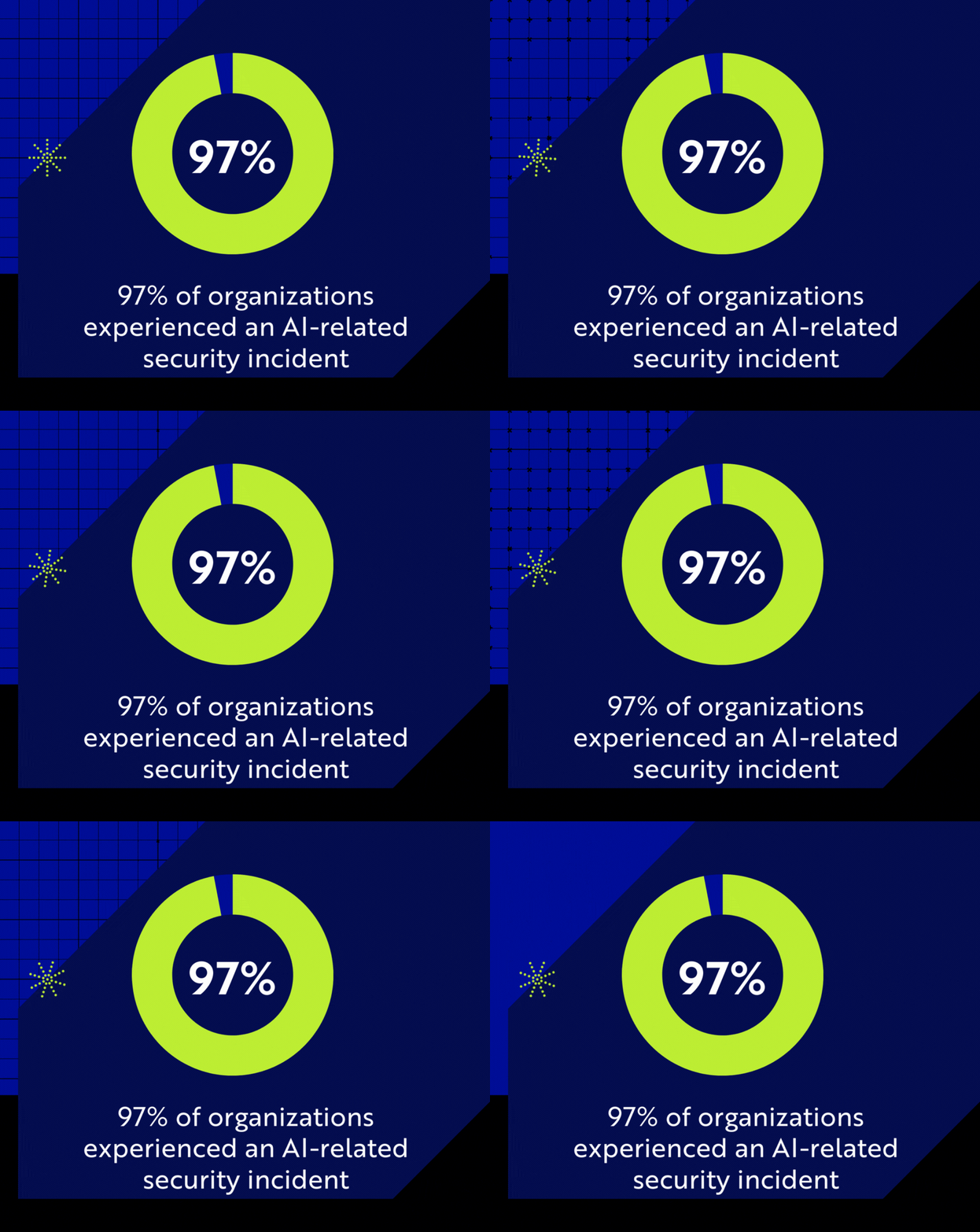
According to IBM’s Cost of a Data Breach Report, 97% of organizations experienced an AI-related security incident. On top of this, the attack lifecycle is accelerating, moving from weeks to days or hours.
The Good News: Use AI as Your Countermove
You have AI, too, and you need to lean into it heavily. Small businesses cannot afford to have human analysts staring at logs all day. There is too much data. Instead, they need AI-driven security operations centers (SOCs). These systems spot anomalies and detect attack patterns faster than any human ever could.
Data confirms this defensive push is smart. IBM’s same Cost of a Data Breach Report found that organizations that extensively used AI and automation reduced breach costs by an average of $2.2 million compared to those that didn’t. They also detected and contained attacks nearly 100 days faster.
This efficiency is vital for a small business’s bottom line, especially when you consider the average cost of a breach for small businesses is often in the millions of dollars.
An IT Director’s Next Move:
- Prioritize security solutions that feature AI and machine learning (ML) components for threat detection and response.
- Assess model vulnerabilities and adversarial AI threats.
- Ensure vendor tools use AI responsibly
- Implement AI tools in your XDR (extended detection and response) and SOAR (security orchestration, automation, and response) platforms.
RELATED RESOURCE
Ready to learn how to embrace AI and keep your organization safe?
2. Endless Connections 🤝 Zero Trust Architecture
Remember when you just had to secure laptops and servers? Those days are long gone. Now, everything and everyone is connected. Whether it’s the breakroom fridge or the company device an employee uses to work from home, every connection is a potential vulnerability.
Internet of Things (IoT): The Attack Surface That Never Stops Growing
By 2030, nearly 40 billion IoT devices will join the internet. In 2026, we are already feeling the weight of this. Every single one of those devices is a potential backdoor. Most of them have terrible default security. They are lightweight, unpatched, and usually ignored..
Hackers love this. They don't need to crack our main firewall. They just need to compromise a smart lightbulb, move laterally to the Wi-Fi, and then jump to the server.
Every Home Office Is a New Front Door for Hackers
Remote work has opened the door to flexibility and growth for small businesses, but it has also widened the attack surface in a big way. When your team works from home, a coffee shop, or anywhere with Wi-Fi, every laptop becomes a new front door to your company’s network.
Home routers, personal devices, and public hotspots just don’t offer the same protection as the office. Add in unauthorized AI tools, outdated VPNs, and aging hardware, and your exposure grows even faster.
Zero Trust Architecture Has Entered the Chat
The old "castle and moat" model is dead. The traditional network boundary is gone, replaced by cloud apps, remote workers, and connected devices.
Zero trust is now your operational baseline. The idea with zero trust architecture (ZTA) is simple: Trust no one, verify everything. Every user and every device, regardless of location, must prove their identity for every resource access attempt. This is the only way to manage risk when your environment stretches from your office server room to your employee’s kitchen table.
Gartner predicts that by 2026, 10% of companies will have a comprehensive, mature, and measurable zero-trust program in place. You need to be in that 10%.
An IT Director’s Next Move:
- Aggressively enforce multi-factor authentication (MFA) across all applications, cloud, RDP, and VPN environments. Every user and device must be authenticated, authorized, and continuously validated.
- Segment the network to contain breaches by isolating networks and workloads. This ensures a compromised endpoint cannot move laterally to critical data servers.
- Implement least-privilege access. No user should have access to more than they need.
- Work with your network architects to cut off internet connection for devices that don’t need it.
3. The $5.74M Talent Gap: Empty Seats Mean Expensive Breaches
You know how hard it is to hire a good Level 3 analyst. It takes months, and they cost a fortune. There is a massive shortage of skilled cybersecurity professionals.
The World Economic Forum predicts a global shortage of 85 million tech workers by 2030, and cybersecurity is a huge chunk of that.
This shortage also has a hefty price tag. The 2024 Cost of a Data Breach Report showed that companies with a severe shortage of security talent paid an average of $5.74 million after a breach. Those with strong teams paid $3.98 million. That is a nearly $2 million difference just based on empty seats.

Outsource the Grind to MSSPs
Since you can't win the bidding war for talent, you must delegate strategically and lean heavily on managed security service providers (MSSPs). Let them handle the 24/7 monitoring, log review, and initial triage. This stabilizes your security posture and ensures eyes are on your alerts, even at 3 AM.
Selling this to the CFO is easy because the cost of an MSSP is predictable. The cost of a 24/7 security analyst team (salary, benefits, training, insurance) is out of the question for a small business. The MSSP is an essential risk transfer and cost reduction strategy.
Upskill Your IT Team
Take your best, most knowledgeable IT staff, the ones who know the ins and outs of your infrastructure, and provide them with specific security training. Their existing knowledge is invaluable. This creates a dedicated security lead who speaks both IT and business.
An IT Director’s Next Move:
- Perform a skills gap analysis. Delegate the 24/7 and low-level reactive functions to a trusted external partner.
- Invest in training and certifications for those who have the aptitude for security. \
- Use automation where you can to free up your existing technical team from high-volume, repetitive tasks.
4. Data Governance: The Toxicity of Hoarding
In 2020, the average person generated 1.7 megabytes of data every second. Imagine what that number is in 2026.
Data is your biggest asset, but if mismanaged, it becomes your biggest liability. Unnecessary, unclassified data becomes a magnet for attackers. It’s perfect extortion material, easy ransomware bait, and a nightmare during incident response. Every gigabyte you don’t need makes an investigation slower, more expensive, and far more complicated.
The Privacy Crackdown
Regulators have notices. There’s GDPR in Europe, CCPA in California, and a dozen other privacy laws that have popped up. In 2026, privacy isn't just a legal checkbox; it's a technical requirement. If customer data leaks, you don’t just deal with angry emails. You face fines, lawsuits, and real financial fallout.
If You Can’t See It, You Can’t Protect It
This is where strong data discipline comes in. Technical leaders need to push for a ruthless approach to data hygiene:
- Classify Everything: Implement data loss prevention (DLP) tools. Classify all sensitive data (PII, IP, PCI) so you know exactly where it lives. You cannot protect what you cannot see.
- Automate Destruction: Establish automated destruction policies for data that has exceeded its mandated retention period. Selling this to the CFO is simple: Storage might be cheap, but managing the legal exposure of old, unneeded data is incredibly expensive.
An IT Director’s Next Move:
- Partner with legal and finance to define data retention schedules.
- Implement tools to automatically enforce those schedules.
- Get rid of the “save everything" policy. It’s dangerous and defunct.
5. Supply Chain Risk: Is Your Vendor Your Weakest Link?
You have spent millions securing your perimeter, but what about your vendors?
In 2026, the supply chain is the soft underbelly for small businesses. They rely on dozens of SaaS providers, cloud hosts, and third-party contractors. If their vendors get hacked, so do they. Because why would cybercriminals spend months hacking a bank when they can just hack the software the bank uses?
Related: Your IT Vendor Was Breached: What to do in the First 24 Hours
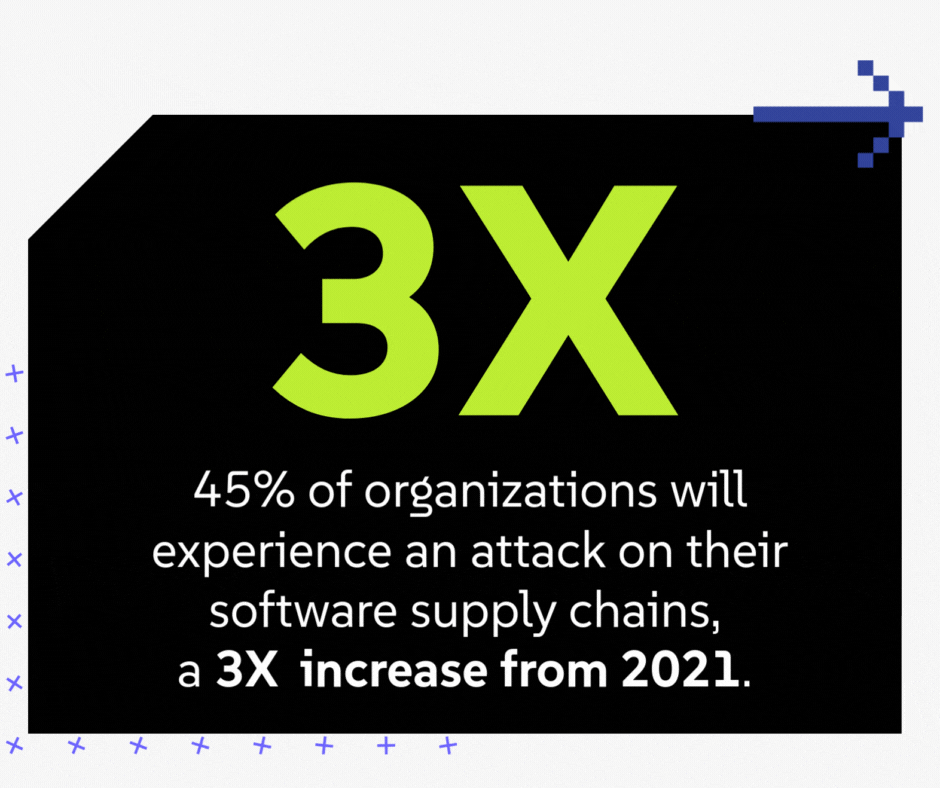
In fact, Gartner predicts that by 2025, 45% of organizations worldwide will have experienced attacks on their software supply chains, a three-fold increase from 2021.
Vendor Risk Management (VRM)
You can’t assume a vendor is secure just because they are large or well-known. You must treat vendor risk management (VRM) with the same scrutiny as internal environments. Audit your vendors and request their SOC 2, ISO 27001, or equivalent audit documentation. When your team wants to buy a new software tool, bring security in before signing the contract.
An IT Director’s Next Move:
- Require security questionnaires and annual updates from key vendors.
- Validate vendor incident-response timelines and communication protocols.
- Ensure contractual agreements include SLAs for breach notifications.
- Limit vendor access to only what is necessary, no exceptions.
6. Platform Consolidation: Less is More
You are probably tired of looking at 50 different dashboards. For years, the strategy was "defense in depth." You bought a tool for email, a tool for endpoints, a tool for the network, and a tool for the cloud. None of them talked to each other, and your team spent half their day toggling between tabs.
This has led to tool sprawl, and it’s killing your efficiency.
Consolidation Is King
The trend for 2026 is consolidation. Organizations are moving toward integrated platforms to improve visibility and simplify operations. Instead of juggling a dozen overlapping tools, they want one vendor that can deliver XDR (extended detection and response), SASE (secure access service edge), SIEM (security information and event management), and more in a single ecosystem.
Research shows that 75% of organizations pursued security vendor consolidation in 2022. That number continues to climb. By 2026, unified security stacks will be the default strategy for most teams.
An IT Director’s Next Move:
- Review your stack. If you have multiple tools performing overlapping functions (e.g., three different endpoint security agents), consolidate them into one integrated platform.
- Prioritize vendors that offer unified visibility so your team can work smarter and move faster.
Preparation Is the Name of the Game, Not Paranoia
It feels like the sky is falling, but it’s not. As an IT Director, you have the advantage of proximity. You see where data flows, where access breaks down, where outdated processes create gaps, and where real risk lives. Use that knowledge to align your strategy and budget with these trends.
This can be the year you finally get ahead of the curve, and CompassMSP can help you get there. We help organizations stay protected with practical cybersecurity solutions like 24/7 monitoring, employee training, and proactive defense.
Get in touch to learn how we can help you stay ahead of the threats coming your way.


Brian Bennet
Brian is a Security Architect at CompassMSP and military combat veteran with 22 years of IT experience spanning the public sector, government contracting, managed services, and executive cybersecurity leadership. He has served as an Information Systems Security Manager for a global aerospace company—where he secured classified and unclassified assets under NISPOM, NIST, and ITAR frameworks and established a classified asset security program from conception through ATO—as well as a vCIO and CISO/vCISO, guiding organizations ranging from 10 to over 1,000 employees through security strategy, framework implementation, audits, and incident response engagements including ransomware events. Brian holds certifications from ISC2, Cisco, Microsoft, VMware, and CompTIA, and draws on his progression from hands-on engineering to the C-suite to drive meaningful security conversations.