
Published: Updated: Jim Ambrosini 12 min read


In the manufacturing sector, compliance is often viewed as a binary state. You either have it or you do not. However, with the full activation of the Cybersecurity Maturity Model Certification (CMMC) Phase 1 in late 2025, that binary view has become dangerous. For a shop owner or COO, the difference between Level 1 and Level 2 is not just a list of extra technical controls. It is a fundamental shift in business operations, legal liability, and long-term contract eligibility.
| NOTE: On July 13, 2026, the DoD suspended CMMC Phase II and its third-party assessment requirements pending a 60-day reform review, but DFARS 7012 and the 110 NIST 800-171 controls remain fully in force. Here's what this means for your obligations. |
Failure to choose the correct level leads to two equally disastrous outcomes. You might over invest in security that your contracts do not require. Alternatively, you might face disqualification from a major contract because you mistakenly believed foundational cyber hygiene was enough. As we move closer to the November 10, 2026 C3PAO mandatory deadline, your choice of path is the most critical decision your leadership team will make this year.

The Baseline Definition: Value of Your Data
The Strategic Roadmap: A Guide for Operations Leaders
Technical and Operational Differences: Level 1 vs. Level 2
The Shop Floor Impact: Challenges for Manufacturers
Financial Strategy: A Smart Path for Your Level
The 2026 Timeline: Critical Decision Points
Frequently Asked Questions About CMMC Level 1 vs. Level 2
The Baseline Definition: Value of Your Data
The Department of Defense (DoD) determines your required CMMC level based on the sensitivity of the information you handle. It is not based on your company size, your revenue, or how long you have been a trusted partner. This distinction is the core of the CMMC framework and dictates your entire infrastructure investment for the next three years.
CMMC Level 1: Foundational Protection for Federal Contract Information
Level 1 represents the baseline of cybersecurity. It is designed for contractors that handle Federal Contract Information (FCI). This is information provided by or generated for the Government under a contract to develop or deliver a product or service, but which is not intended for public release. Examples include contract award amounts, delivery schedules, and basic communications with your Contracting Officer (CO).
The requirements for Level 1 are derived from FAR 52.204-21 and consist of 15 security practices. Because the data sensitivity is lower, the validation is also less rigorous. You must complete an annual self-assessment and a signed affirmation by a senior company official. This result is then uploaded to the Supplier Performance Risk System (SPRS). While simple, an inaccurate self-assessment carries significant legal risk under the False Claims Act.
CMMC Level 2: Advanced Protection for Controlled Unclassified Information
Level 2 is the advanced tier where the majority of the Defense Industrial Base (DIB) will reside. It is mandatory for any manufacturer that handles Controlled Unclassified Information (CUI). This data requires safeguarding or dissemination controls pursuant to law, regulation, or government-wide policy. In your shop, this looks like technical drawings, CAD files, metallurgical specifications, or even specific shipping instructions for military components.
The requirements for Level 2 are much more intensive. They consist of 110 security controls fully aligned with NIST 800-171 Revision 2. In nearly all cases, this level requires a triennial audit by a Certified Third-Party Assessment Organization (C3PAO). You cannot simply check a box; you must provide evidence to a professional auditor that every control is active and managed.
The Strategic Roadmap: A Guide for Operations Leaders
Determination of which level you need starts with a data audit, not an IT audit. As a vCISO, I advise my clients to look at their current and future contract pipeline through three specific lenses. This ensures you do not spend a dollar more than necessary while protecting your eligibility for high-value work.
1. Analysis of the Flow-Down Reality
Analyze your current contracts for the clause DFARS 252.204-7012. If this clause is present, you are already legally obligated to meet NIST 800-171 standards. This makes you an immediate candidate for CMMC Level 2. If you are a subcontractor to a Tier-1 Prime, they will specify the level they require from you. If you handle a blueprint they sent you, you are almost certainly required to meet Level 2 standards. Primes are currently vetting their supply chains to ensure their own DoD contractor compliance is not jeopardized by a weak link.
2. Detection of CUI in Local Systems
Many manufacturers do not realize they have CUI because it is not always clearly marked. You must look for "CUI in the wild" across your local systems. For instance, an email attachment with the chemical composition of a bolt used in a military aircraft is CUI. Conversely, a Purchase Order that just lists a part number might only be FCI. Misclassification here is the leading cause of failed audits. If you store, process, or transmit even one file of CUI, your entire environment (or a specific enclave) must meet Level 2.
3. Strategy for Future Business Growth
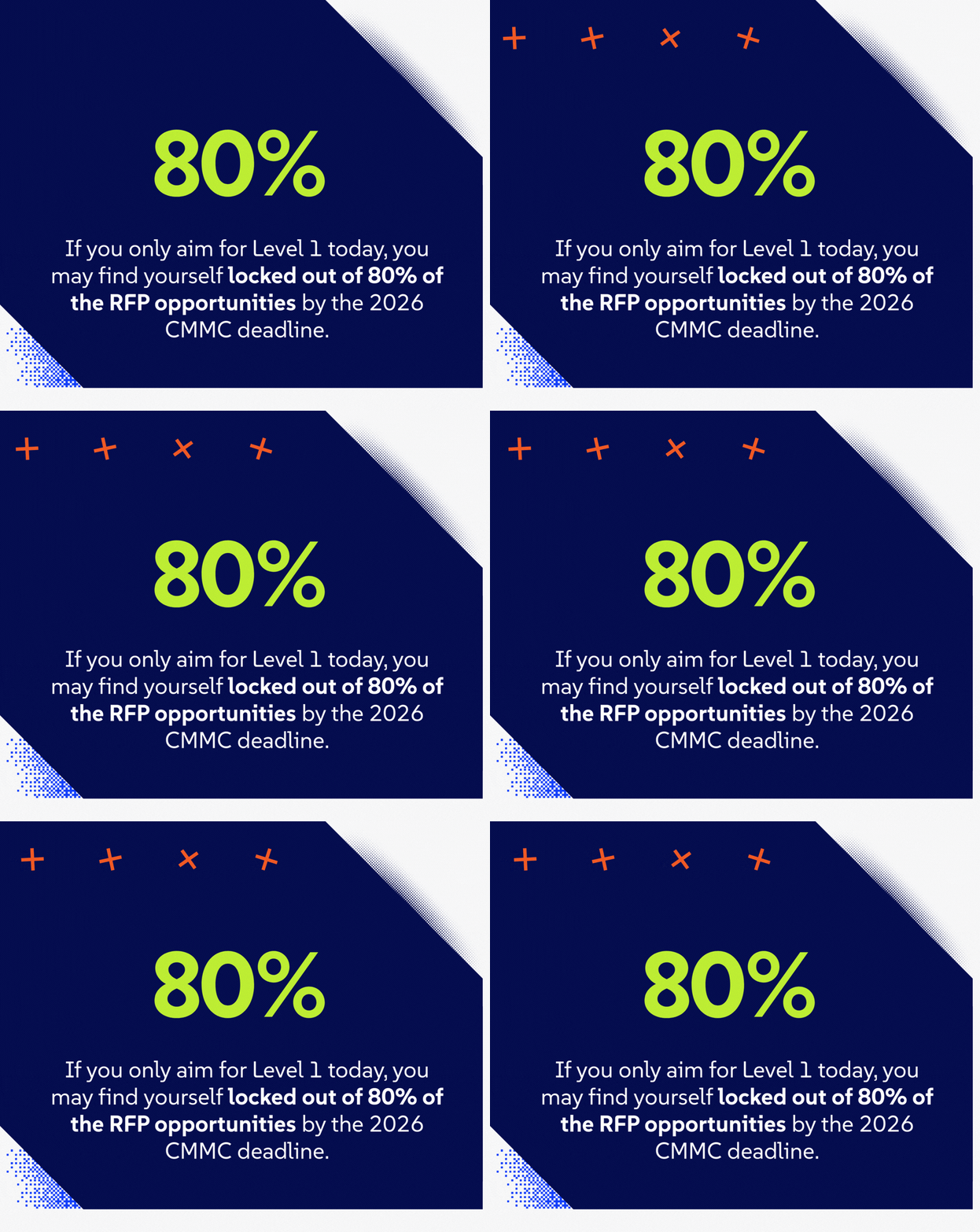
Even if your current work only requires Level 1, you must ask what contracts you want to win next year. The DoD is increasingly move toward CUI-level requirements for even simple parts to ensure supply chain resilience. If you only aim for Level 1 today, you may find yourself locked out of 80% of the RFP opportunities by the 2026 CMMC deadline. We recommend that growth-oriented manufacturers aim for Level 2 now to treat compliance as a competitive barrier to entry.
Technical and Operational Differences: Level 1 vs. Level 2
The jump from 15 practices to 110 controls is not linear. It is exponential in terms of effort, documentation, and cost. Understanding these differences allows a CFO to budget effectively for the transition.
Comparison of Control Domains
|
Feature |
CMMC Level 1 |
CMMC Level 2 |
|
Number of Controls |
15 (Basic FAR) |
110 (NIST 800-171) |
|
Documentation Requirement |
Minimal / Policy focused |
System Security Plan (SSP) + Evidence Artifacts |
|
Identity Management |
Simple Passwords |
Mandatory Multi-Factor Authentication (MFA) |
|
Network Security |
Basic Firewall |
FIPS-validated Encryption + SIEM/SOC Monitoring |
|
Assessment Cost |
$0 (Internal Staff Time) |
$20k to $40k + (C3PAO Fees) |
The Documentation Chasm between Levels
At Level 1, the DoD essentially trusts your word that you follow basic cyber hygiene. At Level 2, trust is replaced by evidence. You must prove that your controls work consistently over time. This requires a System Security Plan (SSP). This document can be several hundred pages long and details exactly how your shop meets every one of the 110 requirements. Without a robust SSP, you will fail a Level 2 audit regardless of how "secure" your firewall is.
The Shop Floor Impact: Challenges for Manufacturers
Small manufacturers face unique challenges that software companies do not. On a factory floor, Information Technology (IT) and Operational Technology (OT) collide. This creates specific friction points during a Level 2 transition.
Solution for the CNC Machine Dilemma
Many CNC machines run on embedded operating systems that are ten or fifteen years old. Under CMMC Level 1, these might stay under the radar. Under Level 2, if that machine receives CUI-based program files, you must secure it. Since you cannot install a modern antivirus on a 2012 controller, you must implement compensating controls. This might include physical air-gaps or strict network segmentation to ensure the machine is isolated from the broader internet.
Management of the Mobile and Remote Access
If your engineers take tablets onto the floor or check drawings from home, Level 2 requires full management of those devices. This includes the ability to remotely wipe the device if it is lost. You must also ensure that all data at rest on that device is encrypted. Level 1 does not mandate this level of granular control, which is why many shops find the move to Level 2 requires a significant upgrade in their mobile device management (MDM) software.
Financial Strategy: A Smart Path for Your Level
For a CEO or CFO, the Level 1 vs. Level 2 debate is a question of Return on Investment (ROI). Compliance is not just an expense; it is a prerequisite for revenue.
Analysis of Level 1 Costs
The cost for Level 1 is primarily internal staff time. It involves staff training on basic hygiene and assurance that your office Wi-Fi is secure. Most manufacturers achieve Level 1 within their existing IT budget. There are no external audit fees, making this a low-friction entry point for shops that strictly handle basic contract data.
Analysis of Level 2 Costs
Level 2 requires a significant compliance tax. This includes hardware upgrades, managed security services like a Security Operations Center (SOC), and the C3PAO audit fees. To mitigate these costs, we implement an Enclave Strategy. Through the creation of a "Compliance Bubble" within your network, we only apply Level 2 controls to the people and machines that actually touch CUI. This can reduce your total compliance cost by 40% or more as it shrinks the number of devices in scope for the auditor.
The 2026 Timeline: Critical Decision Points
The time for a "wait and see" approach ended in November 2025. If you currently self-attest to a score in SPRS, you have effectively told the DoD what level you intend to be.
- The Level 1 Choice: You are limited to basic parts and services.
- The Level 2 Choice: You must begin your CMMC Jumpstart remediation immediately.
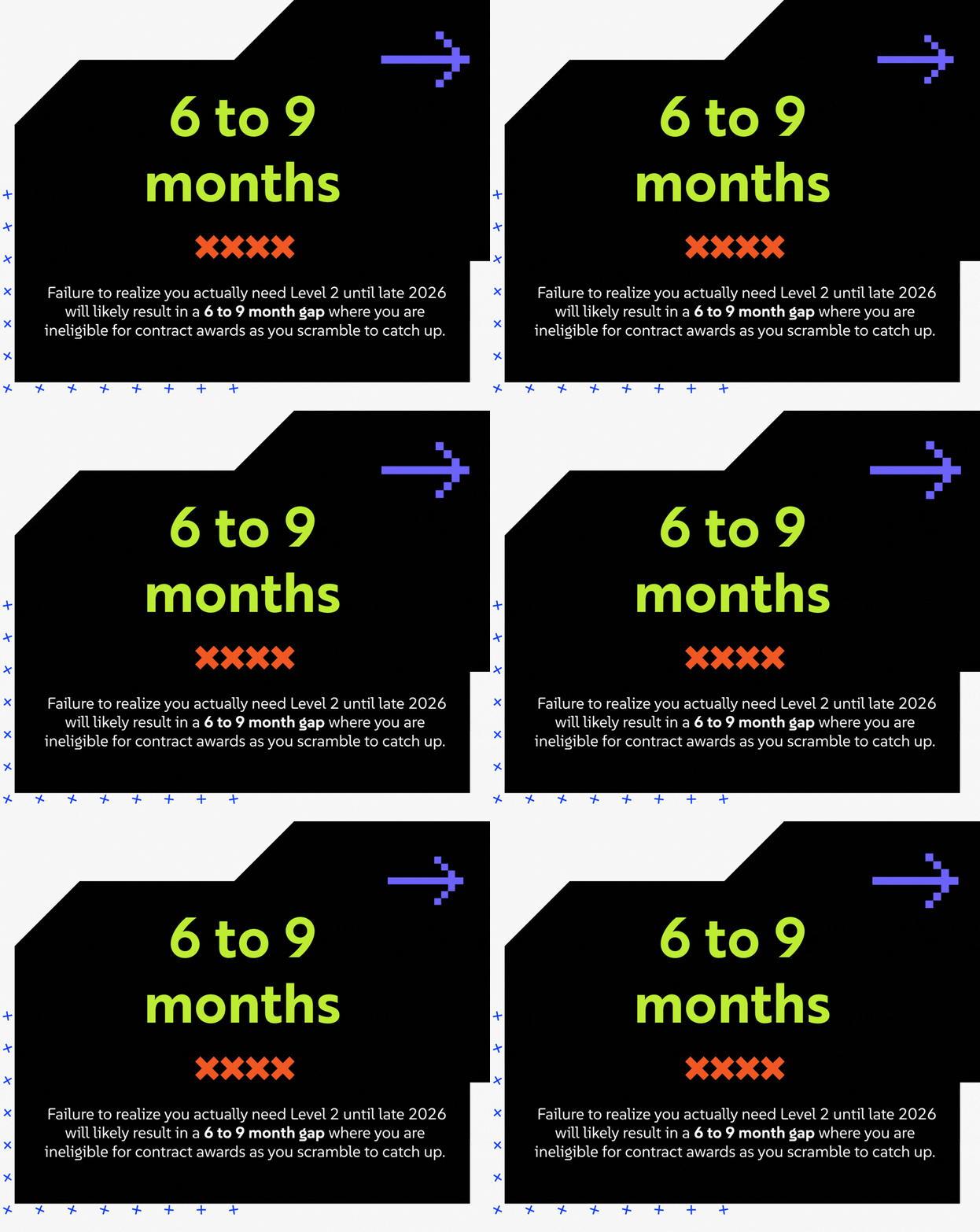
The queue for C3PAO auditors is already growing. Failure to realize you actually need Level 2 until late 2026 will likely result in a 6 to 9 month gap where you are ineligible for contract awards as you scramble to catch up. The DoD has been clear that they will not grant waivers for poor planning.

Jim Ambrosini
Jim is an award-winning CISO and cybersecurity advisor with over two decades of experience helping organizations protect what matters most: their customers, their data, and their reputation.