

Published: Updated: Paul Breitenbach 16 min read


What Every CEO Needs to Know in 2026
With rising tariffs, economic volatility, and tightening budgets, leaders are under pressure to stretch every dollar. For small and mid-sized businesses, IT is often one of the largest and least visible areas of spend, especially during growth. Infrastructure, security tools, telecom services, cloud subscriptions, and vendor contracts expand over time. This becomes a silent tax, creating complexity, duplication, and hidden costs that slowly erode margins.
The real cost of IT isn’t always what shows up on a monthly invoice. It’s the fragmentation and inefficiency behind it. True IT cost optimization for small businesses isn’t about cutting tools or limiting capability. It’s about eliminating waste, reducing friction, and addressing the tech sprawl that occurs when a company outgrows its original infrastructure.
In this article, you’ll learn why IT cost optimization matters, how fragmented IT models create unnecessary spend and risk, and how vendor consolidation and managed services can turn IT into a controlled, scalable operating model that supports growth.
-
From Reactive Cuts to IT Cost Optimization for Small Businesses
-
Why Fragmented IT Costs More: The Triple Threat to Your Bottom Line
-
IT Vendor Consolidation: The Financial Lever Most Businesses Overlook
-
UCaaS Cost Optimization: The Missing Piece of IT Consolidation
-
FAQs: What Small Business Leaders Ask a vCIO About IT Cost Optimization
From Reactive Cuts to IT Cost Optimization for Small Businesses
Unlike large enterprises, small and mid-sized organizations don’t have excess headcount or large contingency budgets. When IT costs creep up or systems fail, the impact is immediate. Downtime stalls operations, and security incidents drain resources. Internal teams get pulled away from revenue-generating work to troubleshoot technology that should support the business, not slow it down.
When IT Spend Grows Faster Than Your Revenue
As teams expand, technology decisions made for speed or convenience start to compound. New tools overlap, vendors multiply, and licenses go unused. Without a clear IT cost optimization strategy, tech spend grows faster than revenue, creating inefficiency and limiting visibility into where money goes.
Done right, IT cost optimization gives business leaders control. It replaces reactive cost-cutting with deliberate decisions about consolidation, standardization, and scalability. Instead of treating IT as a fixed cost or necessary evil, small businesses can turn it into a predictable, well-managed investment that supports growth rather than slowing it down.
That control starts with understanding where fragmentation creeps in, and why it’s one of the most expensive problems growing companies face.
The Hidden Tax of IT Fragmentation
Most small businesses don't start out with a mess. They start with a laptop and a single software subscription. As the team grows, they add a local IT guy for support, a separate vendor for the phones, a different host for the cloud, and a third-party specialist for cybersecurity.
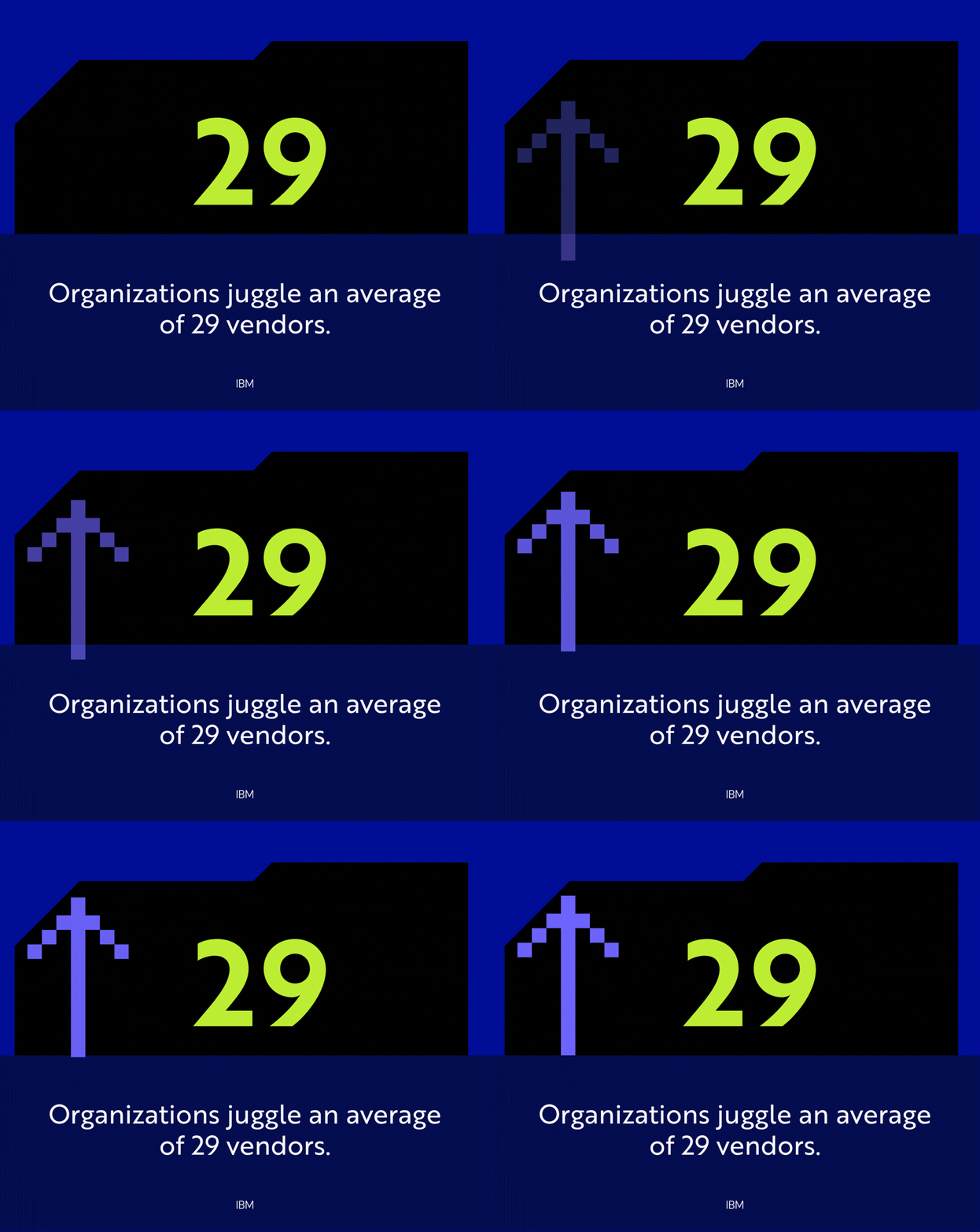
Before you know it, you have a dozen different relationships to manage. This is IT fragmentation, and it is more expensive than most CEOs realize. According to IBM, organizations now juggle an average of 29 different vendors. In a fragmented environment, you don’t just pay for the technology; you pay a "complexity tax."
Why Fragmented IT Costs More: The Triple Threat to Your Bottom Line
To truly master IT cost optimization, a business leader must look past the monthly subscription price and see the operational friction underneath.
Here are the three primary drivers of excess cost that impact your bottom line:
1. Redundancy and Tech Sprawl
When you build your technology stack piece-by-piece over time, you inevitably end up with tools that do the same thing. You might pay for a security suite that includes file encryption, while also paying for a standalone encryption tool, while also having encryption built into your cloud storage.
Tech sprawl, the uncontrolled growth of software and hardware, is more common than you think. Research shows that the average organization only utilizes 47% of its licenses, leaving the remaining 53% unused.
Every redundant tool creates:
- Multiple Licensing Fees: You pay for the same result twice or more.
- Compounded Training Costs: Your team has to learn three different interfaces to perform similar tasks, which kills productivity.
- Patching Overload: Every extra tool opens the door for hackers. Each requires its own updates and maintenance, multiplying the work for your IT support.
2. The Administrative Weight of Inefficient Vendor Management
Small business owners often underestimate the labor cost of "paperwork." When you have 20 different vendors, you have 20 different contracts to negotiate, 20 different support numbers to call, and 20 different invoices hitting your controller’s desk every month. Each one adds time, cost, and friction that rarely shows up clearly on a budget line.
For growing businesses, this IT fragmentation creates real administrative drag:
- Accounts Payable Fatigue: Processing dozens of invoices requires far more staff time than managing a single, consolidated bill.
- Billing Errors: More invoices increase the likelihood of overcharges, duplicate fees, or “zombie” subscriptions slipping through unnoticed.
- The "Finger-Pointing" Loop: When the internet goes down, the phone provider blames the router guy, who blames the cloud host. You pay for the downtime while they argue.
3. High Opportunity Cost: The Innovation Killer
The most dangerous cost of fragmented IT isn't found on a balance sheet; it’s the opportunity cost of what your team isn't doing.
When your internal IT people are preoccupied with manual tool coordination and patchwork troubleshooting, they are effectively "keeping the lights on" instead of work that moves the business forward, like:
- Improving the customer experience.
- Supporting the launch of new products.
- Implementing AI enablement to automate manual workflows.
When an Acquisition Brings Its Own Tech Stack
Tech sprawl usually builds slowly. An acquisition creates it overnight. The day a deal closes, you inherit the other company's entire technology environment: its software licenses, security tools, phone system, cloud tenants, vendor contracts, and every shortcut its IT team ever took.
For growing businesses that buy a competitor, merge with a partner, or join a private equity platform, this is where IT costs can rise fastest. It is also where those costs are hardest to see.
Two of Everything
Most acquired companies solve the same problems you do, just with different tools. After close, you may be running two email platforms, two endpoint security products, two backup solutions, two help desks, and two phone systems. Each one comes with its own contract, renewal date, and invoice.
Without a deliberate consolidation plan, these duplicates don't go away. Teams keep using what they know, contracts auto-renew, and the combined company pays for both sides of the stack indefinitely.
Common sources of post-acquisition redundancy include:
- Overlapping SaaS Licenses: Duplicate subscriptions for collaboration, CRM, accounting, and project management tools.
- Parallel Security Stacks: Two sets of firewalls, endpoint protection, and monitoring tools that don't share visibility, which leaves gaps attackers can exploit.
- Separate Telecom Contracts: Legacy phone systems and carriers that never get folded into a unified communications platform.
- Multiple IT Vendors: Each vendor has its own support process, and none of them is accountable for the whole environment.
The Technical Debt You Didn't Budget For
Redundancy is the visible problem, and technical debt is the hidden one. An acquired company may have delayed hardware refreshes, run unsupported software, or relied on undocumented workarounds that only one person understands. Roughly 40% of infrastructure systems carry some form of technical debt, and in an acquisition, that debt transfers with the deal.
These costs rarely show up in the purchase price. They surface after close, when the integration budget is already set and your negotiating leverage is gone. Change-of-control clauses, early termination fees, and multi-year contracts for outdated services add more cost that nobody modeled.
Price the Technology Before You Own It
The best time to address M&A tech sprawl is before the deal closes. M&A IT due diligence shows leadership what the target's technology will actually cost to run, what needs to be consolidated, and what remediation will be required. That data belongs in the negotiation, not in next year's budget as a surprise.
If you're evaluating an acquisition, start with these 10 IT due diligence questions PE firms should ask before an acquisition. They're just as useful for a founder-led business buying its first competitor.
IT Vendor Consolidation: The Financial Lever Most Businesses Overlook
The most effective way to achieve IT cost reduction is through a consolidated MSP model. Instead of managing a tangled web of disconnected providers, you partner with a single managed services provider (MSP) that handles IT, security, and telecom under one roof.
Vendor consolidation acts as a force multiplier for your IT budget. With one provider, IT spend becomes visible and measurable. Leaders can finally see where money is spent, what it supports, and where waste hides. That visibility enables decisions that make real cost optimization possible.
Enterprise Talent at a Fraction of The Cost
A strategic MSP partner provides enterprise-grade expertise without the enterprise-grade payroll. Hiring a full-time, in-house Cybersecurity Analyst, a Cloud Architect, and a Help Desk Manager would cost hundreds of thousands of dollars in salary and benefits alone.
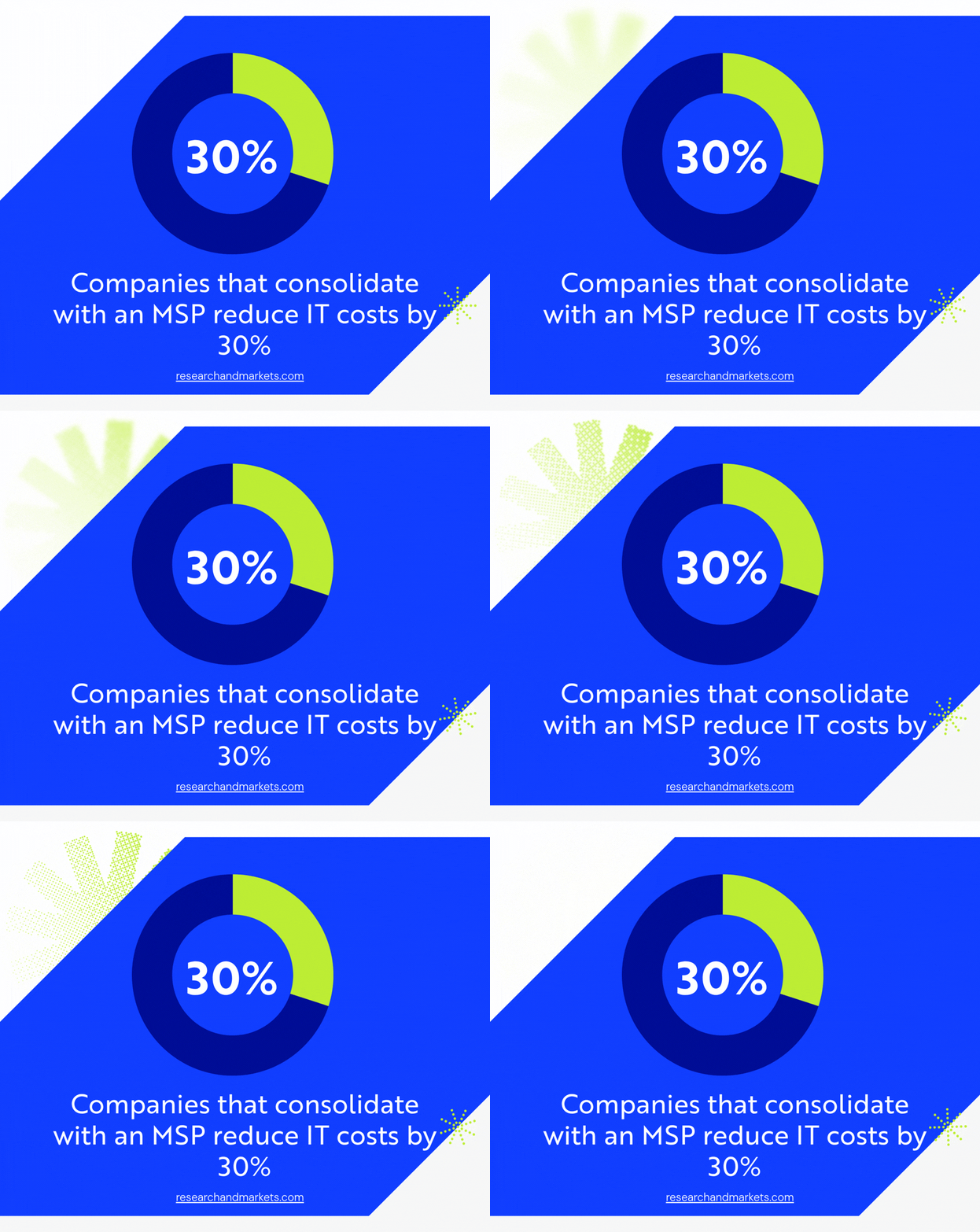
By outsourcing IT services, you access a collective group of experts for a fraction of the cost. In fact, research shows organizations that work with an MSP can reduce overall IT costs by 20% to 30%.
Bulk Pricing Beats Retail
Besides reducing headcount, IT consolidation with an MSP replaces tech sprawl with standardization. Your provider helps rationalize tools across IT, security, and telecom, ensuring every platform serves a clear purpose.
Just as important, MSPs provide access to enterprise licensing and volume discounts that most small and mid-sized businesses can’t negotiate on their own. Instead of paying retail across multiple vendors, organizations benefit from bulk pricing, predictable costs, and fewer contracts to manage.
The result is a lower total cost of ownership, fewer vendors and invoices, and a streamlined IT environment.
The $4.4M Wake-Up Call for Security Spend
It is a common misconception that cutting security spend saves money. In reality, cybersecurity cost optimization is about preventing the most expensive event a small business can face: a data breach.

When the average cost of a breach is $4.4 million, investing in security is a cost-control strategy, not a discretionary expense.
The Cost of a Security Gap
Fragmented IT creates security gaps. If your IT provider isn't talking to your security provider, a software update might accidentally disable a firewall. A consolidated provider ensures there are no gaps between the team managing the computers and the team protecting the data.
24/7 Monitoring Without the 24/7 Payroll
To monitor your systems 24/7/365 in-house, you would need at least three to four full-time employees to cover shifts. An MSP provides 24/7 IT monitoring and a Security Operations Center (SOC) as part of the service. This leads to security efficiencies that small businesses simply cannot achieve on their own.
UCaaS Cost Optimization: The Missing Piece of IT Consolidation
The final piece of the IT consolidation strategy is often the most overlooked: your phone system. Old-school landlines and disconnected VOIP providers are expensive and difficult to manage.
When you treat telecom as an island, you essentially pay a premium for a disconnected tool. UCaaS cost optimization (Unified Communications as a Service) brings voice, video, and messaging into the same ecosystem as IT and security. By consolidating telecom with your managed IT, you eliminate another vendor and another potential point of failure. This ensures that your hybrid or remote teams stay connected without the hidden fees of standalone telecom providers.
Built to Scale With the Business
The benefits go beyond cost savings. UCaaS also improves resilience and day-to-day productivity. Communications are monitored, secured, and supported as part of the broader IT environment, so issues get resolved faster without the usual finger-pointing. The result is fewer vendors, fewer invoices, and a communication system that scales smoothly as the business grows.
The vCIO Advantage: Turn Fragmented IT Into ROI
Most small and mid-sized businesses can’t justify the cost of a full-time CIO, but they still need strategic technology leadership. A managed services provider fills that gap with a vCIO (Virtual Chief Information Officer), providing executive-level oversight without the executive-level salary. The vCIO helps bring order to fragmented IT environments, aligning technology decisions with business goals while controlling rising costs.
Rather than reacting to problems as they surface, the vCIO introduces visibility, discipline, and long-term planning into the IT stack. This shift turns technology from a collection of disconnected tools into a strategic asset that supports growth and cost optimization.
Manage Your Business, Not Vendors
When business leaders face pressure to “do more with less,” fragmented IT is a liability. IT cost optimization isn’t about cutting tools at random; it ensures every dollar spent supports productivity, security, and growth.
CompassMSP helps small and mid-sized businesses by bringing IT, cybersecurity, and telecom under one roof. By combining enterprise-grade tooling, bulk licensing, and vCIO-led guidance, we guide organizations to eliminate vendor sprawl and create predictable IT spend.
Get Your Vendor Consolidation Blueprint
If your IT budget feels like a leaky bucket, download our Vendor Consolidation Blueprint. See exactly how a consolidated IT model can lower costs, close security gaps, and help your organization scale with confidence.
.png?width=1200&length=1200&name=01%20Intro%20(3).png)

.png?width=1200&length=1200&name=Cost%20Optimization%20Carousel%20(1).png)
.png?width=1200&length=1200&name=Cost%20Optimization%20Carousel%20(2).png)
.png?width=1200&length=1200&name=02%20(7).png)
.png?width=1200&length=1200&name=13%20(1).png)

Paul Breitenbach
With nearly 20 years of experience designing enterprise-grade IT solutions, Paul specializes in supporting organizations that cannot afford downtime. Before becoming our CIO, he served as CIO of WorldwideIT, a Compass company, where he led large-scale infrastructure, cloud, and security initiatives for highly regulated industries.