

Published: Updated: Brian Bennet 30 min read


A Buyer's Guide for Regulated SMBs
TL;DR: Bundled cybersecurity services combine executive security leadership (vCISO), 24/7 managed detection and response (MDR), and ongoing compliance support under one accountable partner. The guide below gives you the questions to ask, the deliverables to require, and the red flags to watch for. Skip to the 10-deliverable checklist if you're already in evaluation.
In this article:
- Why Regulated SMBs Need Integrated Cybersecurity Services
- How to Assess vCISO Advisory Services
- How to Evaluate Managed Detection and Response Capabilities
- How to Assess Compliance Support Services
- Evaluation Criteria for Integration
- Key Deliverables to Require from Any Provider
- Red Flags When Evaluating Providers
- How to Structure the Evaluation Process
- Why Compass Delivers This Differently
- Frequently Asked Questions
Most security programs at mid-sized businesses were not designed so much as accumulated. An endpoint tool came with the last IT contract. A monitoring service was added after a close call. A compliance consultant shows up each year before the audit. Each decision made sense on its own, and together they leave a familiar question unanswered: when something goes wrong, who actually owns the response?
That question is what drives IT leaders toward a single security partner, and it is the question this guide will help you answer well.
"Bundled cybersecurity services" is the term most buyers use for the fix: virtual CISO (vCISO) advisory for strategic leadership, Managed Detection and Response (MDR) for 24/7 threat monitoring, and compliance support for audit readiness, delivered together by a single partner. The word "bundle" undersells what actually matters, though. The value is not a discount for buying three things at once. It is that the person who finds a gap and the person who closes it work on the same team.
This guide walks you through how to evaluate providers of this kind: what to look for, what questions to ask, and which deliverables separate serious partners from marketing theater. If you run IT at a regulated SMB, you will leave with a framework for making this decision with confidence.
Why Regulated SMBs Need Integrated Cybersecurity Services
Mid-sized businesses in healthcare, manufacturing, legal, and financial services face a particular challenge. You have real compliance obligations (HIPAA, CMMC, PCI DSS, NYDFS 500, SOC 2) but you do not have the budget or headcount to build an enterprise security program in-house.
The old approach was to patch together point solutions. One vendor handles endpoint protection. Another runs vulnerability scans. A third offers compliance consulting when audit season arrives. The problem is nobody owns the whole picture.
That ownership gap is also where continuous threat exposure management breaks down for smaller companies, because findings pile up with no one assigned to fix them.
Related: How to Evaluate an MSSP for Compliance
The Hidden Cost of Vendor Fragmentation
Here is the uncomfortable truth about most security incidents: the detection was fine, and the response died in a handoff. The MDR vendor alerted the MSP, the MSP waited on the cloud consultant, and the attacker used the gap. This handoff problem, and the missing forensic capability that usually sits behind it, is the DFIR gap that undermines cyber resilience at organizations that otherwise look well protected.
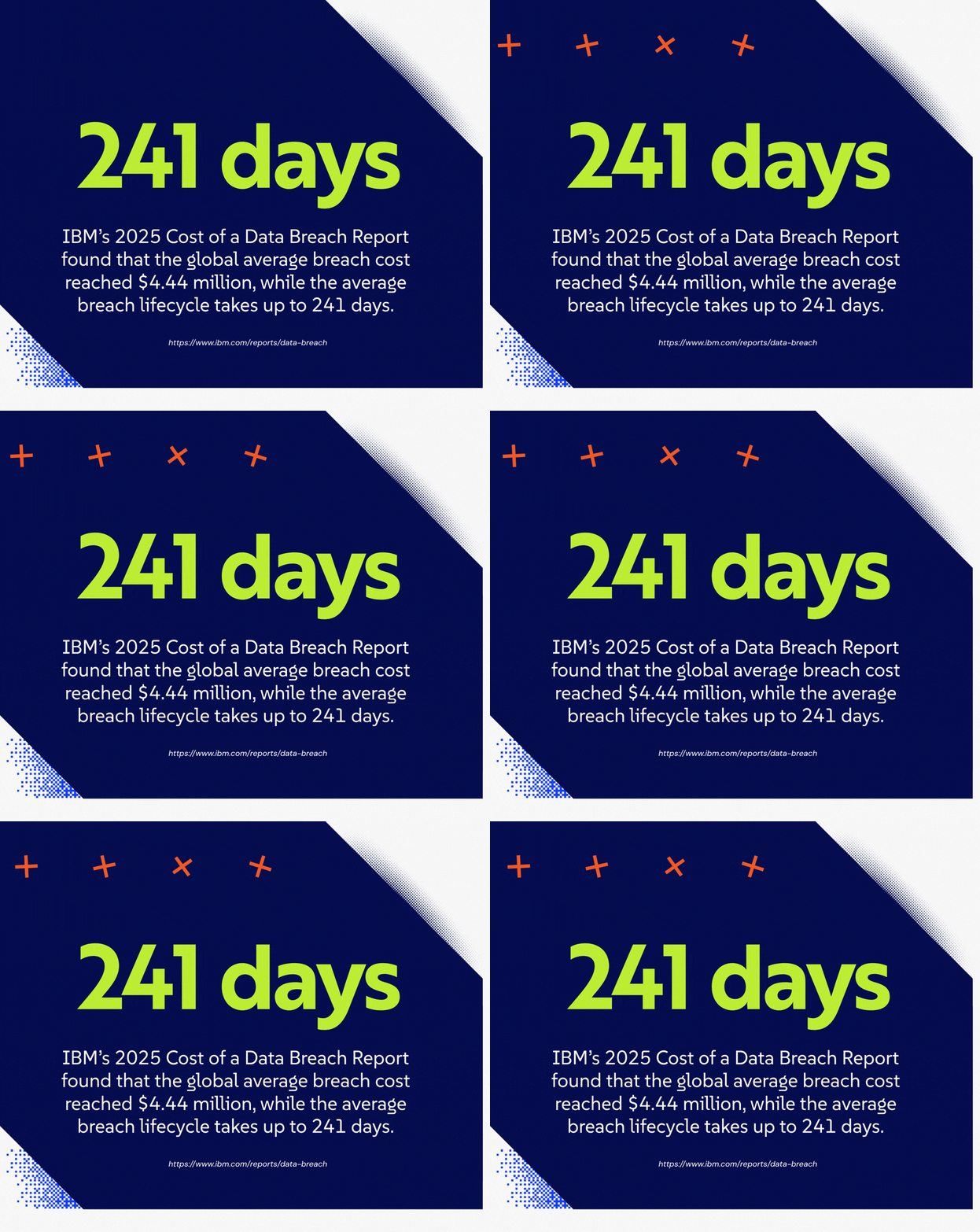
When your MDR provider detects suspicious activity but has no visibility into your compliance posture, they cannot prioritize response based on what data is actually at risk. When your compliance consultant develops policies but never sees your detection logs, those policies become theoretical documents that fail under audit scrutiny.
The cost shows up in places no dashboard tracks:
-
Time lost coordinating between vendors when incidents occur
-
Audit findings caused by gaps between provider responsibilities
-
Duplicate tooling costs from overlapping capabilities you did not need
-
Strategic drift because nobody guides your security program's evolution
Integrated services eliminate these gaps by design. Your vCISO develops strategy with direct visibility into SOC findings. Your compliance documentation reflects actual operational procedures. Incident response playbooks align with the controls you have actually implemented.
What an Integrated Service Should Include
A service worth evaluating combines three core components:
vCISO Advisory: Executive-level security leadership without the full-time hire cost. Your vCISO develops strategic roadmaps, communicates with your board, and ensures security investments align with business objectives. They translate technical risk into business language.
Managed Detection and Response (MDR): 24/7 threat monitoring, investigation, and active response from a Security Operations Center. MDR goes beyond alert forwarding; it includes human analysts who investigate incidents and take containment actions when threats are confirmed.
Compliance Support: Ongoing documentation, audit preparation, and framework alignment. This includes gap assessments, policy development, evidence collection, and remediation tracking, not just annual check-ins before the auditor arrives.
Compass delivers all three inside one operating model, the Compass Command Center. Detection and response run on the Apex Security Platform, a tiered model that matches protection to your risk. vCISO & Security Advisory and Compliance & Risk Management run alongside it, so strategy, operations, and evidence come from the same team.
How to Assess vCISO Advisory Services
The vCISO component determines whether your security program has direction or just activity. Many providers offer "strategic guidance" without defining what that means in practice. Here is how to evaluate whether a vCISO service will actually guide your program.
What Questions Should You Ask About vCISO Experience?
Not every security consultant qualifies as virtual CISO material. Ask specifically:
What CISO-level roles has your assigned advisor held? You want someone who has built and run security programs, not just consulted on them.
What industries has your advisor worked in? A vCISO experienced in healthcare compliance will navigate HIPAA differently than someone whose background is retail.
How many clients does each vCISO support simultaneously? An advisor stretched across 30 clients cannot give your program meaningful attention.
What certifications does your vCISO team hold? Look for CISSP, CRISC, or CCSP as baseline qualifications.
Can I meet the actual people? A provider that publishes its vCISO team by name, with their backgrounds, is telling you something a "team of experts" page is not.
What Deliverables Should a vCISO Provide?
Vague promises about "improved security posture" fail audits. Require specific deliverables with acceptance criteria:
Strategic Security Roadmap: A multi-year plan aligned to business growth, risk tolerance, and regulatory requirements, reviewed at least quarterly. Each initiative should include estimated costs, success criteria, and timeline. The roadmap should evolve based on threat landscape changes and your business priorities, not remain static after onboarding.
Board-Ready Security Reports: Executive summaries that translate technical metrics into business risk. Your vCISO should prepare reports suitable for direct board package inclusion without your team reformatting them. These should cover compliance status, risk trends, and investment outcomes.
Risk Assessment Documentation: Formal assessments that identify, quantify, and prioritize risks across your environment, refreshed on a defined cycle rather than annually. These should map to your applicable compliance frameworks and inform remediation planning.
Policy Development and Governance: Security policies and accountability models aligned to your regulatory requirements and operational reality. Policies should reflect how your business actually works, not generic templates that fail under audit scrutiny.
Vendor and Tool Evaluation: Guidance that ends tool sprawl and shelfware by tying every security investment to a strategic need.
Incident Readiness: Tabletop exercises and response planning, plus executive decision support before, during, and after incidents, including regulatory notification strategy.
AI Governance: Visibility into which AI tools your workforce is using, data-handling rules, and acceptable-use policy. Shadow AI is now one of the fastest-growing sources of data exposure, and boards are asking about it.
How Does the vCISO Integrate with MDR and Compliance?
The vCISO's value multiplies when they have visibility into your SOC operations and compliance status. Ask providers:
-
Does the vCISO review SOC incident findings to inform strategic priorities?
-
How do roadmap updates incorporate compliance gap findings?
-
Does the vCISO participate in incident response coordination?
-
Does the vCISO help select the right detection and response tier, and revisit that choice as your risk changes?
If the vCISO operates in isolation from detection and compliance teams, you are paying for strategy that disconnects from operational reality.
How to Evaluate Managed Detection and Response Capabilities
MDR is the operational backbone of an integrated security service. This is where threats get detected, investigated, and contained before they become breaches. Evaluating MDR requires looking beyond marketing claims about "advanced AI" and "24/7 coverage."
What Response Commitments Should You Require?
Every MDR provider promises fast detection and response. The difference shows in contractual commitments, and serious providers differentiate those commitments by severity and by service tier rather than promising one number for everything.
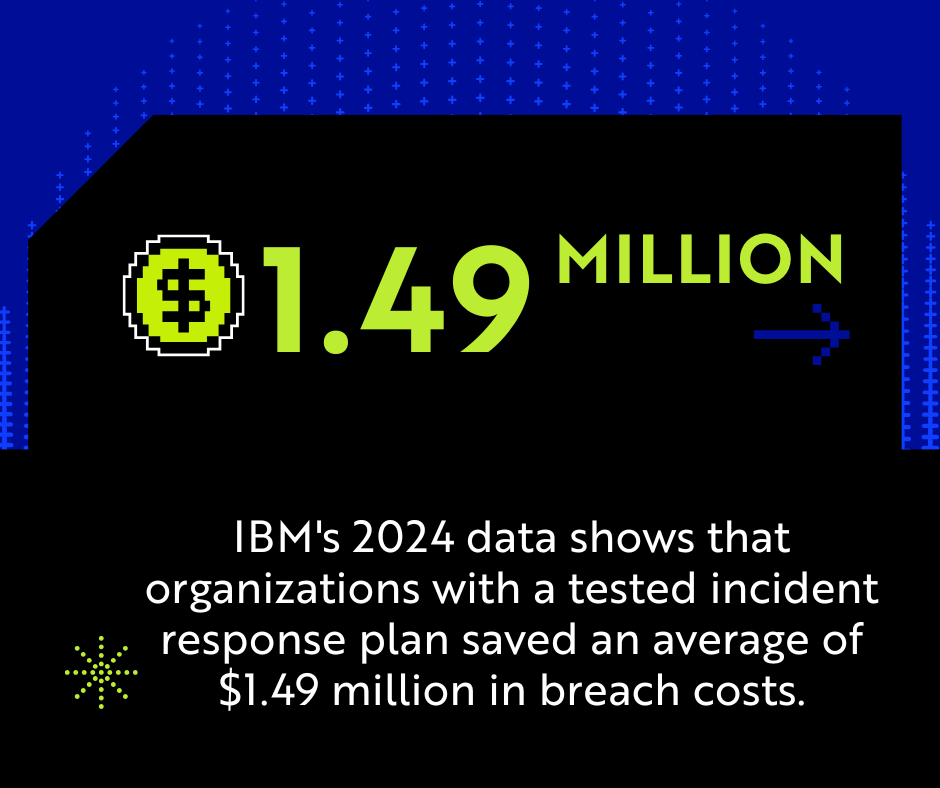
Acknowledgment, confirmation, and containment are three different clocks. Ask for all three. Acknowledgment is when an analyst picks up the alert. Confirmation is when a real threat is validated. Containment is when the attacker is stopped. A provider quoting only one of these is hiding the other two.
Benchmarks for the highest tier of service: 5-minute alert acknowledgment, 15-minute incident confirmation, and a 1-hour containment target for priority-one incidents. Not every organization needs commitments at this level, but knowing what the top of the market looks like tells you how to read a mid-tier proposal.
After-Hours Coverage: Confirm that live analysts, not just automated systems, staff the SOC during nights, weekends, and holidays. Attackers do not operate on business hours.
Escalation path: What happens when an incident exceeds MDR scope? A provider with an on-demand incident response capability, and clear terms for engaging it, is very different from one that hands you a phone number for a third party.
Compass delivers 24/7 monitoring from a 100% U.S.-based SOC across all tiers of the Apex Security Platform. Response commitments scale with the tier: the Core tier includes documented escalation procedures and response targets, the Complete tier adds enhanced response commitments and dedicated analyst support, and the Enterprise tier formalizes the 5-minute / 15-minute / 1-hour commitments above with a named analyst team. Compass Incident Response is available on demand to any organization, with priority engagement at preferred terms for Complete-tier clients and above.
For a deeper look at what separates a real 24/7 SOC from a staffed phone line, see 10 Red Flags When Hiring a 24/7 SOC Provider.
What Response Actions Can the MDR Team Take?
Detection without response is just expensive alert forwarding. Evaluate what containment actions the SOC can execute:
Endpoint isolation: Can they quarantine infected devices before malware spreads?
Account suspension: Can they disable compromised credentials or force resets to stop lateral movement?
Network blocking: Can they block malicious traffic or command-and-control communications?
Custom playbook execution: Can they follow your specific incident response procedures?
Ask about the authorization model. Some providers require your approval for every action, which delays response. Others execute pre-approved containment actions automatically, with notification after the fact. The right model depends on your risk tolerance and internal capabilities.
Then ask the question most buyers miss: does the SOC have administrative control of the systems it is defending? When the team that detects a threat also manages the endpoints, identities, and cloud accounts involved, containment happens in one motion. When it does not, every containment action is a request to someone else. This is the practical case for integrated services, and it is the reason Compass describes its model as closed-loop delivery: no vendor handoffs between detection, containment, and remediation.
What Environments Does the MDR Service Cover?
Modern attacks move across cloud, on-premises, and identity systems. Your MDR service should cover:
-
Endpoints: Workstations, servers, and mobile devices
-
Identity: Active Directory, Entra ID, SSO, and MFA platforms, with monitoring of authentication patterns and privilege changes
-
Cloud and SaaS: Microsoft 365, AWS, Azure, and Google Cloud, including audit logs where a growing share of attacks now begin
-
Email: Business email compromise detection
-
Network: Firewall logs, DNS traffic, and network flow data
Partial coverage creates blind spots. If your MDR only monitors endpoints but attackers compromise your identity provider, you will not see the initial breach until they move laterally.
Ask about tool compatibility, too. A vendor-agnostic platform that ingests telemetry from what you already run (Microsoft 365, AWS, Cisco Duo, SentinelOne, Datto, WatchGuard, and similar) protects your existing investment instead of forcing a rip-and-replace.
How Does MDR Support Incident Investigation?
When incidents occur, you need more than alert data. Evaluate investigation capabilities:
-
Root cause analysis: Can the provider determine how attackers gained initial access?
-
Impact assessment: Can they identify which systems and data were affected, and whether data was exfiltrated?
-
Evidence preservation: Do they maintain forensic artifacts with chain of custody suitable for legal proceedings and insurance claims?
-
Post-incident reporting: Do you receive detailed incident reports with lessons learned, and do those lessons become new detections?
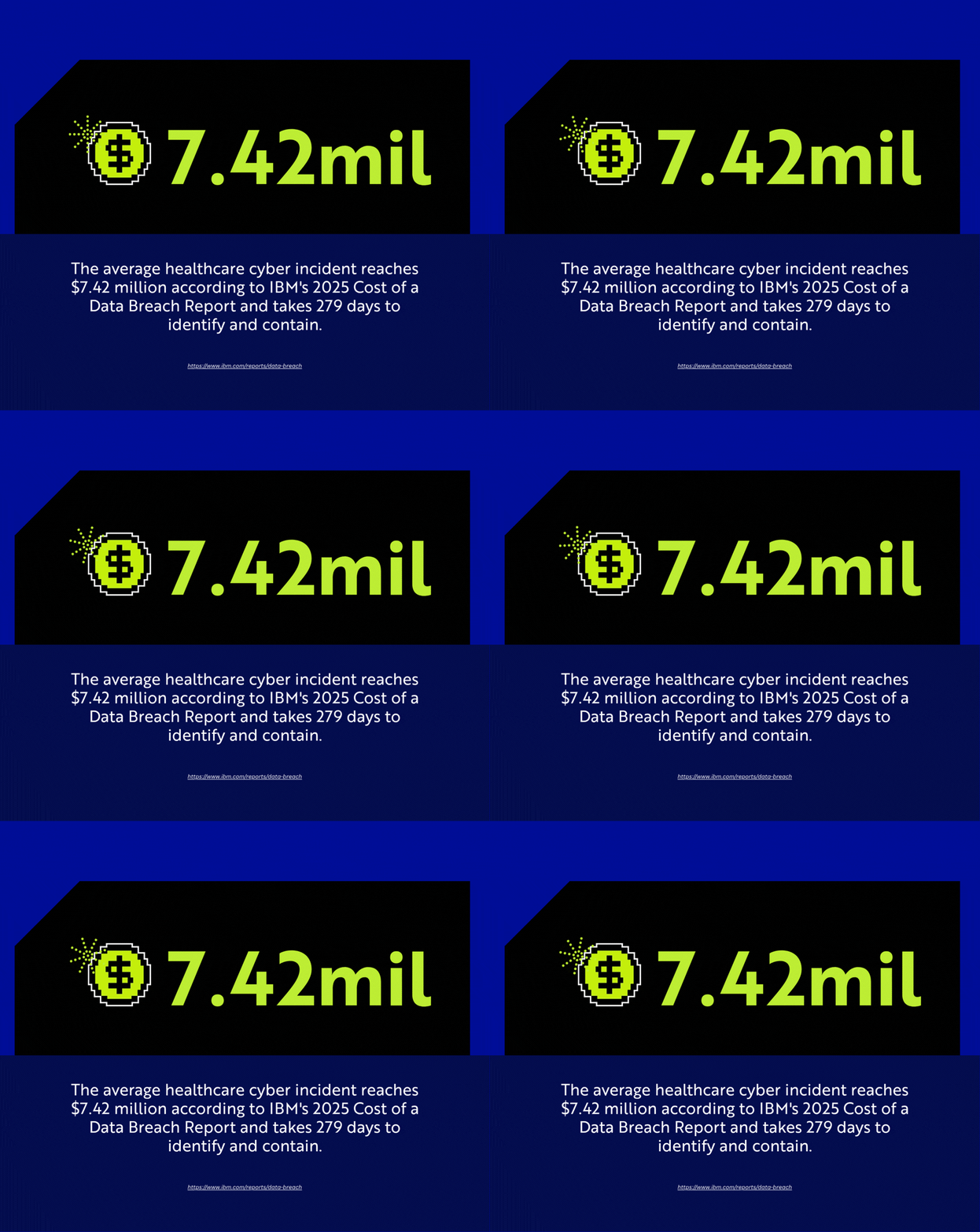
These capabilities matter for compliance. HIPAA, CMMC, and PCI DSS all require documented incident response and investigation procedures, and cyber insurers increasingly require definitive proof of attack vector and scope before paying a claim.
How to Assess Compliance Support Services
Compliance is not a project. It is an ongoing state that requires continuous documentation, monitoring, and remediation. The compliance component should keep you audit-ready year-round, not scramble to generate evidence when assessors arrive.
Which Compliance Frameworks Should the Provider Support?
Your provider should have deep expertise in your specific regulatory requirements:
Healthcare: HIPAA Security Rule, HITRUST CSF
Defense Contractors: CMMC Level 2, NIST SP 800-171
Financial Services: SOC 2, PCI DSS, NYDFS Part 500, FINRA
Manufacturing and everyone else: NIST Cybersecurity Framework, the common language of "reasonable security" referenced by regulators, insurers, and courts
Ask for evidence of framework expertise. Does the provider hold relevant designations? Have they supported clients through assessments in your framework? Can they show sample documentation aligned to your requirements?
Compass supports regulated industries with compliance services HIPAA, HITRUST, PCI DSS, SOC 2, GDPR, CMMC, NIST CSF, FINRA, and NYDFS 500, and holds Registered Practitioner Organization (RPO) status from The Cyber AB for CMMC readiness guidance, meaning control mapping is based on assessor expectations.
Related Case Studies:
- Burke Aerospace Clears the Runway for CMMC Readiness and Manufacturing Uptime
- Telescope Health Delivers Better Patient Outcomes with Managed IT Services for Healthcare
What Documentation Should Compliance Support Deliver?
Auditors want evidence, not assurances. Require specific documentation deliverables:
Shared Responsibility Matrix: A document defining exactly which controls you own, which the provider owns, and which require collaboration. Ambiguity about control ownership is one of the most common causes of audit findings, and it eliminates itself when the same team both operates the control and documents it.
Control Mapping Documentation: Crosswalks showing how the provider's services address specific framework requirements, and which gaps remain your responsibility. For organizations facing multiple frameworks, ask whether the provider builds one control set and maps evidence to each framework's reporting view, or makes you maintain three separate programs.
Audit Evidence Packages: Pre-organized documentation aligned to your framework, available on demand. Evidence should include timestamps demonstrating ongoing compliance, not point-in-time snapshots. The best evidence is generated by the systems that actually run your environment, not screenshots assembled the week before the audit.
Gap Assessment Reports: Regular assessments identifying compliance gaps with prioritized remediation recommendations. These should feed your vCISO's roadmap, and, ideally, land in the queue of the same team that will fix them. That handoff from finding to fixing is the Mobilization stage of a CTEM program.
Training Evidence: Security awareness and role-based compliance training with completion tracking formatted for auditors. Training is a required control in most frameworks.
Related: Managed IT for Cybersecurity Compliance: What Regulated SMBs Need
How Does Compliance Support Handle Framework Changes?
Regulatory frameworks evolve. HIPAA guidance updates. PCI DSS releases new versions. CMMC assessment requirements move. Your provider should:
-
Monitor regulatory changes affecting your industry
-
Assess impact on your current compliance posture
-
Update documentation and controls proactively
-
Deliver the change, the impact, and the remediation plan together, not a list
Ask how the provider handled recent framework changes and how quickly client documentation was updated.
Struggling to stay on top of ever-changing compliance mandates? Subscribe to our quarterly Compliance newsletter: thefineprint.compassmsp.com

Evaluation Criteria for Integration
The whole point of an integrated service is integration. Evaluating it requires looking at how the three components work together, not just how each performs independently.
How Does Threat Intelligence Flow Between Components?
When the SOC detects a new threat targeting your industry, that intelligence should inform vCISO strategic planning and compliance risk assessments. Ask providers:
Do SOC findings feed into vCISO roadmap priorities?
Does threat intelligence inform compliance gap prioritization?
How quickly do detection findings translate into control improvements?
How Does Incident Response Coordinate Across Teams?
During an active incident, you need coordinated response, not finger-pointing between SOC analysts and compliance consultants. Evaluate:
-
Who leads incident response coordination?
-
How do compliance considerations factor into containment decisions?
-
Who handles regulatory notification requirements?
-
Does post-incident analysis inform both detection improvements and compliance updates?
What Does the Single Point of Contact Look Like?
An integrated service should simplify your vendor management, not complicate it. Clarify:
-
Do you have one primary contact or multiple contacts across service lines?
-
How are escalations handled when issues span the SOC, vCISO, and compliance?
-
Is reporting consolidated, or do you receive separate reports from each team?
A single contract, unified reporting, and one relationship to manage frees your team to focus on core business operations.
Key Deliverables to Require from Any Provider
Before signing, require documentation of specific deliverables. Marketing promises do not satisfy auditors. Contractual commitments do.
10 Essential Deliverables
|
Deliverable |
Purpose |
Acceptance Criteria |
|
24/7 Monitoring Commitments |
Guarantees detection and response speed |
Written acknowledgment, confirmation, and containment targets, differentiated by severity, with financial remedies for misses |
|
Shared Responsibility Matrix |
Eliminates control ownership ambiguity |
Control-level specificity with both parties' signatures |
|
Audit-Ready Documentation |
Maintains ongoing compliance evidence |
Framework-specific organization with timestamps and retention policies |
|
vCISO Strategic Roadmap |
Guides security program evolution |
Multi-year plan with quarterly reviews, risk prioritization, and budget alignment |
|
Incident Response Playbooks |
Standardizes threat response procedures |
Coverage for ransomware, BEC, unauthorized access, with annual tabletop testing |
|
Control Mapping Documentation |
Shows framework coverage and gaps |
Practice-level mapping with evidence linkage across all applicable frameworks |
|
Monthly Security Reporting |
Keeps leadership informed |
Threats detected and contained, posture changes, and risk-ranked recommendations in business language |
|
Board-Ready Reports |
Communicates security to executives |
Business language with trend visualization and presentation-ready format |
|
Remediation Tracking |
Ensures findings get fixed |
Risk-based prioritization with owner assignment and timeline commitments |
|
Penetration Test Coordination |
Validates controls under simulated attack |
Independence verification with findings integrated into remediation tracking |
Request sample deliverables from prospective providers. Redacted examples from existing clients demonstrate what you will actually receive, not what marketing materials promise.
Red Flags When Evaluating Providers
Some warning signs indicate a provider will create more problems than they solve.
Vague Service Descriptions. When providers describe offerings as "strategic guidance" and "advanced protection" without specific deliverables, they are selling concepts rather than outcomes. Every capability should have documented acceptance criteria.
No Framework-Specific Expertise. Generic cybersecurity experience does not translate to compliance readiness. If a provider cannot demonstrate specific expertise in your regulatory framework, with client references and sample documentation, they will learn on your timeline and budget.
Separate Teams Without Integration. Some providers bundle services by repackaging separate offerings under one contract. If the vCISO, SOC, and compliance teams operate independently with separate reporting structures, you lose the integration benefits that justify buying them together.
One Response Time for Everything. A provider promising the same response time for every alert regardless of severity is either overselling or triaging so aggressively that they miss real threats. Realistic commitments differentiate by severity and distinguish acknowledgment from containment.
A Maturity Ladder Instead of a Risk Match. Be wary of providers who frame every tier as a rung you are "behind on." The right level of protection is a function of your data, your regulatory exposure, your liability profile, and what downtime costs you. A good advisor will tell you when the lower tier is the right answer today.
No Proof of Concept Option. Providers confident in their capabilities offer proof-of-concept engagements. A 30-day POC with seeded test threats validates detection and response claims before long-term commitment.
Read more about red flags to avoid when evaluating a SOC provider.
How to Structure the Evaluation Process
The steps below cover the full integrated service. If your evaluation is focused specifically on the compliance side of a security provider, our guide on how to evaluate an MSSP for compliance goes deeper on framework mapping and contract terms.
Step 1: Define Your Requirements
Before contacting providers, document:
-
Which compliance frameworks apply to your business
-
Your risk profile: the value of your data, your regulatory and liability exposure, and the cost of downtime
-
What internal security resources you have
-
Your budget range
-
Timeline pressures (upcoming audits, contract requirements, insurance renewals)
Step 2: Create a Shortlist
Research providers with demonstrated expertise in your industry and compliance requirements. Look for:
-
Designations relevant to your frameworks (RPO for CMMC, HITRUST experience for healthcare)
-
Client references in similar industries and company sizes
-
Documented service deliverables rather than capability descriptions
-
A published, named advisory team
Step 3: Conduct Structured Discovery Calls
Use consistent questions across all providers:
-
Walk me through how your vCISO, SOC, and compliance teams work together.
-
What specific deliverables will I receive, and what are the acceptance criteria?
-
How do you handle clients in my industry with my compliance requirements?
-
What does onboarding look like, and how long until I see value?
-
What happens between signing and full coverage?
-
Can you share references from clients similar to my organization?
Step 4: Request and Review Sample Deliverables
Ask for redacted samples of shared responsibility matrices, strategic roadmaps, board reports, incident response playbooks, and control mapping documentation. Review for specificity, clarity, and alignment with your needs.
Step 5: Verify Through References
Ask current clients:
-
How responsive is the provider during incidents?
-
How did audit preparation compare to expectations?
-
What surprised you about working with this provider?
-
Would you choose them again?
Step 6: Run a Proof of Concept
Before committing to a multi-year engagement, deploy monitoring on a subset of your environment, seed test scenarios, evaluate communication quality and report usefulness, and assess responsiveness.
Why Compass Delivers This Differently
Regulated SMBs need more than monitoring software and quarterly check-ins. You need a security partner who understands the stakes of audit failures, the complexity of overlapping frameworks, and the operational reality of running security with constrained resources.
Compass runs every engagement through the Compass Command Center, an operating model built on account intelligence and closed-loop delivery. Because Compass controls and manages the systems it defends, the U.S.-based SOC that detects a threat has direct administrative control of the endpoints, identities, and cloud accounts it needs to contain it. Detection, containment, and remediation happen inside one team, in one motion, with no vendor handoff.
The Apex Security Platform delivers detection and response in tiers matched to your risk. Core provides AI-driven 24/7 MDR with human validation of every alert. Complete adds dedicated analysts, human-led investigation, threat hunting, and forensic reporting rigorous enough for auditors, insurers, and boards. Enterprise adds the platform's fastest commitments and a named analyst team for large or complex environments. All tiers share one platform and one SOC, so scaling up is a decision, not a migration.
Around the platform, Compass vCISOs turn SOC findings into strategy, and Compliance & Risk Management generates audit evidence from the systems that operate your environment. Framework expertise spans HIPAA, HITRUST, PCI DSS, SOC 2, GDPR, CMMC, NIST CSF, FINRA, and NYDFS 500.
The right direction starts with a partner who knows how your business works. Talk to a Compass security advisor about your obligations, your current posture, and which tier of the Apex Security Platform fits your risk today.

Brian Bennet
Brian is a Security Architect at CompassMSP and military combat veteran with 22 years of IT experience spanning the public sector, government contracting, managed services, and executive cybersecurity leadership. He has served as an Information Systems Security Manager for a global aerospace company—where he secured classified and unclassified assets under NISPOM, NIST, and ITAR frameworks and established a classified asset security program from conception through ATO—as well as a vCIO and CISO/vCISO, guiding organizations ranging from 10 to over 1,000 employees through security strategy, framework implementation, audits, and incident response engagements including ransomware events. Brian holds certifications from ISC2, Cisco, Microsoft, VMware, and CompTIA, and draws on his progression from hands-on engineering to the C-suite to drive meaningful security conversations.