

Published: Updated: Brian Bennet 19 min read


Choosing a 24/7 SOC provider has never been a higher-stakes decision. According to Mandiant's M-Trends 2026 report, attackers now hand off initial access to ransomware affiliates in a median of just 22 seconds — down from more than 8 hours in 2022. Verizon's 2025 Data Breach Investigations Report found ransomware in 44% of all breaches, and a striking 88% of breaches at small and mid-sized businesses involved ransomware. The window between compromise and consequence is measured in hours, not weeks.
Yet most managed SOC providers still operate on assumptions that haven't been true for years: that alerts can wait until business hours, that endpoint visibility is enough, that "guidance" counts as response, and that compliance is something the buyer figures out on their own.
This guide breaks down the 10 most consequential red flags to watch for when evaluating a 24/7 SOC provider, and then shows how five of the most commonly considered vendors (CompassMSP, Arctic Wolf, Huntress, CrowdStrike Falcon Complete, and Rapid7) actually perform against those criteria.
Why the Stakes Are Higher Than Vendors Will Tell You
Before diving into the red flags, it's worth grounding the conversation in current data.
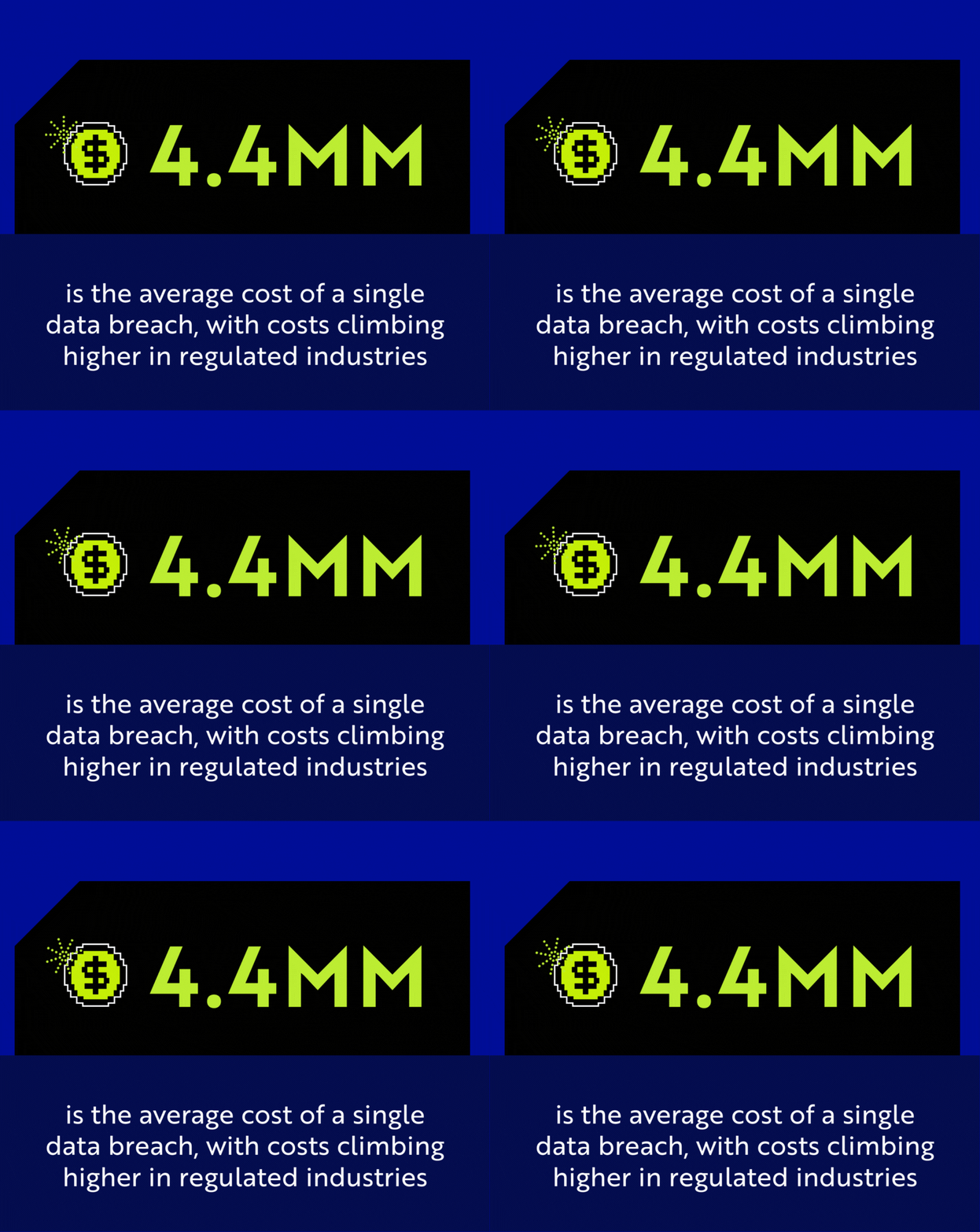
- The average global breach cost is $4.44 million, but the U.S. average is $10.22 million, per IBM's 2025 Cost of a Data Breach Report.
- Healthcare breaches average $7.42 million and take 279 days to identify and contain — the costliest sector for the 14th consecutive year.
- Breaches detected in under 200 days cost $3.61M on average; those detected later cost $5.49M — a $1.88 million swing tied almost entirely to detection speed.
- Organizations using AI and automation extensively identify and contain breaches 80 days faster and save $1.9 million per incident.
- Mandiant's M-Trends 2026 found a 14-day global median dwell time in 2025, but a 9-day median when detection came from internal sources and 25 days when it came from external notification.
- The CMMC Final Rule went into effect November 10, 2025, with the Department of Defense beginning to enforce certification requirements across the defense industrial base; full rollout completes in 2028.
- HHS OCR resolved 21 HIPAA enforcement actions in 2025, the second-highest annual total on record.
The story underneath the numbers is consistent: defenders who detect early, document well, and respond fast win. Everyone else pays for the gap.
Defenders who detect early, document well, and respond fast win. Everyone else pays for the gap.
Related Article: The IT Directors' Guide to Cybersecurity
The 10 Red Flags
Red Flag #1: They forward alerts instead of investigating them
A surprising number of "managed SOC" services are, in practice, alert-routing services. A detection fires, a ticket is generated, and the customer is notified. The investigation — determining whether the alert is a false positive, what triggered it, what to do about it — is left to the customer's internal team.
This is the foundational red flag because every other failure compounds on top of it. If an analyst isn't validating the alert before it reaches you, alert fatigue is guaranteed, mean time to respond is guaranteed to be slow, and your team will eventually start ignoring notifications.
Ask: "Walk me through what your analyst does between alert generation and customer notification."
Red Flag #2: No autonomous response authority
If your provider has to wait for approval before isolating an endpoint or disabling a compromised account, the 22-second handoff window Mandiant documented is already lost. The question isn't whether the provider can take action; it's whether they will take action without waking up your team at 2 AM on a Saturday.
Containment authority should be explicitly defined in your service agreement — what actions the SOC can take autonomously, under what conditions, and with what notification protocols.
Ask: "What specific containment actions can your team execute without my approval, and at what severity threshold?"
Red Flag #3: Offshore-only analyst coverage for core workflows
This isn't a quality-of-analyst argument — there are excellent analysts everywhere. It's a structural argument. Offshore-only models often involve handoffs between time-zone-distributed teams, which introduces context loss at exactly the moments when context matters most. Regulated industries also frequently face data residency questions that get harder when your incident responder is offshore.
The bar to look for isn't "U.S.-only analysts" — most global providers have global SOCs and that's fine. The bar is whether the detection and containment workflow for your account stays with a consistent team that understands your environment.
Ask: "Does my account have analyst continuity, or does the handler rotate every shift across continents?"
Red Flag #4 — Triage only on "high" and "critical" alerts
The Sophos 2025 Active Adversary Report found that median dwell time across MDR cases dropped to as low as one day for non-ransomware attacks, but only for organizations whose providers actually investigate the quiet stuff. Real attackers know that the loudest alerts get attention first, and they specifically tune their tradecraft to stay below severity thresholds.
A provider that only triages "high" and "critical" by definition misses precursor activity.
Ask: "Do your analysts investigate every alert, or do you filter by severity? What's the threshold?"
Red Flag #5: Endpoint-only visibility
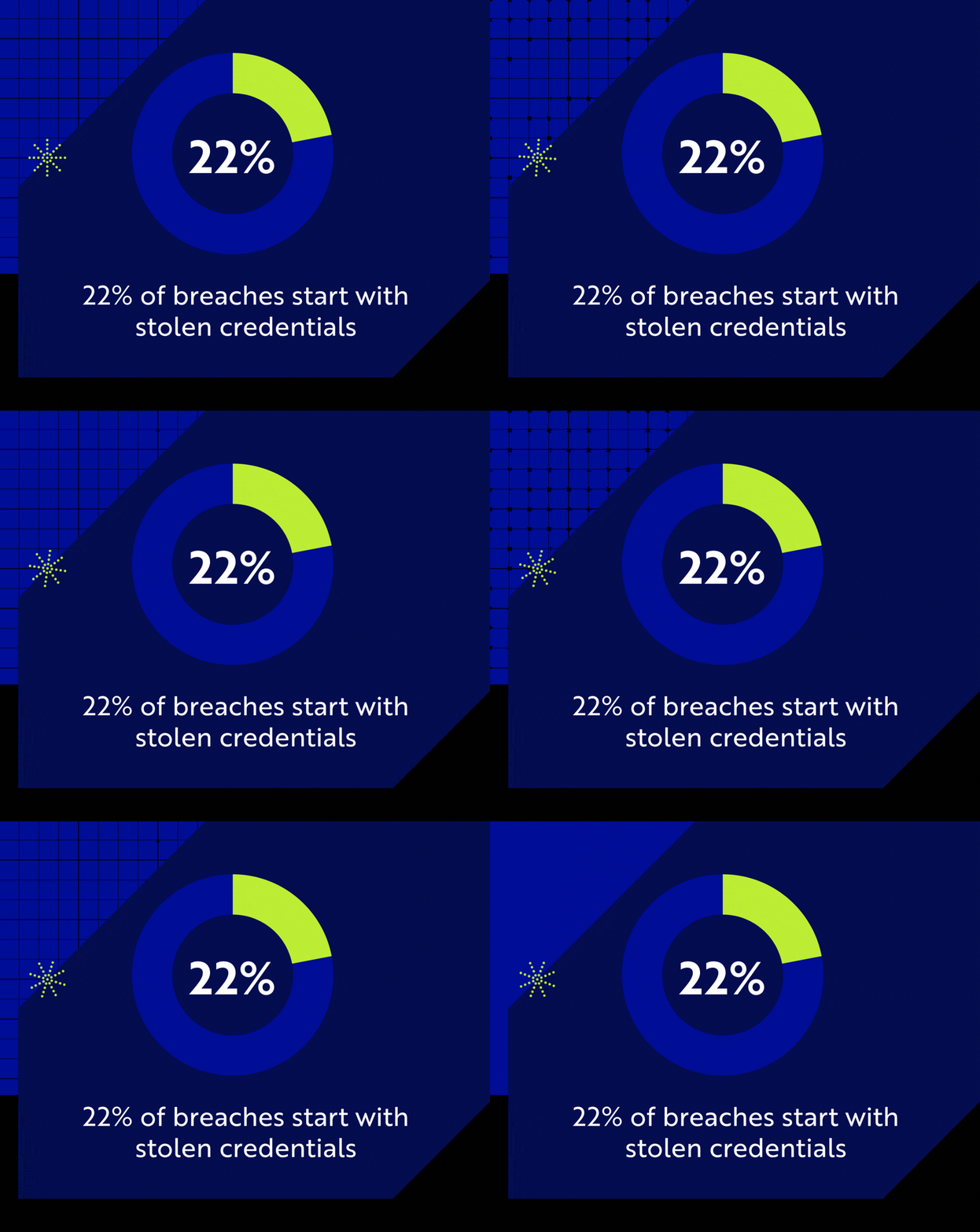
Verizon's 2025 DBIR shows that 22% of breaches start with stolen credentials, and IBM's research finds credential-based attacks take an average of 246 days to identify and contain. Identity-based attacks accounted for 40% of all security incidents in 2025, according to Huntress's RSA Conference 2026 research.
An MDR product built around endpoint telemetry alone is structurally incapable of seeing the most common attack vector. Multi-domain correlation — endpoint, identity, cloud, network, application — isn't optional anymore.
Ask: "Beyond endpoint, what telemetry sources does your detection logic correlate across?"
Red Flag #6: Detection without remediation under one roof (the "DFIR gap")
This is the gap CompassMSP has explicitly built around: the space between "we detected something" and "it's resolved." Most providers stop at the detection-and-guidance line. They tell you what happened. They might help you contain it. But the forensic investigation, root cause analysis, and full remediation often involve handoffs to your internal team, a separate IR firm, or a third-party tooling stack.
For organizations without a mature internal SOC, that DFIR gap is where incidents get worse.
Ask: "When an incident escalates beyond initial containment, does your team handle forensic investigation and remediation in-house, or do you hand it off?"
Red Flag #7: Generic compliance reports
The line "compliance reports available" is in every MDR vendor's marketing materials. The question is whether the documentation generated actually maps to the framework your auditor uses. HIPAA, CMMC, NYDFS 500, SOC 2, PCI DSS, and FINRA each have specific evidence requirements — chain of custody, forensic timelines, analyst attribution, kill-chain reconstruction, root cause analysis tied to specific controls.
Generic logs and dashboards are not audit evidence.
Ask: "Can you show me a sample incident report formatted for [your framework]? I want to see what an auditor would actually receive."
Red Flag #8: Incident response billed as a separate, surprise engagement
This is a contract-structure red flag with enormous financial consequences. Many MDR providers treat incident response as a billable engagement separate from the MDR subscription. The result: you find out what IR costs in the middle of an active breach, when leverage is minimal and time pressure is maximum.
Look for providers that include IR as a standard feature, ideally with no retainer fees and no emergency-rate surprises.
Ask: "What's the scope of incident response included in my MDR contract? What triggers additional billing?"
Red Flag #9: You don't own your licenses, data, or logs
Some MDR providers structure agreements so that licenses, normalized log data, and dashboards belong to them, not to you. If you switch providers — even just to evaluate — you lose visibility into your own historical data. This is sometimes hidden behind language about "platform access" or "managed instances."
For regulated organizations, this is also an audit risk: if you can't retrieve historical incident data on demand, you may not be able to satisfy retention requirements.
Ask: "If I terminate this contract tomorrow, what data do I keep? What do I lose?"
Red Flag #10: No persistence verification after containment
Stopping the initial attack is roughly half the job. Attackers routinely deploy persistence mechanisms — scheduled tasks, registry modifications, startup folder changes, OAuth grants, malicious inbox rules — that give them a path back into the environment after the initial compromise is "resolved." Mandiant's M-Trends 2026 data on the 22-second initial-access-to-handoff window highlights how quickly compromised access gets sold to follow-on actors.
A SOC that doesn't proactively hunt for persistence after containment is a SOC that resolves the symptom and ignores the disease. Ask: "After containment, what specific persistence mechanisms does your team check for, and how is that documented?"
How the Major MDR Vendors Stack Up Against the 10 Red Flags
CompassMSP— All-in-One IT and Cybersecurity, with Compliance Depth Built In
What sets CompassMSP apart from every other provider on this list is structural: it isn't a pure-play MDR vendor. It's a managed IT and cybersecurity services partner where detection, investigation, response, remediation, and remediation handoff to IT operations all happen inside one accountable organization. This eliminates the "DFIR gap" (Red Flag #6) by design, because there's no handoff to a separate IT team — the IT team and the security team are the same team.
The cybersecurity portfolio is structured in two tiers:
- Core Defense — the MDR foundation for mid-market organizations: continuous 24/7 monitoring across endpoint, identity, and cloud; analyst-led alert validation; playbook-driven containment; monthly executive reporting.
- Apex Security — built for high-liability environments: continuous forensic and incident response, full kill-chain reconstruction, MITRE ATT&CK classification, multi-domain detection across identity, endpoint, cloud, network, and applications, and audit-ready reporting that satisfies HIPAA auditors, CMMC assessors, and cyber insurance underwriters. Full-scale Incident Response is included as a standard feature — no retainer fees, no emergency billing rates (directly addressing Red Flag #8).
How CompassMSP performs against the 10 red flags:
- Investigates every alert (#1, #4): Human analysts validate every alert before reaching the customer's IT team. No severity-threshold filtering.
- Autonomous containment (#2): The SOC executes containment actions per pre-agreed playbooks without waiting for approval chains.
- U.S.-based analyst continuity (#3): U.S.-Based SOC with U.S.-based analyst coverage; no offshore handoffs in core detection and containment workflows.
- Multi-domain visibility (#5): Apex Security correlates telemetry across endpoint, identity, cloud, network, applications, and servers — the cross-domain correlation that endpoint-only tools structurally cannot perform.
- Closed-loop model (#6): This is the differentiator. Because Compass is also a managed IT provider with 350+ professionals nationally, remediation is handled inside the same accountable team that detected the threat. The Apex tier explicitly closes the DFIR gap.
- Forensic-grade, framework-specific compliance docs (#7): RPO certification from The Cyber AB for CMMC readiness guidance. Dedicated Compliance & Risk Management practice with expertise in HIPAA, HITRUST, PCI DSS, SOC 2, NYDFS 500, FINRA, GDPR, NAIC, FedRAMP, and CCPA.
- IR included (#8): Standard component of Apex Security.
- Data ownership (#9): Licenses, logs, and dashboards remain accessible to the client.
- Persistence verification (#10): Apex Security explicitly performs continuous forensic investigation and full kill-chain reconstruction post-containment.
Why the all-in-one model matters: When detection, IT operations, vCISO advisory, and compliance documentation live in one organization, the friction that normally fragments a security program disappears. The team that found the compromised identity is the same team that resets the password, the same team that updates the conditional access policy, and the same team that documents the chain of custody for the auditor. For mid-market organizations without an internal CISO function, this is the only model that actually scales protection, response, and compliance from a single accountable partner.
Recognition: Named to CRN's MSP 500 List for 2026 in the Pioneer 250 category, recognized on Cloudtango's MSP Select 2026 list, and earned SonicWall's 2025 Managed Security Partner of the Year award.
Best fit for: Mid-market organizations in healthcare, financial services, legal, manufacturing, defense contracting, and any sector with active compliance obligations that want detection depth, IT execution, and audit-ready documentation from one accountable partner.
Arctic Wolf — Concierge Service for Organizations That Want a Named Team
Arctic Wolf assigns a named Concierge Security Team (CST) to each customer, building on the Aurora open XDR platform that ingests telemetry from existing security tools rather than requiring replacement. The company was recognized as a 2026 Gartner Peer Insights Customers' Choice for Managed Detection and Response and reports processing more than 7 trillion security events per week. According to their own published data, the CST identifies latent threats in 73% of customer environments within the first 90 days.
How Arctic Wolf performs against the 10 red flags:
- Investigation depth (#1, #4): Concierge model emphasizes triage and prioritization; named team learns the environment over time, which reduces false positives.
- Response model (#2): Arctic Wolf's response model has historically been guided. Customers should ask exactly which actions the CST takes directly versus which require the customer's team to execute on guidance.
- Analyst continuity (#3): The named-team model is one of Arctic Wolf's strongest differentiators.
- Multi-domain visibility (#5): Aurora platform supports endpoint, network, cloud, and identity telemetry — broad coverage that's particularly strong if the customer already runs a heterogeneous security stack.
- DFIR gap (#6): Arctic Wolf is an MDR pure-play. Customers needing incident response beyond MDR engage the Incident360 Retainer, which is a separate service with separate scope.
- Compliance documentation (#7): Security posture assessments support compliance posture but generally are not built around the evidentiary depth of forensic-grade frameworks like CMMC Level 2 or HIPAA breach documentation.
- IR cost (#8): Incident360 Retainer pricing is separate from MDR subscription.
- Data access (#9): Customers should confirm what raw telemetry they can query directly versus by report request.
Best fit for: Mid-market organizations with an existing heterogeneous security stack that want a named team relationship and broad telemetry coverage without replacing existing tools.
Huntress — Strong Identity Coverage, Lightweight Footprint
Huntress has expanded substantially from its original endpoint-focused positioning. The Huntress Agentic Security Platform now includes EDR, Managed ITDR (covering both Microsoft 365 and, as of March 2026, Google Workspace), SIEM, Security Awareness Training, and Identity Security Posture Management. The company reports protecting more than 10 million Microsoft 365 identities across over 93,000 organizations and cites a 3-minute MTTR for identity threats, with autonomous identity isolation enabled by default.
How Huntress performs against the 10 red flags:
- Investigation depth (#1, #4): Strong human-led investigation model; analysts produce written remediation guidance rather than raw alerts.
- Autonomous response (#2): Identity Isolation is a managed response action that automatically contains compromised Microsoft 365 identities without waiting for IT staff.
- Identity visibility (#5): This is a Huntress strength. ITDR coverage is genuinely deep for Microsoft 365 and Google Workspace identity environments.
- DFIR gap (#6): Huntress is primarily a product company; while the SOC handles detection and response within its product scope, remediation across the broader IT environment falls back to the customer or their MSP.
- Compliance documentation (#7): Incident Report Timeline (released January 2026) provides chronological incident views, but compliance documentation depth is more limited than purpose-built compliance providers.
- IR cost (#8): Pricing is per-endpoint and includes the SOC. Per industry analysis, Huntress endpoint pricing is significantly lower than enterprise alternatives — a strong fit for cost-sensitive deployments.
- Network coverage (#5): Network and OT/IoT coverage remains more limited than full-stack MDR.
Best fit for: Organizations with lean IT resources, primarily Microsoft 365 or Google Workspace identity environments, and a strong preference for fast deployment and identity-first protection.
CrowdStrike Falcon Complete — Enterprise-Scale, AI-Forward MDR
Falcon Complete is CrowdStrike's fully-managed MDR layered on the Falcon platform. The service integrates Falcon Adversary OverWatch (managed threat hunting), Charlotte AI (generative and agentic AI for investigations), and Falcon Next-Gen SIEM for cross-domain telemetry. CrowdStrike was named a Customers' Choice in the 2026 Gartner Peer Insights Voice of the Customer for Managed Detection and Response report. The company's published data on OverWatch claims up to 500x reduction in alert volume with 98% true positives in customer deployments.
How CrowdStrike Falcon Complete performs against the 10 red flags:
- Investigation depth (#1, #4): Strong AI-augmented investigation pipeline with elite human threat hunters via OverWatch.
- Autonomous response (#2): Hands-off remediation for qualified threats is part of the Falcon Complete promise.
- Analyst coverage (#3): Global SOC with U.S. headquartered operations.
- Multi-domain visibility (#5): Endpoint, identity, cloud workloads, and third-party data via Falcon Next-Gen SIEM. Identity Threat Protection Complete adds managed identity coverage.
- DFIR gap (#6): Full-cycle remediation is included within Falcon's scope; however, broader IT remediation outside Falcon's purview falls back to the customer.
- Compliance documentation (#7): Enterprise-grade reporting; compliance alignment depends on customer-specific configuration.
- IR cost (#8): Falcon Complete includes incident response within scope; CrowdStrike Services offers additional IR engagements.
- Configuration complexity: Industry analysis consistently notes that getting full value from Falcon Complete requires deep platform adoption and dedicated resources to manage configuration — a meaningful operational consideration for mid-market buyers.
Best fit for: Mid-market and enterprise organizations with the budget for premium endpoint protection, the operational maturity to manage a deep configuration, and a willingness to standardize on the Falcon ecosystem.
Rapid7 — Detection Plus Vulnerability Management in One Subscription
Rapid7 Managed Threat Complete (MTC) is the company's flagship MDR offering, combining 24/7 SOC coverage with unlimited vulnerability management via InsightIDR (SIEM) and InsightVM. In January 2026, Rapid7 launched Rapid7 MDR for Microsoft, integrating bi-directional with Microsoft Defender and bundling unlimited incident response. The integrated platform connects threat detection to vulnerability prioritization, helping security teams understand both what attackers are doing and what they could target next.
How Rapid7 performs against the 10 red flags:
- Investigation depth (#1, #4): MDR SOC team validates threats and produces Findings Reports with prioritized recommendations.
- Autonomous response (#2): Active Response capabilities can contain across endpoint, identity, and firewall infrastructure.
- Analyst coverage (#3): Global MDR SOC with assigned primary high-tier analysts who learn customer environments.
- Multi-domain visibility (#5): Strong on endpoint, identity, cloud, and network via the Insight platform. Vulnerability data flows natively into SIEM, providing pre-attack context.
- DFIR gap (#6): Managed Threat Complete includes unlimited incident response — a meaningful contractual differentiator (addresses Red Flag #8 directly).
- Compliance documentation (#7): GRC capabilities supported via integrated platform; depth depends on which Rapid7 modules the customer subscribes to.
- IR cost (#8): Unlimited IR included in MTC is a real strength.
- Operational complexity: The full Insight platform is powerful but requires investment in configuration and tuning — smaller security teams often struggle to extract full value.
Best fit for: Organizations that want vulnerability management and MDR consolidated with one vendor, with security teams large enough to operate the Insight platform effectively.
Comparison Table
| Provider | All-in-One IT + Cybersecurity | Closed-Loop DFIR | CMMC RPO Certified | Unlimited IR Included | Identity Coverage |
|---|---|---|---|---|---|
| CompassMSP | ✓ | ✓ (Apex tier) | ✓ | ✓ (Apex tier) | ✓ |
| Arctic Wolf | ✗ | ✗ (separate retainer) | ✗ | ✗ | ✓ |
| Huntress | ✗ | Limited (within product scope) | ✗ | ✓ (within scope) | ✓ (best-in-class for M365/GWS) |
| CrowdStrike Falcon Complete | ✗ | Limited (within Falcon scope) | ✗ | ✓ (within scope) | ✓ |
| Rapid7 | ✗ | ✗ | ✗ | ✓ (MTC) | ✓ |
Compliance Considerations: Why This Conversation Is Different in 2026
For organizations under regulatory obligation, SOC provider selection is no longer just a security decision — it's a compliance evidence decision.
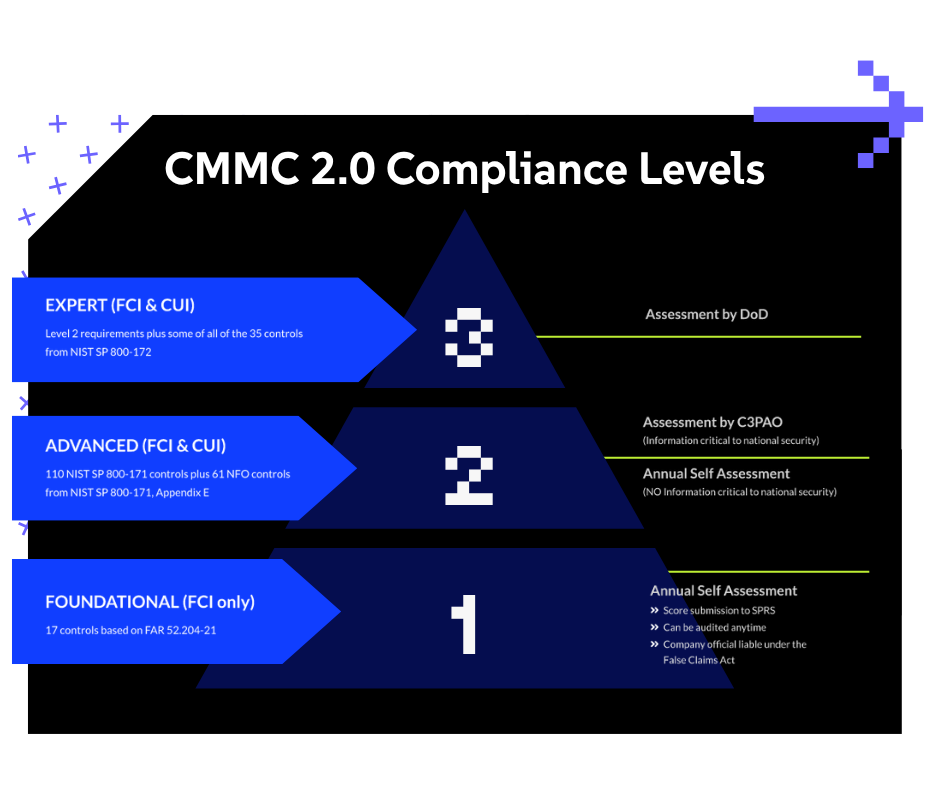
CMMC went live November 10, 2025. The Department of Defense has begun including CMMC requirements in solicitations, with full rollout completing by 2028. Defense contractors handling Federal Contract Information or Controlled Unclassified Information now face third-party assessments that demand specific evidence of incident handling, monitoring, and response — not generic logs.
HIPAA enforcement reached a near-record 21 OCR settlements in 2025. Healthcare breaches average $7.42 million and take 279 days to identify and contain, per IBM's data. A SOC that can't produce forensic-grade breach documentation with chain of custody puts covered entities in a difficult position the moment OCR comes asking.
NYDFS 500, FINRA, SOC 2, and PCI DSS each have specific evidence requirements around incident response, log retention, and reporting timelines. Generic dashboards don't satisfy them.
The structural question for buyers: does your SOC provider have a dedicated compliance practice with framework expertise, or does compliance documentation arrive as a byproduct of detection? CompassMSP holds RPO certification from The Cyber AB and operates a dedicated Compliance & Risk Management practice separate from (but integrated with) its MDR tiers. That structural separation is what makes audit-ready documentation a deliverable rather than an afterthought.
What Questions Should You Ask Before Signing?
Use these to test what's behind the marketing language:
- "Walk me through what your analyst does between alert generation and notification to me."
- "What specific containment actions can your team execute without my approval, and at what severity threshold?"
- "Does my account have analyst continuity, or does the handler rotate every shift?"
- "Do your analysts investigate every alert, or do you filter by severity?"
- "Beyond endpoint, what telemetry sources does your detection logic correlate across?"
- "Does forensic investigation and broader remediation happen in-house, or do you hand it off?"
- "Can you show me a sample incident report formatted for [my specific framework]?"
- "What incident response scope is included in my contract? What triggers additional billing?"
- "If I terminate this contract, what data do I keep? What do I lose?"
- "After containment, what specific persistence mechanisms does your team check for?"
The right provider will answer these directly and specifically. The wrong one will deflect to marketing language or "depends on the situation."
Why CompassMSP Is the Best Fit for Small and Mid-Sized Businesses (Especially in Regulated Industries)
The structural advantage CompassMSP brings to the SOC conversation isn't about being a better detection product; it's about being a different category of partner. As an all-in-one managed IT and cybersecurity provider, Compass eliminates the seams that fragment a security program at most organizations:
- The team that detects the threat is the same team that operates your IT.
- The team that contains the incident is the same team that documents it for your auditor.
- The team that remediates the root cause is the same team that updates your security roadmap with the vCISO advisory practice.
For small and mid-sized businesses across every industry: from professional services and construction to logistics, education, nonprofits, retail, and local government, that integration is what makes serious security operationally affordable. SMBs face the same threat landscape as enterprises (the Verizon 2025 DBIR found 88% of SMB breaches involved ransomware), but rarely have the budget or headcount to staff parallel security and IT functions. Consolidating both under one accountable partner is the only model that actually scales.
That value compounds in regulated industries: healthcare, financial services, legal, manufacturing, and defense contracting (where compliance evidence and operational uptime both carry direct consequences). For these organizations, the integration is the difference between a security program that scales and one that fragments at the worst possible moment.
CompassMSP serves clients nationally with more than 350 professionals, fixed-fee pricing that eliminates surprise charges, and a proven track record of recognition (CRN MSP 500 2026 Pioneer 250, Cloudtango MSP Select 2026, SonicWall 2025 Managed Security Partner of the Year).
Schedule a cybersecurity assessment to see how your current security posture measures up — and what a genuine 24/7 SOC partnership inside an all-in-one IT and cybersecurity practice actually looks like.

Brian Bennet
Brian is a Security Architect at CompassMSP and military combat veteran with 22 years of IT experience spanning the public sector, government contracting, managed services, and executive cybersecurity leadership. He has served as an Information Systems Security Manager for a global aerospace company—where he secured classified and unclassified assets under NISPOM, NIST, and ITAR frameworks and established a classified asset security program from conception through ATO—as well as a vCIO and CISO/vCISO, guiding organizations ranging from 10 to over 1,000 employees through security strategy, framework implementation, audits, and incident response engagements including ransomware events. Brian holds certifications from ISC2, Cisco, Microsoft, VMware, and CompTIA, and draws on his progression from hands-on engineering to the C-suite to drive meaningful security conversations.