
Mar 13, 2026 3:02:13 PM Wesley Reinhart 14 min read

For organizations within the Defense Industrial Base (DIB), the transition from NIST SP 800-171 self-assessment to a formal CMMC Level 2 certification is a watershed moment. It is no longer enough to "claim" compliance; you must now "prove" it to a third party. This shift introduces a critical new vendor into your ecosystem: the C3PAO.
The decision of which C3PAO to hire is often treated as a procurement formality, but for CEOs and IT Directors of defense contractors, it should be viewed as a high-stakes strategic choice. The right partner ensures a rigorous, fair, and efficient validation of your security posture. The wrong one can lead to "assessment drift," ballooning costs, and—most critically—delays that put your federal contracts at risk.
What is a C3PAO? Defining the Role of the Assessor
The Stakes: Why Your Choice of C3PAO Matters
Best Practices for Selecting a C3PAO
Metrics to Compare C3PAO CMMC Consulting Firms
C3PAO Turnaround Time and Scheduling
The CompassMSP Perspective: How to Navigate the Shared Responsibility Matrix
Frequently Asked Questions About Selecting a C3PAO
What is a C3PAO? Defining the Role of the Assessor
Before diving into selection metrics, we must establish a clear baseline: What is a C3PAO? A Certified Third-Party Assessment Organization (C3PAO) is an entity authorized by the Cyber AB (the CMMC Accreditation Body) to conduct CMMC assessments and submit the results to the Department of Defense (DoD).
Think of a C3PAO as the "CPA of Cybersecurity" for the defense world. They do not implement your security controls—in fact, to maintain independence, a C3PAO cannot assess an organization for which they provided significant implementation consulting. Their sole mission is to verify that your organization has met all 110 practices of NIST SP 800-171 as required by CMMC Level 2. They evaluate your "objective evidence," interview your staff, and observe your processes to ensure that your security "is what you say it is."
The Crucial Distinction: C3PAO vs. RPO
In the CMMC ecosystem, you will frequently encounter another acronym: the RPO, or Registered Provider Organization. Understanding the difference between these two is critical for your budget and your compliance timeline.
- The RPO (The Architect/Builder): Registered Provider Organizations are firms that have associated themselves with the Cyber AB to provide specialized CMMC consulting. They are your "pre-assessment" partners. An RPO helps you perform gap analyses, write your System Security Plan (SSP), and implement the technical controls required for compliance. They are the "doers" who get you ready for the exam.
- The C3PAO (The Proctor/Grader): As stated, the C3PAO is the authorized "grader." While some C3PAOs also have RPO arms, strict "Ethical Firewalls" must exist. You cannot have the same individual who built your security environment also be the one who audits it.
The Golden Rule of CMMC Procurement: You hire an RPO like CompassMSP to get compliant; you hire a C3PAO to certify that you are compliant. Using an RPO ensures that by the time the C3PAO arrives, there are no surprises.
The Stakes: Why Your Choice of C3PAO Matters
Choosing the right C3PAO for your CMMC Level 2 assessment is not a small decision. It is the difference between a professional, evidence-driven evaluation and a chaotic experience that drains your team’s morale and your company's budget.
All C3PAOs are authorized by the Cyber AB, but they are not all the same. Some have deep experience with manufacturing environments, enclave scoping, GCC High, and the real-world implementation of NIST SP 800-171. Others are still building that muscle. For CMMC Level 2, you are not just proving compliance. You are demonstrating maturity across 110 practices tied to federal contract eligibility. The wrong assessment partner can create risk you did not need to take.
The Anatomy of a High-Performing C3PAO
A good C3PAO will:
- Clearly define the scope before the assessment starts to avoid "scope creep."
- Set expectations around what constitutes "sufficient" objective evidence.
- Respect your operational environment, especially in complex manufacturing or shop-floor settings.
- Communicate findings without ambiguity, ensuring you understand exactly where a gap exists.
- Stay disciplined to the official CMMC Assessment Guide (CAP).
Red Flags in an Assessment Partner
A weak C3PAO will:
- Blur scoping boundaries, leading to "re-work" mid-assessment.
- Chase evidence mid-interview, indicating a lack of preparation.
- Create unnecessary friction with your internal engineers or MSP.
- Leave you guessing about whether a control is "Met" or "Not Met."
Best Practices for Selecting a C3PAO
When beginning your search, you must look beyond the price tag. CMMC certification is a multi-year commitment, and the C3PAO you select will likely be the one you return to for your triennial recertification.
1. Verify Authorization via the Cyber AB Marketplace
The first step in how to find a C3PAO is visiting the official Cyber AB Marketplace. This is the only "source of truth" for authorized organizations. Do not rely on a vendor's website alone; ensure they are listed as "Authorized" and not just "Candidate."
2. Prioritize Vertical Expertise
If you are a manufacturer, you do not want an assessor who only understands software development environments. Ask potential C3PAOs:
3. Evaluate Their Technical Stack
In modern CMMC assessments, "paper-based" audits are dead. You should look for a C3PAO that is willing to work within a GRC (Governance, Risk, and Compliance) Tool. If your organization or your MSP (like CompassMSP) uses a tool like IntelliGRC to track compliance, your C3PAO should be able to ingest evidence directly from that platform. This drastically reduces the administrative burden on your IT team.
Metrics to Compare C3PAO CMMC Consulting Firms
To make an objective decision, CEOs and CFOs should use a scorecard. When interviewing firms, use these metrics to compare C3PAO CMMC consulting firms:
|
Metric |
Why It Matters |
What to Look For |
|
Assessment Velocity |
Measures how quickly they move from Kickoff to Final Report. |
A clear, documented project plan with milestones. |
|
Scoping Precision |
Prevents the assessment of non-CUI assets. |
A dedicated "Scoping Phase" before the clock starts on the assessment. |
|
Evidence Standards |
Clarifies what is needed for a "Met" status. |
A pre-assessment "Readiness Check" or "Pre-Assessment" option. |
|
MSP Partnership Experience |
Most DIB companies use an MSP. |
Experience working with external vCISOs and Managed Service Providers. |
C3PAO Turnaround Time and Scheduling
One of the most common questions I hear from CEOs is about the C3PAO turnaround time. Once the CMMC rule is fully enacted and the "glide path" begins, the demand for assessments will skyrocket.
Currently, a typical CMMC Level 2 assessment can take anywhere from two weeks to six months, depending on the size of the organization and the complexity of the enclave. However, the "turnaround" is not just the time the assessor is on-site; it includes the time it takes to review the final report and upload the results to the SPRS (Supplier Performance Risk System).
Best C3PAOs for Short Project Timelines
If you have a contract renewal looming, you need a partner built for speed. The best C3PAOs for short project timelines are those that:
- Utilize automated evidence collection tools.
- Have a large bench of Certified CMMC Assessors (CCAs).
- Have a streamlined Internal Quality Assurance (IQA) process for report reviews.
Do you want to stay ahead of the regulations but don't have time to dig through all the information? We read the boring stuff so you don't have to. Subscribe to our regulatory newsletter, The Fine Print.Strategic Tip:
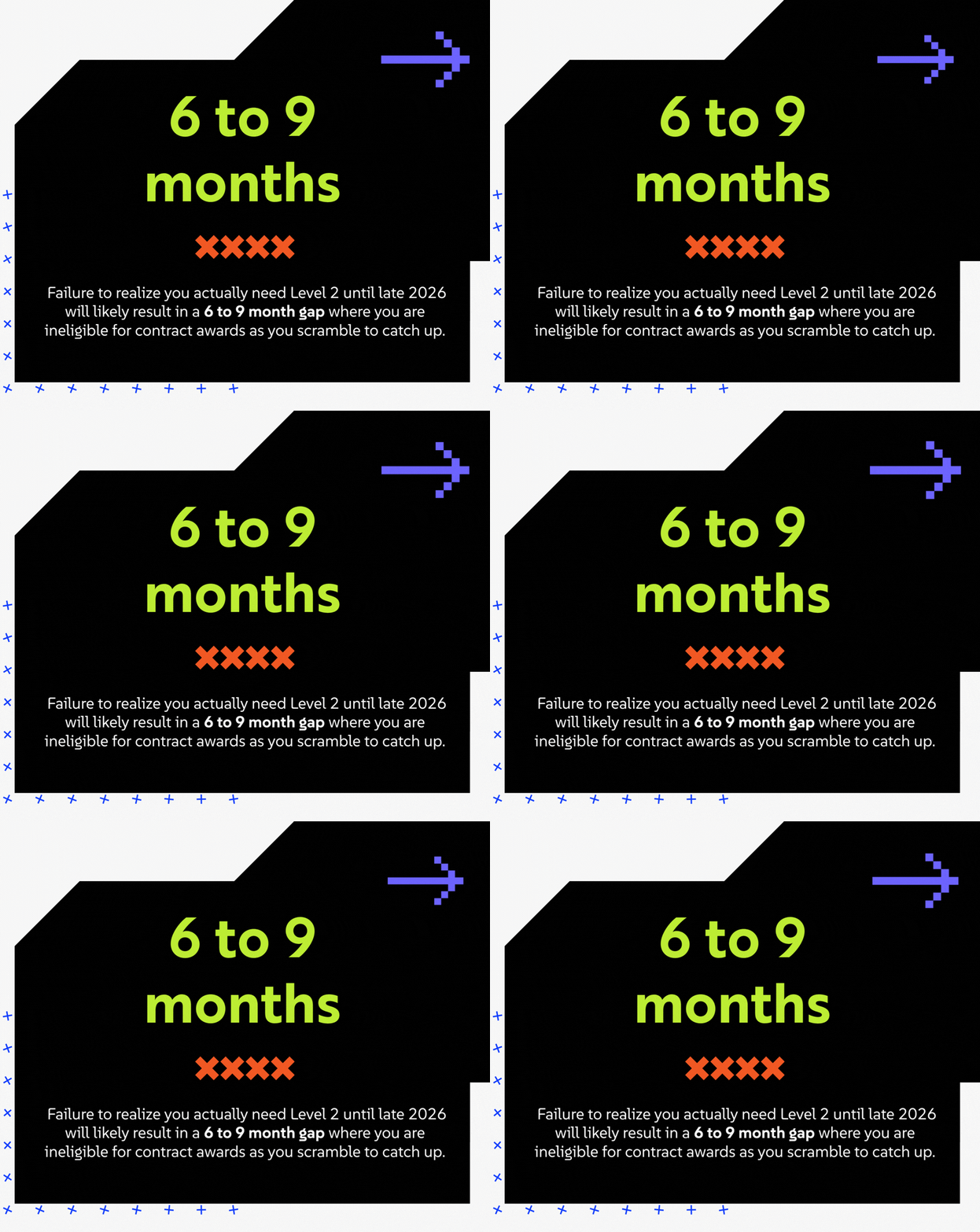
Do not wait until your contract is up for bid. Secure your assessment slot 6-9 months in advance to ensure you aren't caught in the "compliance bottleneck."
The CompassMSP Perspective: How to Navigate the Shared Responsibility Matrix
As a CMMC advisor, I often see DIB companies struggle because they don't know where their responsibility ends and their MSP's begins. This is known as the Shared Responsibility Matrix.
When selecting a C3PAO, ask them: "How do you handle shared responsibility in MSP-supported environments?" A sophisticated C3PAO understands that many controls (like 24/7 SOC monitoring or patching) are "inherited" from your MSP. They should be prepared to review the MSP's SOC 2 Type II reports or internal CMMC documentation as part of your assessment. At CompassMSP, we proactively prepare these "Inheritance Packages" for our clients to ensure the C3PAO has exactly what they need on day one.
Credibility Markers and Authority
According to the Cyber AB's 2024 State of the Ecosystem Report, the number of authorized C3PAOs is growing, but the "readiness gap" among DIB contractors remains significant. Furthermore, NIST's SP 800-171 Rev. 3 update introduces new nuances that your C3PAO must be prepared to interpret accurately.
Due diligence up front protects your contracts later. If you are preparing for a Level 2 assessment, talk to multiple C3PAOs. Ask about their general flow. Ask how they handle GCC High configurations. The list goes on.
Is Your Documentation C3PAO-ready?
Selecting the right assessment partner is the final hurdle, but the preparation starts with a clear understanding of your current gaps.
To ensure you are fully prepared for your Level 2 assessment, start with our CMMC Level 2 Compliance Checklist. If you need executive-level leadership to bridge the gap between your current state and audit-ready status, explore our CMMC Cybersecurity Advisory services. At CompassMSP, we don't just help you find a C3PAO; we ensure you pass their assessment.
Not sure where to begin? Book your no-cost, no-commitment, 30-minute CMMC Strategy session with our RPO CMMC experts. We'll help you outline what you need to do to prepare for your audit and an estimate of how long it will take you.

Wesley Reinhart
Wesley is an experienced cybersecurity executive with a focus on Information Technology / Cybersecurity Lifecycle Management, Compliance, and Governance. Wesley leads our CMMC Program at CompassMSP.