

Published: Updated: Paul Breitenbach 19 min read


If you're running IT at a healthcare practice, financial firm, or manufacturer with DoD contracts, you've probably noticed that piecemeal cybersecurity no longer works. You end up with an MDR tool from one vendor, a vCISO retainer from another, and compliance documentation that nobody owns.
The stakes have never been higher. According to the IMF's April 2024 Global Financial Stability Report, cyberattacks against the financial sector have nearly doubled since before the COVID-19 pandemic, with the financial sector accounting for roughly one-fifth of all reported cyber incidents globally. Healthcare is equally exposed: according to IBM's 2025 Cost of a Data Breach Report, healthcare has been the costliest industry for data breaches for 15 consecutive years, averaging $7.42 million per incident globally in 2025, while U.S. organizations across all industries now face a record average of $10.22 million per breach. Meanwhile, according to KnowBe4's Financial Sector Threats Report, nearly all (97%) of major U.S. banks experienced a third-party breach in 2024, underscoring that no regulated organization is immune regardless of sector.
.gif?width=940&height=788&name=Copy%20of%20Stats%20-%20Blog%20(5).gif)
Before evaluating any provider on this list, it helps to understand what you are actually comparing. The cybersecurity services market includes three distinct categories that are often confused with one another:
Security tools are software products (EDR platforms, SIEM solutions, vulnerability scanners, GRC platforms) that generate data, alerts, or reports. They require someone to operate, tune, and act on them. WatchGuard, SentinelOne, CrowdStrike, and IntelliGRC are examples of security tools.
Managed security contractors are firms that provide services using those tools, typically on a project or retainer basis. A fractional CISO firm, a compliance consultant, or a penetration testing company falls into this category. They advise and document but generally do not own operational response.
Managed service providers (MSPs) and MSSPs are organizations that take on ongoing operational responsibility for your security environment, including monitoring, detection, and (depending on the provider) active response. The critical distinction within this category is whether the provider operates its own integrated platform or assembles its service by stacking third-party tools and wrapping a help desk around them.
That last distinction matters more than most buyers realize.
The tool-stack problem most providers won't tell you about
The gap between a genuine managed security program and a collection of tools is not technological. It is architectural.
Most providers in this space have built their offerings by aggregating tools and wrapping a help desk around them, or placing a middle person using vendor managed service contracts between you and the technology. They call it a managed security offering, but what they really have is a monitoring service with escalation paths. The inevitable result is that the sprawl of disconnected tools and handoff-driven processes drives up mean time to detect and respond, and in security operations, that time is everything.
When an alert fires at 2 AM on a Friday, here is what happens in a tool-stack model: the monitoring tool generates an alert, it routes to a ticket queue, someone reads the ticket and escalates to a senior analyst, the analyst tries to correlate data across three separate platforms that do not share context, then calls your IT team to get permission to act. By the time containment begins, the attacker has moved laterally. This is not a hypothetical. It is the operational reality for most regulated SMBs today.
A closed-loop model works differently. Detection, investigation, containment, documentation, and advisory all operate within the same platform, staffed by the same team, under a single accountable relationship. When a threat is identified, the same analysts who spotted it contain it, generate the forensic record, and notify your vCISO in real time. There are no handoffs, no gaps in the audit trail, and no ambiguity about who is responsible for what. For regulated organizations, this architecture also means that compliance documentation reflects what actually happened during security events, rather than being reconstructed days later for auditors.
CompassMSP's integrated cybersecurity services are built on this model. The rest of this guide explains where each provider fits, what type of offering they actually are, and how to evaluate whether their architecture matches your compliance and risk requirements.
Quick guide: 7 cybersecurity service bundles for regulated SMBs
- CompassMSP: Best overall choice for regulated SMBs needing vCISO advisory, MDR, and compliance documentation under one roof with a true closed-loop model
- Arctic Wolf: A strong option for mid-market organizations wanting a named concierge security team and a proprietary platform
- Blackpoint Cyber: An MSP-channel MDR platform with autonomous SOC response, built for endpoint and identity threats
- Huntress: A channel-focused MDR tool for MSPs serving smaller businesses, strongest in endpoint and Microsoft 365 identity
- Red Canary: A technology-agnostic MDR service for organizations with existing EDR investments; now part of Zscaler
- Integris: A national MSP with tiered cybersecurity packages and CMMC compliance capabilities
- Fractional CISO: A consulting firm providing strategic vCISO leadership without operational monitoring
How we chose the best cybersecurity service bundles for regulated SMBs
A cybersecurity partner is not like software you can swap out. You are trusting someone with your patient records, financial data, and federal contract eligibility. We looked at providers through the lens of what regulated SMBs actually need, not just feature lists.
Bundled services: Does the provider combine vCISO advisory, MDR, and compliance support into a coordinated offering? Or do you need to manage three separate relationships?
Regulatory expertise: Can the provider speak fluently about HIPAA, CMMC, NYDFS, FINRA, and PCI DSS? Do they have customers in your industry?
Response ownership: When a threat is detected, does the provider take action or just send you an alert to figure out yourself?
Audit-ready documentation: Can the provider generate the evidence your auditors and insurers require without you chasing down logs?
Human-led investigation: Do real analysts review threats, or does the service rely primarily on automated playbooks?
Scalable engagement: Can you start with core protection and add vCISO advisory or deeper compliance support as your needs evolve?
The 7 best cybersecurity service bundles for regulated SMBs
1. CompassMSP: Best overall cybersecurity bundle for regulated SMBs
What it is: A fully integrated MSP delivering MDR, vCISO advisory, and compliance documentation through a single closed-loop operating model.
CompassMSP combines 24/7 U.S.-based SOC monitoring with vCISO advisory and compliance documentation into a unified operating model. When a threat is detected, CompassMSP analysts validate it, initiate containment, and coordinate remediation. You are never left interpreting an automated alert on your own.
For IT leaders at healthcare organizations, financial services firms, manufacturers, and law offices, CompassMSP brings the regulatory fluency that matters. The team includes specialists who understand exactly what HIPAA auditors expect, how CMMC assessments work, and what NYDFS 500 mandates require. This depth eliminates the translation overhead that occurs when working with generic security vendors.
CompassMSP structures cybersecurity services into two tiers. Core Defense delivers modern MDR with analyst-validated threat detection across endpoint, identity, and cloud environments. Apex Security adds forensic-grade investigation, human-led threat hunting, and audit-ready incident reporting for organizations where downtime or regulatory scrutiny carries significant consequences.
CompassMSP benefits
- 24/7 SOC monitoring: Analysts investigate threats and communicate directly with your team without language barriers or handoff delays
- vCISO and vCIO strategic guidance: Executive-level leadership helps you prioritize security investments, prepare for board reporting, and align cybersecurity with business objectives.
- Multi-framework compliance support: Documentation and controls mapped to HIPAA, CMMC, FINRA, PCI DSS, SOC 2, NYDFS, and GDPR reduce audit preparation time
- Closed-loop incident response: Detection, investigation, containment, and remediation coordination happen through one accountable partner, not a chain of escalations between disconnected vendors and tools
- Forensic depth for high-stakes environments: Apex Security delivers the kill-chain reconstruction and evidence preservation that insurers and regulators expect after a security event
- Fully-managed or Co-managed flexibility: Your internal IT team can retain ownership of day-to-day operations while CompassMSP handles security monitoring and strategic advisory or Compass can manage all of your IT needs.
CompassMSP pros and cons
Pros:
- Integrated vCISO, MDR, and compliance services eliminate vendor fragmentation
- The closed-loop model means detection, response, advisory, and compliance documentation all operate under one accountable roof, with no handoffs between disconnected tools or teams when an incident occurs
- Deep expertise in healthcare, financial services, manufacturing, and legal verticals
- RPO certification by The Cyber AB for CMMC readiness guidance
Cons:
- Primarily focused on U.S.-based organizations, though global SOC coverage is available
- Best suited for organizations with 500 employees or fewer
2. Arctic Wolf: Concierge security team for mid-market organizations
What it is: A purpose-built security operations platform with a named analyst team, proprietary Aurora Platform, and a technology-agnostic integration model.
Arctic Wolf assigns a named Concierge Security Team to each customer rather than rotating analysts through a ticket queue. This approach gives you consistent contacts who learn your environment over time. The Aurora Platform is Arctic Wolf's proprietary security operations cloud, which ingests and processes telemetry from your existing tools rather than requiring you to replace them.
The $3 million Security Operations Warranty is available when customers deploy Aurora Endpoint Defense alongside a Security Operations Bundle. It provides financial support for covered security incidents, not a blanket guarantee on all engagements. Arctic Wolf is an independent security operations company with its own platform and SOC infrastructure.
Arctic Wolf benefits
- Named concierge team: You work with the same analysts who understand your network topology and business context
- Proprietary Aurora Platform: Arctic Wolf's own security operations cloud processes more than eight trillion security observations per week, integrating telemetry from your existing EDR, SIEM, identity, and cloud tools
- Predictable pricing: Costs are based on users and servers rather than log volume, which makes budgeting more straightforward
Arctic Wolf pros and cons
Pros:
- Named security team creates continuity and reduces onboarding friction
- Works with existing security investments without forcing a rip-and-replace
- Includes security awareness training and vulnerability management in core bundles
- Proprietary platform with significant scale and AI investment
Cons:
- vCISO advisory is not a core included service; strategic guidance is delivered through the Concierge model but differs from a dedicated vCISO engagement
- Compliance documentation depth varies by regulatory framework; organizations with complex HIPAA or CMMC requirements should verify coverage before signing
- The $3M warranty requires the purchase of Aurora Endpoint Defense alongside a Security Operations Bundle; it is not automatic on all plans
- Response authority varies based on customer preferences, which can slow containment in environments that require approval workflows
3. Blackpoint Cyber: Autonomous SOC response through MSP partners
What it is: A proprietary MDR platform sold exclusively through MSP channel partners, with an autonomous SOC that acts without waiting for human approval.
Blackpoint Cyber is available only through MSP partners, so it is best understood as an MDR tool and service that your existing MSP can deploy on your behalf, not a direct relationship with a security operations company. The company was founded by former NSA operators and built the SNAP-Defense platform to detect lateral movement and credential abuse, the attack patterns that typically precede ransomware. In April 2025, Blackpoint launched CompassOne, a unified security posture platform that consolidates signals, workflows, and data across client environments for MSP management.
The SOC acts autonomously without waiting for partner approval, reporting average response times of 16 minutes for on-premises incidents and 7 minutes for cloud incidents.
Blackpoint Cyber benefits
- Autonomous response authority: The SOC isolates compromised endpoints immediately, without waiting for approval workflows that slow containment
- Lateral movement detection: Patented SNAP-Defense technology identifies attackers moving through your network before ransomware deploys
- MSP integration: The CompassOne platform consolidates multi-tenant management, making it efficient for MSPs to oversee multiple client environments
Blackpoint Cyber pros and cons
Pros:
- Rapid, autonomous response times meaningfully reduce attacker dwell time
- Proprietary platform built specifically around adversary tradecraft, not assembled from third-party tools
- Quick deployment through existing MSP relationships
Cons:
- Blackpoint is a tool and service your MSP deploys on your behalf; you do not have a direct relationship with Blackpoint as your security operations partner. If your MSP changes, your security continuity is at risk
- No vCISO advisory, compliance documentation, or regulatory guidance; these require entirely separate engagements from other vendors
- No formal public SLA commitments published
- Not available for organizations without an existing MSP relationship
4. Huntress: Channel-focused MDR for MSPs and smaller businesses
What it is: A managed detection and response tool for MSPs, strongest in endpoint protection and Microsoft 365 and Google Workspace identity threat detection.
Huntress is a cybersecurity platform sold to and through MSPs, not a direct relationship between Huntress and your organization. Your MSP deploys the Huntress agent and manages the relationship. Huntress provides 24/7 SOC coverage behind the platform, reviewing and validating alerts before notifying your MSP. The platform deploys in under 30 minutes and integrates with common RMM tools.
Huntress reports an average response time of 8 minutes for endpoint threats. The identity product, now called Managed ITDR (Identity Threat Detection and Response), covers both Microsoft 365 and Google Workspace for account takeover and business email compromise.
Huntress benefits
- Fast deployment: Lightweight agent installs quickly through existing RMM tools
- Human-reviewed alerts: SOC analysts validate every detection before notifying your MSP, which reduces noise and false positives
- Identity coverage: Managed ITDR monitors Microsoft 365 and Google Workspace for account takeover and inbox compromise
Huntress pros and cons
Pros:
- Quick setup with minimal configuration overhead
- High-signal, low-noise alerting with human validation before escalation
- One-click remediation for common threats
Cons:
- Huntress is a tool your MSP licenses and deploys; your primary relationship is with your MSP, not with Huntress. The quality of response depends heavily on your MSP's own capabilities
- Network and cloud coverage beyond Microsoft 365 and Google Workspace require add-on products
- No formal SLA commitments or breach warranty
- No vCISO advisory, compliance documentation, or regulated-industry expertise
5. Red Canary: Technology-agnostic MDR for organizations with existing EDR investments
What it is: A managed detection and response service, acquired by Zscaler in May 2025 for $675 million, that integrates with existing EDR and security tools rather than requiring proprietary agents.
Red Canary integrates with the EDR, identity, and cloud tools you already own, connecting to CrowdStrike, SentinelOne, Microsoft Defender, Carbon Black, Palo Alto Networks, and others. Zscaler completed the acquisition in May 2025 for $675 million and operates Red Canary as a separate business unit.
The company reports a 99%+ true positive rate, meaning analysts focus on confirmed threats rather than chasing false positives. The platform offers both guided and automated response playbooks.
Red Canary benefits
- Multi-platform integration: Connects your existing EDR, identity provider, and cloud environments into one detection pipeline without requiring new agents
- High-accuracy detections: A 99%+ true positive rate reduces alert fatigue and focuses analyst attention on real threats
- Automated response playbooks: Containment actions execute in seconds when threats are confirmed
Red Canary pros and cons
Pros:
- Extracts more value from your existing security stack
- Recognized as a Forrester Wave Leader in MDR (Q1 2025) with the highest scores in detection engineering and analyst experience
- Tiered plans from core MDR to enterprise SOC augmentation
Cons:
- Acquired by Zscaler in May 2025; long-term product direction, pricing, and service model are subject to change as the integration progresses
- No vCISO advisory or compliance documentation services in the core offering
- Active remediation and incident response beyond guided response require add-on services
- Best suited for organizations that already have a mature security stack; less appropriate for regulated SMBs starting from scratch
6. Integris: National MSP with tiered cybersecurity packages
What it is: A national managed service provider with tiered cybersecurity packages, a 24/7 U.S.-based SOC, and CMMC Level 2 C3PAO certification, built partly through acquisition rather than native platform development.
Integris is a national MSP that has grown significantly through acquisition, including the 2025 purchase of TechMD, which brought with it an MDR capability and a GRC compliance platform built in partnership with the third-party vendor IntelliGRC. Integris uses WatchGuard as a core technology partner for endpoint security and network protection. Their cybersecurity offering is structured in three tiers: Essential (baseline monitoring and EDR), Advanced (CIS-aligned defense-in-depth), and a GRC tier that adds compliance support for frameworks including CMMC, NIST, SOC 2, and ISO 27001.
Integris earned CMMC Level 2 C3PAO certification in 2025, which is a meaningful credential for defense contractors evaluating MSP partners.
Integris benefits
- Industry verticals: Dedicated practices for community banks, legal firms, and regulated industries
- Fractional CIO included: Strategic IT planning included with managed services engagements
- CMMC Level 2 C3PAO certified: One of a limited number of MSPs to hold this credential, relevant for defense industrial base organizations
Integris pros and cons
Pros:
- Industry-specific expertise for banking, legal, and manufacturing verticals
- CISSP-certified vCISO team members
- Assessment-led approach that maps technology to business goals
- CMMC Level 2 C3PAO certification provides firsthand audit experience
Cons:
- No closed-loop model: Integris's cybersecurity offering is structured as separate, tiered packages rather than a unified platform where detection, response, compliance, and advisory share context in real time. During an incident, coordination across these tiers depends on internal handoffs rather than an integrated architecture
- The MDR capability relies on third-party tools assembled into a managed offering, not a natively integrated platform. Clients inherit the limitations and roadmap dependencies of those vendors
- GRC and compliance documentation are only included in the top-tier GRC package; organizations on Essential or Advanced plans must purchase compliance support as a separate engagement
- vCISO advisory and SOC monitoring are not integrated by default; your strategic advisor and your detection team operate from different systems without shared real-time context
7. Fractional CISO: Consulting-first strategic guidance
What it is: A pure consulting firm providing executive-level vCISO leadership, with no operational security monitoring, no MDR, and no 24/7 SOC.
Fractional CISO (fractionalciso.com) is a consulting company that provides experienced security executives on a retainer or project basis. The service is focused on security program development, compliance strategy, risk management, and board reporting. Every engagement pairs a virtual CISO with a cybersecurity analyst. This model works for organizations that have operational security covered elsewhere but need executive guidance to frame strategy, navigate compliance audits, or prepare for board-level scrutiny.
The firm reports that its clients have not failed a compliance audit, and it serves organizations across SOC 2, HIPAA, ISO 27001, GDPR, CMMC, and other frameworks.
Fractional CISO benefits
- Executive experience: Work with professionals who have held CISO roles at comparable organizations, not junior consultants following templates
- Flexible engagement: Scale hours up or down based on project needs without a long-term operational commitment
- Strategic focus: Emphasizes program development, compliance strategy, and board communication over day-to-day operations
Fractional CISO pros and cons
Pros:
- Direct access to experienced security leadership at a fraction of the cost of a full-time CISO hire
- Compliance audit support across major frameworks
- Flexible retainer or project-based pricing
Cons:
- No MDR, no 24/7 monitoring, and no SOC; Fractional CISO is a consulting firm, not a security operations provider. You need a completely separate vendor for operational detection and response
- Compliance documentation support is strategic and advisory; implementation typically requires additional resources or a separate managed services engagement
- If an incident occurs, your fractional CISO can advise, but they are not positioned to contain threats, preserve forensic evidence, or coordinate response in real time
- The consulting model creates coordination risk; your vCISO may have no visibility into your SOC's findings until you tell them
Comparison table: The best cybersecurity service bundles for regulated SMBs
| Provider | Type | 24/7 U.S.-Based SOC | vCISO Included | CMMC Support | Closed-Loop Model |
|---|---|---|---|---|---|
| CompassMSP | Integrated MSP | ✓ | ✓ | ✓ | ✓ |
| Arctic Wolf | Security Operations Platform | ✓ | ✗ | ✓ | Partial |
| Blackpoint Cyber | MDR Tool (MSP-deployed) | ✓ | ✗ | ✗ | ✗ |
| Huntress | MDR Tool (MSP-deployed) | ✓ | ✗ | ✗ | ✗ |
| Red Canary | MDR Service | ✓ | ✗ | ✗ | ✗ |
| Integris | National MSP (tiered) | ✓ | ✓ | ✓ | ✗ |
| Fractional CISO | Consulting Firm | ✗ | ✓ | ✓ | ✗ |
Why regulated industries are prime targets and why your security model needs to match
The threat environment for regulated SMBs is unambiguous. According to KnowBe4's Financial Sector Threats Report, financial firms are targeted by cyberattacks roughly 300 times more often than other industries, and targeted intrusions against financial institutions increased by 109% year-over-year. The IMF's April 2024 Global Financial Stability Report corroborates the trend at a macroeconomic level, finding that cyberattacks against the financial sector have nearly doubled since before the COVID-19 pandemic and that the financial sector accounts for roughly one-fifth of all reported cyber incidents globally. According to IBM's 2025 Cost of a Data Breach Report, the average financial services data breach cost $5.56 million in 2025, well above the global average of $4.44 million.
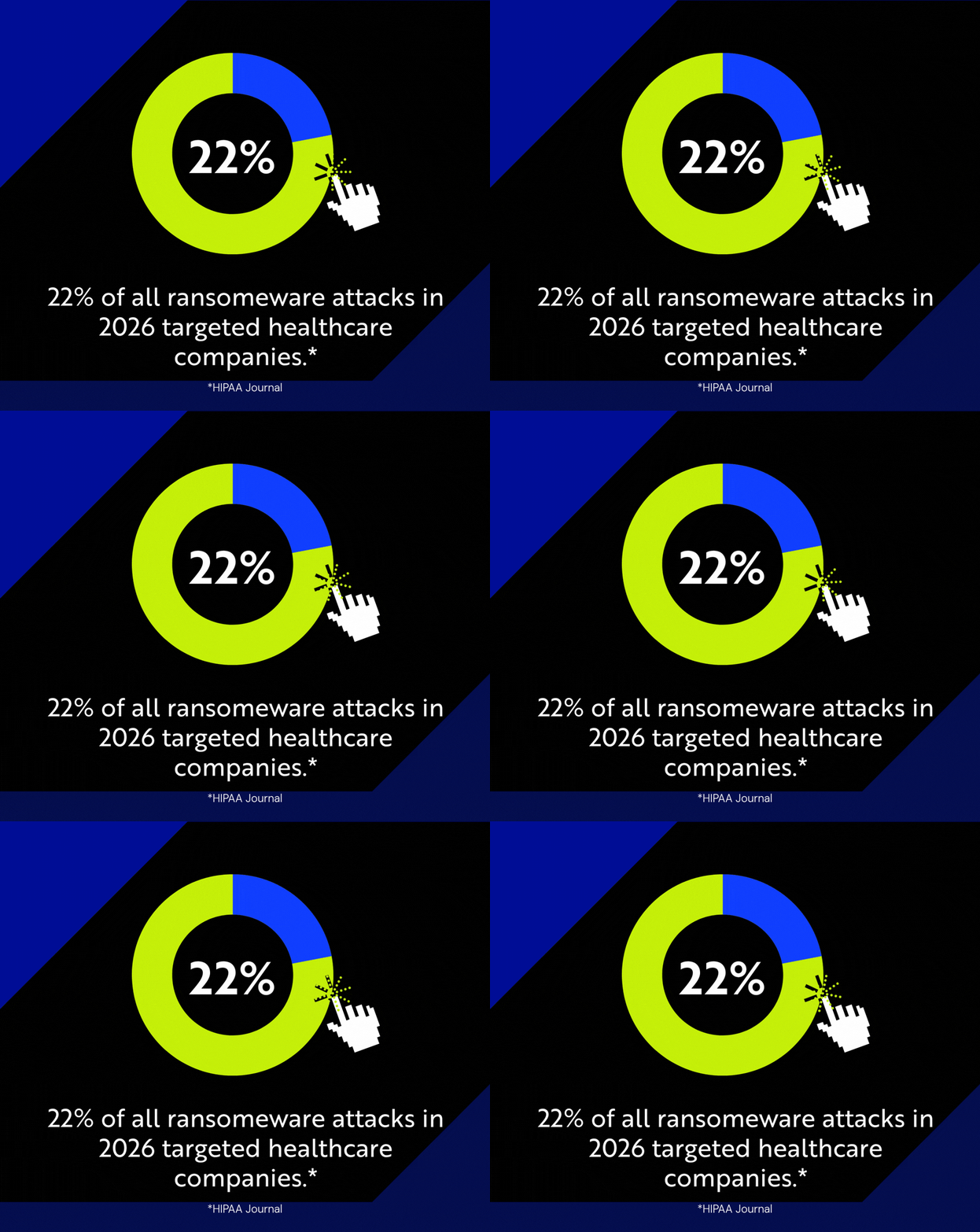
Healthcare is equally exposed. IBM's 2025 Cost of a Data Breach Report found healthcare averaged $7.42 million per breach globally, the costliest of any industry for 15 consecutive years, while U.S. organizations across all sectors reached a record $10.22 million average. The 2024 Change Healthcare incident exposed the protected health information of approximately 190 million people and cost UnitedHealth Group an estimated $3.09 billion, making it the largest healthcare data breach in history. In 2024 alone, approximately 275 million healthcare records were breached in the United States, representing 82% of the U.S. population.
For manufacturers in the Defense Industrial Base, CMMC 2.0 enforcement means that failing an assessment does not just create legal exposure. It can disqualify an organization from DoD contracts entirely.
These are not abstract risks. They are the operational reality that IT leaders in regulated industries face every day, which is why tool-stack security programs and consulting-only engagements are not sufficient. You need a partner who understands what auditors actually require, what regulators will scrutinize, and how to move quickly when something goes wrong.
See how CompassMSP serves financial services organizations specifically, including FINRA and NYDFS compliance support.
What should you look for when evaluating a cybersecurity service bundle?
A good cybersecurity service bundle should reduce complexity, not add to it. Before signing with any provider, ask these questions to verify you are getting genuine integration rather than repackaged point solutions.
First, find out who owns incident response. When a threat is detected at 2 AM on a Saturday, what happens next? The answer should be that trained analysts take immediate action, not that you receive an email asking what you want to do. Ask explicitly: does the SOC have the authority to contain threats without waiting for your approval?
Second, verify compliance depth. Generic "compliance support" often means a checklist PDF or a separately purchased GRC tool. For regulated industries, you need a provider who can produce the specific evidence auditors request, map controls to your framework requirements, and explain findings in terms regulators understand.
Third, understand the integration architecture. Ask whether your vCISO, your SOC, and your compliance documentation operate from the same platform and share real-time context, or whether they are separate tools and relationships that you are responsible for coordinating.
- Ask for sample incident reports to evaluate documentation quality and audit-readiness
- Request references from organizations in your industry with similar compliance requirements
- Clarify whether the provider's MDR capability is built on its own platform or assembled from third-party vendor tools
- Understand escalation paths for complex incidents and ask how strategic advisory integrates with real-time SOC findings
For a deeper framework on evaluating security providers, see how to evaluate an MSSP for compliance in 2026.
Why CompassMSP is the best cybersecurity bundle for regulated SMBs
The challenge for IT leaders at regulated SMBs is not finding security tools. It is finding a partner who understands that HIPAA auditors do not care about your detection rate; they care about your documentation. That CMMC assessors want evidence of control implementation, not marketing slides about platform capabilities. That FINRA examiners need specific audit trails, not just a report confirming your firewall is running.
CompassMSP brings this regulatory fluency because the team has spent years working with healthcare organizations, financial services firms, defense contractors, and law offices. Every service is built around what these industries actually need: audit-ready documentation, rapid incident containment, and strategic guidance that connects security investments to business outcomes.
The closed-loop model means you are not managing three vendors and hoping they communicate. When CompassMSP detects a threat, the same organization investigates it, contains it, documents it, and advises you on preventing recurrence. This integration delivers faster response times, cleaner audit trails, and less operational overhead for your team.
Ready to see how bundled cybersecurity services work in practice? Talk to a CompassMSP cybersecurity expert about your specific compliance requirements and threat landscape.
For organizations weighing their managed IT options more broadly, these resources provide a useful foundation:

Paul Breitenbach
With nearly 20 years of experience designing enterprise-grade IT solutions, Paul specializes in supporting organizations that cannot afford downtime. Before becoming our CIO, he served as CIO of WorldwideIT, a Compass company, where he led large-scale infrastructure, cloud, and security initiatives for highly regulated industries.