

Published: Updated: Richard Mendoza 13 min read


If your organization holds a license, registration, charter, or authorization from the New York Department of Financial Services, you are covered by one of the most prescriptive and aggressively enforced cybersecurity regulations in the United States. As of November 1, 2025, the final phase of NYDFS Part 500's Second Amendment is fully in effect. The multi-year phase-in is over. There are no more deadlines on the horizon to delay behind. Either your organization is compliant right now, or it is not.
This article breaks down what changed, what the regulation now requires in full, what NYDFS has already proven it is willing to do when covered entities fall short, and what every small and mid-sized financial firm and insurance entity needs to do before the April 15, 2026 annual certification deadline.
In This Article
- Stay Ahead of What's Coming
-
What NYDFS Has Already Proven It Will Do - Real Examples of Fines and Violations
-
Frequently Asked Questions: NYDFS Part 500 Compliance for Small and Mid-Sized Financial Firms
If you are also managing AI governance obligations alongside your Part 500 program, our team has covered FINRA's parallel requirements in detail: FINRA 2026 GenAI Governance: A Survival Guide for Small Financial Firm CEOs. The two regulatory frameworks are converging rapidly, and small firms need a coordinated response to both.
What Is NYDFS Part 500 and Who Does It Apply To?
NYDFS Part 500 was first enacted on March 1, 2017, establishing cybersecurity requirements for financial services companies: a first-in-the-nation regulatory framework designed to protect consumers and the stability of New York's financial system against cyber threats. It has been amended and strengthened twice since, most significantly through the 2023 Second Amendment, which represented the most substantial revision since the regulation launched. (Akin Gump)
Part 500 applies to any covered entity operating under a license, registration, charter, or authorization from NYDFS. This includes banks, trust companies, credit unions, insurance companies, agents and brokers, mortgage lenders and servicers, money transmitters, virtual currency businesses, and investment advisers.
This scope matters enormously for small and mid-sized firms. Many small broker-dealers, independent insurance agencies, mortgage companies, and registered investment advisers operate under the assumption that Part 500 is primarily a large-institution regulation. It is not. The regulation applies based on your NYDFS authorization, not the size of your balance sheet or employee count. A five-person registered investment adviser is as covered as a 500-person regional bank and subject to the same rigorous controls.
The regulation applies based on your NYDFS authorization, not the size of your balance sheet or employee count.
There is a limited small business exemption, but it is narrower than most small entities assume. The small business exception only reduces certain MFA obligations. Entities qualifying for it are still required to use MFA for remote access to information systems, remote access to third-party applications, and all privileged accounts other than service accounts. It does not eliminate the requirement for a written cybersecurity program, risk assessments, a designated CISO, incident response planning, third-party vendor oversight, or annual certification filing. For most small firms, the practical compliance burden under the exemption remains substantial.
The NYDFS Second Amendment: What Actually Changed
The Second Amendment, adopted November 2023 and fully phased in by November 1, 2025, was not a routine update. It expanded both scope and depth, introduced personal executive liability through dual-signature certification requirements, set breach notification deadlines of 72 hours for cybersecurity incidents and 24 hours for ransomware payments, and required new technical controls including asset inventories, vulnerability scans, and privileged access management. (BARR Advisory)
The changes most likely to create immediate compliance gaps at smaller organizations fall into five areas.
Multi-Factor Authentication
The prior version of Part 500 only mandated MFA for access to internal networks from outside the network. The amended rule significantly broadens this. Covered entities must now implement MFA for all individuals remotely accessing any information system from which data is accessed or provided, including cloud applications such as Microsoft 365, Google Workspace, and other SaaS platforms. (Businessinformationgroup)
NYDFS has explicitly stated that MFA deficiencies are the most commonly exploited gap in cybersecurity breaches among covered entities. They have also published prescriptive FAQs, released just after the November 1 deadline, that detail exactly which authentication methods satisfy the requirement and which do not. Push-based and SMS authentication methods are explicitly flagged as vulnerable to modern attacks. NYDFS strongly recommends phishing-resistant alternatives including FIDO2, WebAuthn, and hardware security keys. If your organization is currently relying on SMS codes or push notifications as its MFA standard, you have a documented compliance gap.
Written Asset Inventory
Covered entities must now maintain written procedures for creating and maintaining a comprehensive information system asset inventory. For small firms managing their IT informally, this is often the most disruptive requirement to build from scratch. An asset inventory is not an IT asset spreadsheet. Under Part 500, it is a documented, maintained program that accounts for hardware, software, data flows, and access points. It must be current and defensible under examination. In January 2024, NYDFS cited Genesis Global Trading, Inc. for failing to address asset inventory and device management as part of its cybersecurity program, one of several Part 500 violations that resulted in an $8 million penalty and the surrender of its operating license. Asset inventory compliance is now an active NYDFS examination priority.
Ransomware Notification — 24 Hours
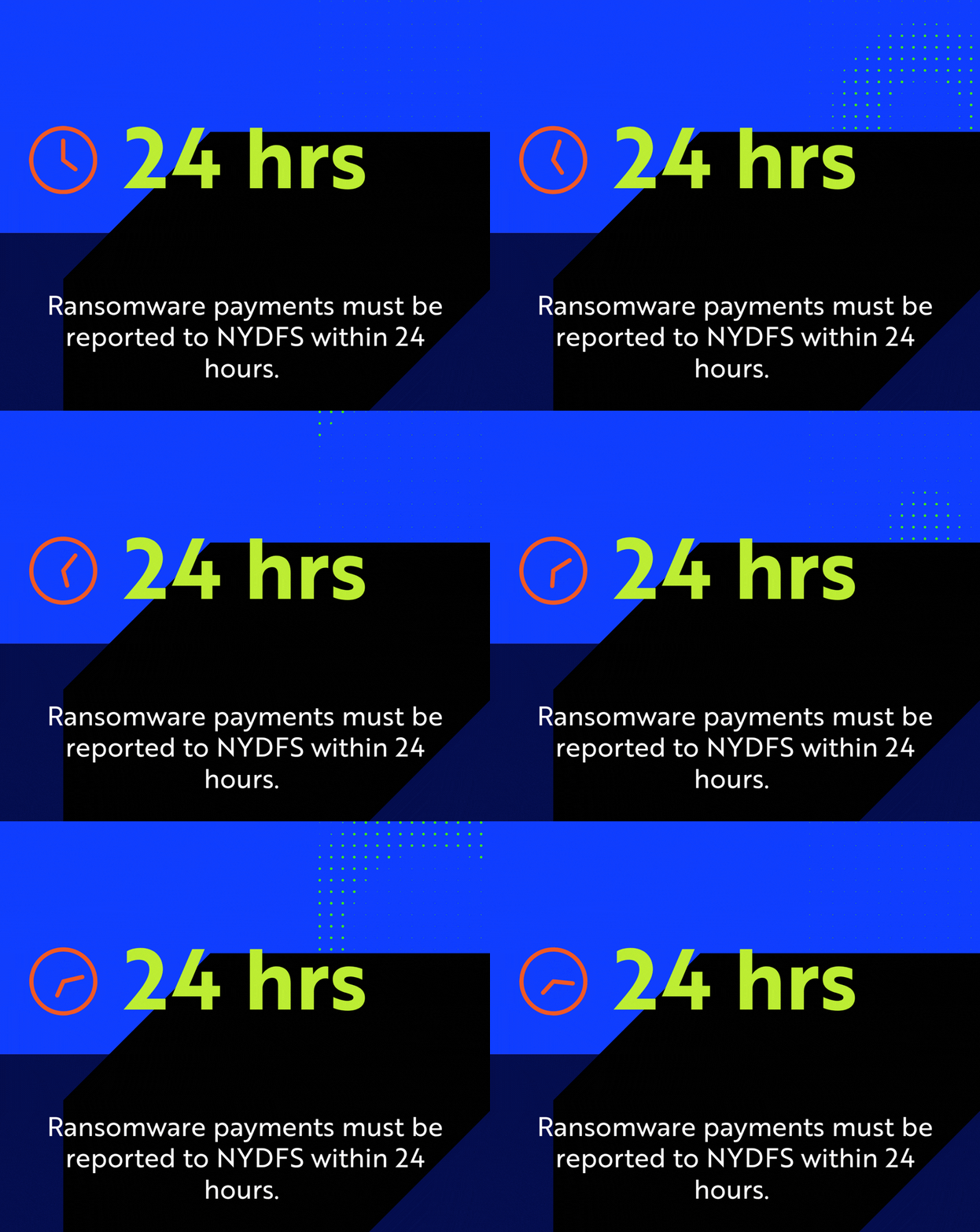
Ransomware payments must be reported to NYDFS within 24 hours. This is one of the most operationally demanding requirements in the regulation. In a ransomware incident, the first 24 hours are typically consumed by incident response: containing the spread, assessing the scope, engaging forensic support, and communicating internally. The notification obligation does not pause for any of that. Organizations that have not pre-built their NYDFS notification workflow into their incident response plan will almost certainly miss this window under pressure. (BARR Advisory)
Third-Party Risk Management
NYDFS issued new, highly prescriptive third-party risk management guidance just days before the November 1 deadline. Under the amended regulation, covered entities are responsible for ensuring that their service providers and vendors who access nonpublic information also maintain appropriate cybersecurity controls. This means reviewing vendor contracts, conducting due diligence on third-party security posture, and maintaining documented oversight. For small firms relying heavily on cloud platforms, accounting software, payroll processors, and other SaaS vendors, this requires a structured vendor inventory and review process most have never built or created an approach to manage the vendor life-cycle. (NAIC)
Personal Executive Liability
The annual compliance certification now requires dual signatures from both the CEO and the CISO, with both executives attesting compliance using verifiable data retained for five years, creating direct personal regulatory liability for both signatories. This is the change that should most concentrate the attention of small firm leadership. If your organization files a Certification of Material Compliance and NYDFS subsequently identifies deficiencies during an examination or following a breach, the individuals who signed that document are personally accountable for its accuracy.
Filing an optimistic certification is not a safe middle ground. It is a liability. Making false statements to NYDFS through a certification of compliance is itself independently actionable, in addition to any substantive violations of Part 500 that the certification conceals. NYDFS has demonstrated its willingness to pursue enforcement action when certifications prove inaccurate, and enforcement findings frequently include the conclusion that the certifying officer failed to exercise appropriate oversight or relied on incomplete information when signing. (ReliaQuestPCI Security Standards Council)
What NYDFS Has Already Proven It Will Do
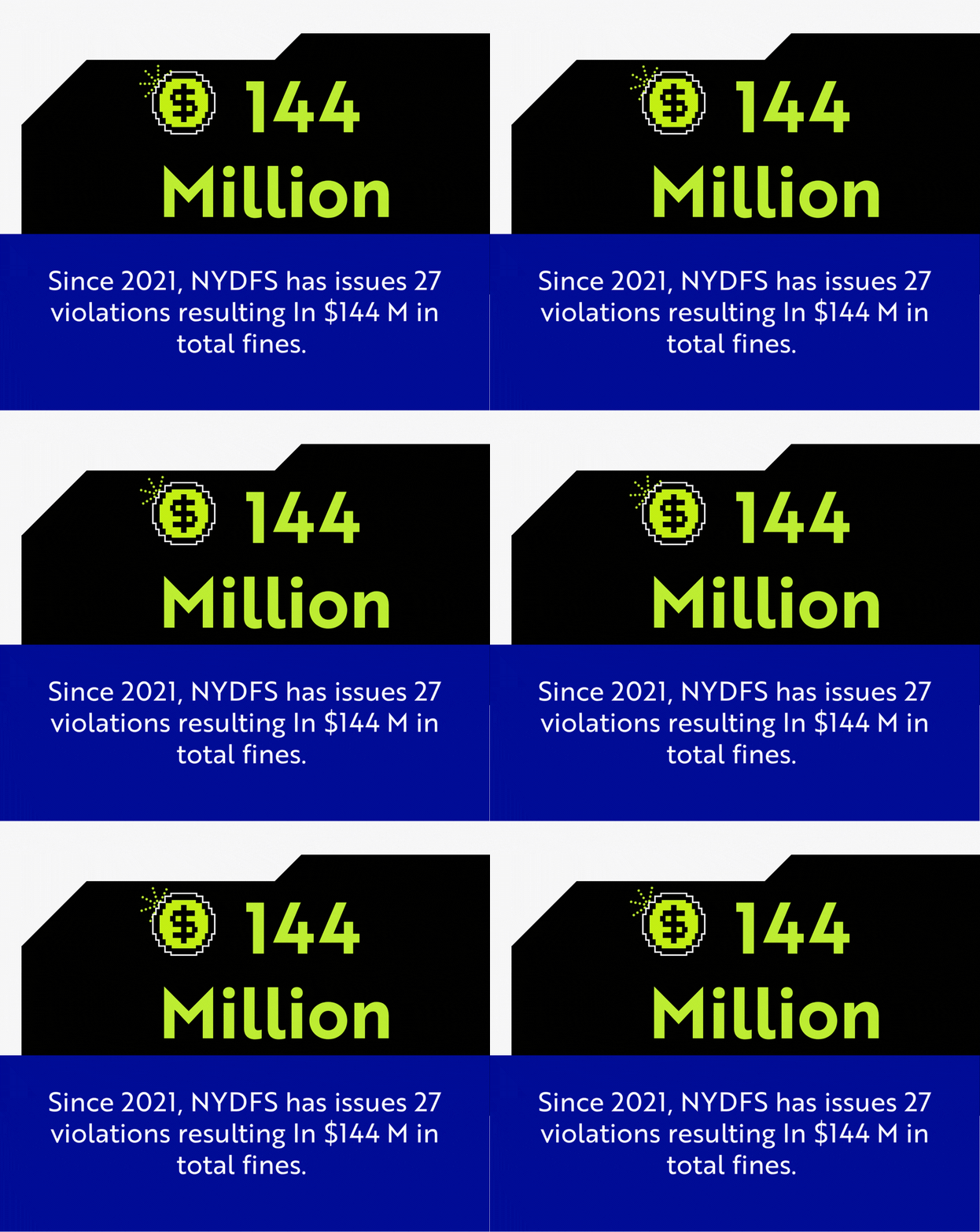
Understanding the enforcement record is essential context for any organization still treating Part 500 compliance as a low-priority item. NYDFS is not a regulator that issues warnings and waits for self-correction. Since 2021, NYDFS has entered into consent orders with 27 entities for violations of the cybersecurity regulation, resulting in over $144 million in total fines. Two cases from the past year make the enforcement posture concrete. (Cytranet)
CASE IN POINT
|
Healthplex, Inc. Penalty: $2,000,000 | NYDFS | August 2025 What happened: Healthplex is a licensed insurance agent and independent adjuster — not a large bank, not a major financial institution. A single phishing email gave an attacker access to one employee's inbox and exposed the nonpublic information of tens of thousands of consumers. NYDFS found that Healthplex violated Part 500 by failing to implement MFA on its email system, lacking a data retention policy that would have limited the scope of the exposure, and failing to notify NYDFS within the required 72-hour window. The notification arrived four months after the breach was discovered. (Source: Pillsbury Law, August 2025) What it means for your firm: This was not a sophisticated attack defeating a well-prepared organization. One employee clicked a phishing link. The $2 million penalty came from three missing controls, not the breach itself. If your firm holds any NYDFS license, this case describes your regulatory environment. Size is not a defense. License type is not a defense. The absence of basic documented controls is the violation. |
|
Gemini Trust Company, LLC Penalty: $37,000,000 | NYDFS | February 2024 What happened: Gemini's Earn Program allowed customers to loan their virtual currency to Genesis Global Capital, an unregulated third party not licensed by NYDFS. Genesis defaulted on approximately $1 billion worth of loans, leaving hundreds of thousands of customers unable to access their assets. NYDFS found that Gemini had failed to conduct sufficient and ongoing due diligence on Genesis before routing customer funds through it, and had made misleading representations to customers about the program's safety. The result was a $37 million penalty and a commitment to return over $1.1 billion to harmed customers. Alston & Bird What it means for your firm: NYDFS holds covered entities directly accountable for the third parties they rely on — whether those third parties are technology vendors, lending partners, or service providers. If a relationship with an unvetted or inadequately monitored third party causes harm to your customers or creates risk to your organization's safety and soundness, NYDFS will hold you responsible for that failure. The question regulators ask is not whether the third party caused the problem. It is whether you did sufficient due diligence before the relationship began and maintained adequate oversight throughout it. (Source: NYDFS Press Release, February 28, 2024)
|
Taken together, these two cases span the full range of covered entities: a small licensed adjuster and one of the largest fintech platforms in the country. The enforcement pattern is consistent regardless of organization size or type. Penalties can start at $2,500 per day for each instance of noncompliance. Under New York Banking Law, civil penalties for willful violations scale to $75,000 per day, and recent enforcement actions have reached individual fines exceeding $30 million. These numbers do not scale down because your organization is smaller. They accumulate based on the duration and nature of the violation.
Your April 15, 2026 Certification: What Needs to Be True
The requirements that took effect November 1, 2025 are subject to the annual certification requirement due April 15, 2026, which covers calendar year 2025. That means your upcoming certification must reflect compliance with the complete scope of the Second Amendment.
Before that filing, every covered entity should be able to answer these questions with documented evidence, not estimates:
Is MFA implemented for all remote access to every information system your organization uses, including every cloud application? Is your information system asset inventory written, current, and maintained under a documented program? Have you reviewed and tightened your third-party vendor agreements to reflect the new risk management requirements? Is your incident response plan updated to include the 24-hour ransomware payment notification and 72-hour cybersecurity incident notification workflows? Can both your CEO and CISO attest to the accuracy of your certification with verifiable, retained documentation?
If any of those questions produced hesitation, treat that hesitation as a compliance gap that needs to be closed before April 15.
How CompassMSP Supports NYDFS Part 500 Compliance
For small and mid-sized financial firms and insurance entities, building and maintaining a Part 500-compliant cybersecurity program is a significant operational undertaking. Most organizations in this category do not have a full-time CISO, a dedicated compliance team, or the internal capacity to manage the documentation, controls, and ongoing evidence collection the regulation requires.
CompassMSP's financial services compliance practice is built specifically for covered entities navigating NYDFS Part 500, FINRA, SEC Regulation S-P, and related obligations. Our vCISO and compliance team can serve as your organization's dedicated cybersecurity leadership, building the written programs, risk assessments, asset inventories, incident response plans, and vendor management frameworks that satisfy Part 500's requirements and the evidence packages that make your annual certification defensible under examination.
We work with broker-dealers, registered investment advisers, insurance agencies, mortgage companies, and other NYDFS-licensed entities to build compliance programs that are sustainable, documented, and built to survive an audit rather than simply check a box.
The TL;DR
NYDFS Part 500 has evolved from a risk-based guideline into one of the most prescriptive and aggressively enforced cybersecurity mandates in the United States. The Second Amendment is fully in effect. The personal liability provisions are live. The April 15 certification deadline is approaching.
The organizations that have faced the largest penalties were not reckless. Most were simply behind, lacking controls they had not prioritized, missing documentation they had not built, and discovering the gap at the worst possible moment. The difference between them and the organizations that stayed compliant was not sophistication. It was timing.
Stay Ahead of What's Coming
NYDFS Part 500 is one of dozens of regulations actively affecting small and mid-sized businesses across finance, healthcare, insurance, manufacturing, and more. Keeping up with all of them is a full-time job — which is why we built The Fine Print.
Every quarter, CompassMSP's vCISO and compliance team tracks the regulatory updates, enforcement actions, and deadlines that matter most to your industry and delivers them in a format you can actually use. No jargon. No filler. Just what you need to know.
Subscribe free at thefineprint.compassmsp.com
If something in this article raised a concern about your organization's compliance posture, our team is available to help you understand where you stand and what to do about it.
Explore our Compliance and Risk Management services

Richard Mendoza
Richard is the Director of vCISO services with CompassMSP. He has over twenty-five years of experience as an Information Security professional with hands-on experience in engineering process and information security, and IT audit disciplines. With a wide-ranging knowledge as a Systems Engineer, Information Security Officer, and Senior Auditor, Richard has expertise in managing internal and external audits focused on reducing overall risk exposure and infrastructure redundancy for organizations.