

Published: Updated: Richard Mendoza 9 min read


This article was originally published by vCISO, Richard Mendoza on LinkedIn.
There's a quiet conversation happening across the legal industry in 2026, and it isn't happening in the conference rooms of the AmLaw 100. It's happening in the offices of solo practitioners, three-attorney boutiques, and forty-lawyer regional firms, the ones who can no longer pretend the new cybersecurity rules apply only to the big shops downtown.
For more than a decade, smaller and mid-sized firms operated on a comforting assumption: that "reasonable security" was a sliding scale, and that their size put them safely on the lighter end of it. That assumption is now collapsing under the weight of a coordinated push from state bars, federal regulators, cyber insurers, and corporate clients. The standards being set are national. The expectations are uniform. The burden, however, is anything but evenly distributed.
As a vCISO who works closely with legal practices of every size, I am watching firms with three full-time staff being asked to meet the same documentation requirements as firms with three hundred. That's the part of the story that doesn't make headlines, and it deserves to.
The ABA's Quiet Revolution Has Been Adopted by 42 States
Federal Regulators Are Already Inside the Tent
The 50-State Notification Patchwork Is a Trap for the Unprepared
When Insurers and Clients Become the Real Regulators
The Disproportionate Burden on Smaller Practices
Closing the Gap Without Closing the Practice
The ABA's Quiet Revolution Has Been Adopted by 42 States
The foundation of every modern legal cybersecurity mandate traces back to a single sentence the American Bar Association added to Model Rule 1.1 Comment 8 in 2012: that competent representation includes "keeping abreast of changes in the law and its practice, including the benefits and risks associated with relevant technology."
For years, that language was treated as aspirational. In 2026, 42 states have adopted Comment 8 or an equivalent provision, transforming technology competence into an enforceable ethical standard in nearly every American jurisdiction. Combine that with ABA Model Rule 1.6's confidentiality obligations and ABA Formal Opinions 477R (secure client communications), 483 (data breach response), and 498 (virtual practice), and you have a national ethical framework with real teeth.
What makes this difficult for smaller firms is not the standard itself. It's the documentation required to prove compliance.
Federal Regulators Are Already Inside the Tent
Many small firms don't realize how much federal regulation already reaches them.
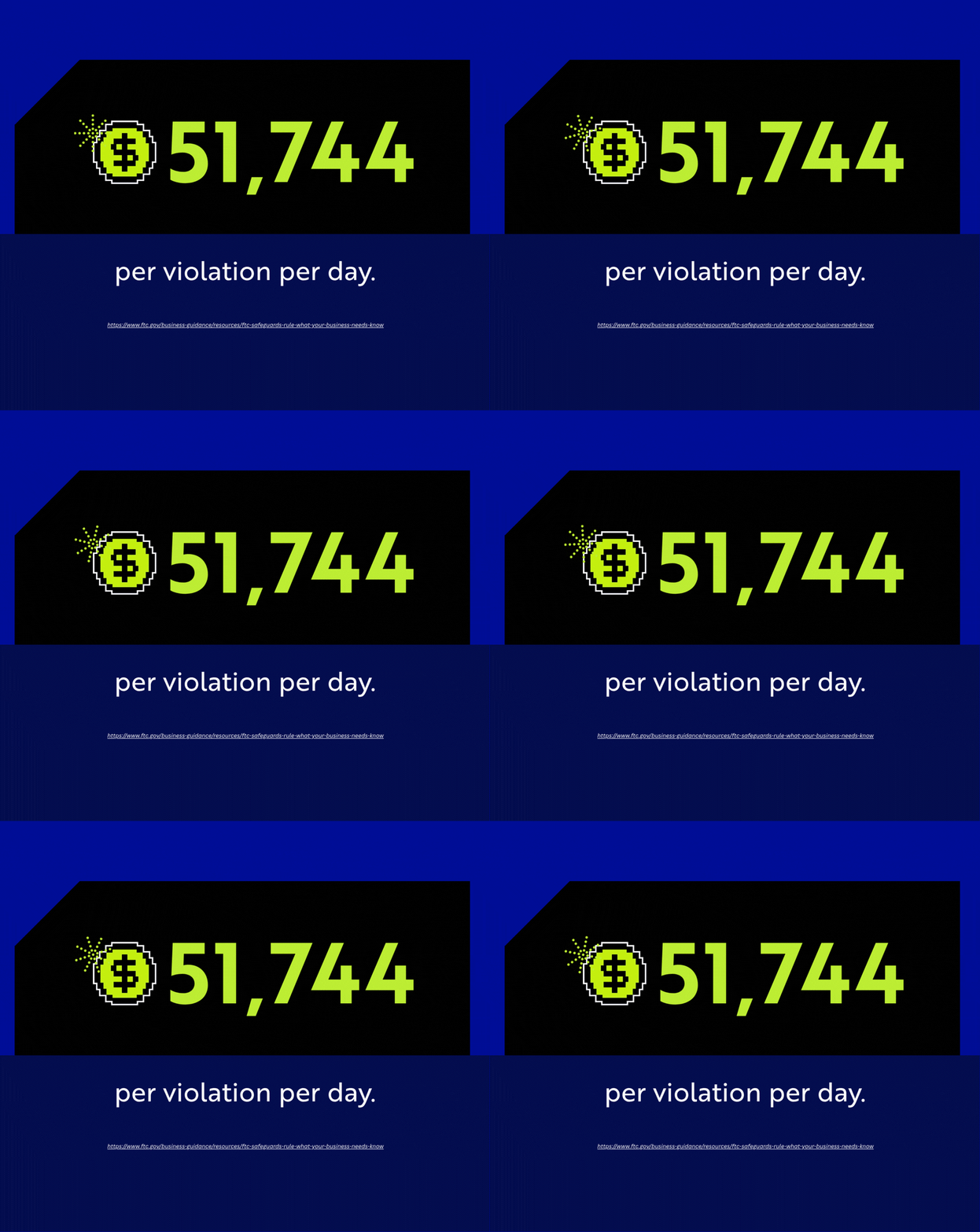
If a firm handles healthcare-related matters (medical malpractice, personal injury, ERISA disputes), HIPAA's Security Rule typically applies through business associate agreements. If a firm advises clients on financial services, mortgage transactions, or tax preparation, the FTC Safeguards Rule can apply, with civil penalties of up to $51,744 per violation per day.
As of May 2024, the Safeguards Rule also requires reporting breaches affecting 500 or more individuals to the FTC within 30 days. That public-facing disclosure creates reputational risk on top of the regulatory one.
Firms in New York that serve banks or insurers as third-party service providers can be pulled into NYDFS 23 NYCRR 500. Firms that accept credit card payments are subject to PCI DSS 4.0. Firms advising EU clients can find themselves answering to GDPR and, where the financial sector is involved, DORA.
None of these frameworks were written with law firms specifically in mind. All of them apply anyway.
The 50-State Notification Patchwork Is a Trap for the Unprepared
Beyond the federal layer sits something even more punishing for smaller firms: all 50 states, the District of Columbia, and four U.S. territories now have data breach notification statutes. Twenty of those states impose specific numeric deadlines ranging from 30 to 60 days, and the rest use qualitative language that creates its own ambiguity-driven risk.
California's SB 446, effective January 1, 2026, now mandates firm deadlines for notifying both affected individuals and the state Attorney General. Texas SB 2610, effective September 1, 2025, offers a "safe harbor" from punitive damages for firms with fewer than 250 employees, but only if they can prove documented alignment with the NIST Cybersecurity Framework or CIS Controls (Spencer Fane, Oct 2025). New York's Senate Bill S7672-A requires reporting within 72 hours and mandates annual cybersecurity training as of January 1, 2026 (NY Senate, 2025).
A small firm with clients in multiple states is now expected to know, and comply with, fifty-four different breach notification regimes simultaneously. There is no federal preemption to lean on. The map is the territory.
When Insurers and Clients Become the Real Regulators
If state bars and federal agencies move slowly, two other forces are not waiting.
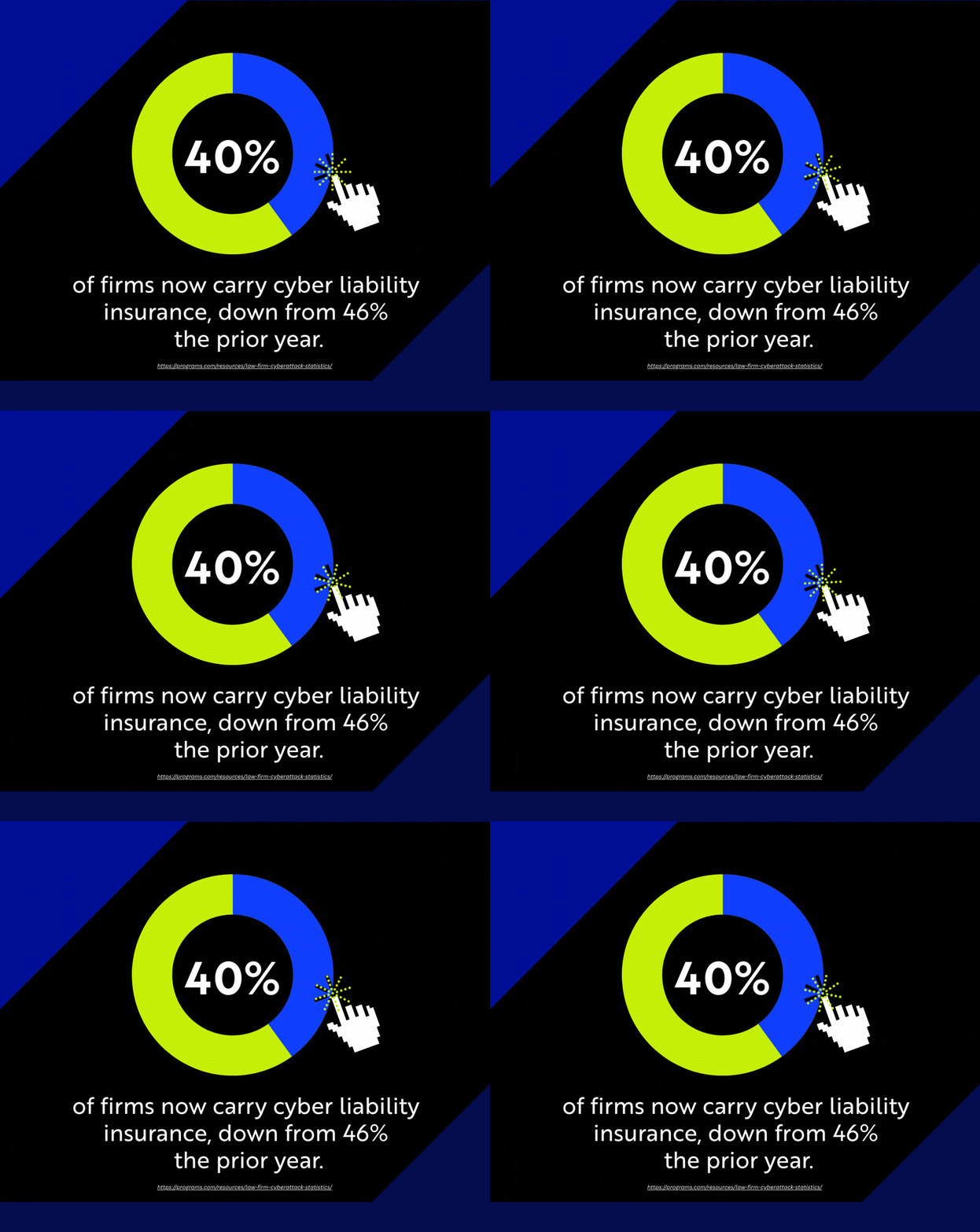
The first is cyber insurance. Underwriters in 2026 have made multi-factor authentication, endpoint detection and response (EDR), immutable backups, and documented incident response plans non-negotiable prerequisites for coverage. A firm that cannot demonstrate these controls faces premium increases of 300% or outright denial of renewal. For smaller firms, where insurance is often the only viable financial backstop against ransomware, this functions as private regulation with hard teeth. And the gap is widening: only 40% of firms now carry cyber liability insurance, down from 46% the prior year.
The second is corporate clients. Fortune 500 legal departments now treat outside counsel as third-party risk. Receiving a 200-question security questionnaire before onboarding has become routine, and increasingly those questionnaires demand proof of NIST CSF alignment, recent penetration test results, and SOC 2 documentation. The New York City Bar's Formal Opinion 2024-3 explicitly addressed the proliferation of outside counsel guidelines and the cybersecurity-reporting burdens they place on firms.
A small firm that loses an RFP because it can't answer the questionnaire doesn't get a rejection letter. It just stops getting calls.
The Disproportionate Burden on Smaller Practices
Here is the uncomfortable truth: the ABA's own 2025 TechReport found that firms of 10 to 49 attorneys reported the highest breach incident rates of any segment. These are precisely the firms least equipped to absorb the cost of compliance, and the most exposed when they cannot.
The average law firm data breach now costs $5.08 million. For mid-size firms, a single ransomware event runs $120,000 to $500,000 when downtime, recovery, and lost billables are tallied. The gap between what is required and what is actually in place is widening, not narrowing.
This is not a problem of negligence. It is a problem of resourcing. A four-attorney firm cannot hire an in-house CISO. A twenty-attorney firm cannot afford a dedicated compliance officer. Yet the standard of care continues to be set by the firms that can.
Closing the Gap Without Closing the Practice
The path forward isn't to match the staffing model of large firms. It's to access the same caliber of expertise through a different operating model. A mature MSP partnership, particularly one that includes a vCISO function, gives smaller firms the documented program, 24/7 monitoring, framework-aligned controls, and compliance roadmap that regulators, underwriters, and clients are now demanding. It also gives partners back their evenings.
In 2026, the question is no longer whether your firm will be held to the new standard. It is whether you will discover the gap on your terms or someone else's.
Compass MSP works with legal practices of every size to translate this evolving regulatory landscape into a workable security program. For continuing analysis of the rules reshaping the legal industry, and what to do about them, subscribe to our newsletter, The Fine Print.

Richard Mendoza
Richard is the Director of vCISO services with CompassMSP. He has over twenty-five years of experience as an Information Security professional with hands-on experience in engineering process and information security, and IT audit disciplines. With a wide-ranging knowledge as a Systems Engineer, Information Security Officer, and Senior Auditor, Richard has expertise in managing internal and external audits focused on reducing overall risk exposure and infrastructure redundancy for organizations.