

Published: Updated: Thai Pham 16 min read


Right now, somewhere in middle America, a referral coordinator at a 40-provider orthopedic group is staring down a stack of incoming patient referrals. It's probably late afternoon. She has a dozen more to process before she leaves, each one a wall of faxed clinical notes she needs to boil down to a few lines for the scheduling team. So she does what she did last week, and the week before: she opens a free AI chatbot in a browser tab, pastes in the notes, and asks for a summary. Thirty seconds later she has a clean paragraph, and the referral moves along.
Nobody trained her to do this. Nobody told her not to. The IT team has no idea, the compliance officer has no idea, and a third-party AI model just ingested a patient's name, date of birth, diagnosis, and imaging history with zero guardrails in place. She's not being reckless, she's being efficient, and the tools she was given weren't.
In this article:
-
Why Regulated SMBs Need a Different Approach to AI Governance
-
Frequently Asked Questions About AI Governance for Regulated SMBs
That scene plays out across regulated small and mid-sized businesses every single day. A Gartner survey of 302 cybersecurity leaders found that 69% have evidence, or strongly suspect, that employees are using prohibited public generative AI tools at work. Gartner predicts that by 2030, more than 40% of enterprises will experience a security or compliance incident tied directly to unauthorized shadow AI.
The financial picture is getting worse, not better. IBM's 2026 Cost of a Data Breach Report found that shadow AI was present in 43% of breached organizations, more than double the 20% reported a year earlier, and that 68% of breached organizations had no policies in place to govern AI use or detect shadow AI. The global average breach now costs $4.99 million, and breaches involving shadow AI ran higher, at $5.39 million on average, with one in five resulting in a regulatory fine. Healthcare and financial services continue to carry the highest breach costs of any industry.
.gif?width=940&height=788&name=Copy%20of%20Stats%20-%20Blog%20(16).gif)
For regulated businesses in healthcare, financial services, manufacturing, and legal industries, those numbers carry real operational weight. You are already managing HIPAA, PCI DSS, SOC 2, NYDFS, or CMMC requirements. AI governance is not an optional layer on top of that work. It is the next chapter of the same compliance story you have been writing for years.
This guide walks through the practical steps to enable Microsoft 365 Copilot across your organization while reducing shadow AI risk, protecting regulated data, and building governance that scales with your business. If you want the broader strategic framework first, start with the Shadow AI Playbook, which lays out a seven-step approach to guiding, governing, and growing with AI.
What Shadow AI Actually Costs a Regulated Business
Shadow AI refers to any artificial intelligence tool that employees use without formal approval or oversight from IT and security teams. IBM defines it as the unsanctioned use of AI tools or applications by employees without the knowledge of the IT department. It rarely arrives through a single front door. As we covered in how unmonitored AI tools are entering your business, it shows up through public chatbots, browser extensions with broad permissions, and low-code automations that quietly connect AI services to back-end systems.
The cost goes beyond the obvious data breach headlines. When a team member pastes financial records into an unapproved AI tool, that data leaves your controlled environment. If your organization falls under HIPAA, PCI DSS, or NYDFS regulations, that single action could constitute a reportable incident.
The real expense shows up in three places:
- Audit exposure. Unapproved tools create gaps in your documentation trail that auditors will find. There is no log of what data was exchanged with an external AI service, so there is nothing to show when an examiner asks for evidence of access control.
- Remediation labor. Your IT and compliance teams have to trace what data left, where it went, and whether notification requirements apply. IBM found that AI-related breaches most often trace back to basic control gaps: 92% of organizations that suffered an AI-related breach lacked adequate AI access controls.
- Lost productivity. Once shadow AI incidents surface, the typical organizational response is to lock everything down, which stalls the very productivity gains your team was chasing in the first place.
- Approved tools and platforms. Specify which AI tools are sanctioned for business use (such as Microsoft 365 Copilot) and which categories are prohibited, including browser extensions and personal chatbot accounts.
- Data classification rules for AI inputs. Define what types of data can and cannot be entered into AI tools. If your organization handles PHI, PII, or CUI, those data types need explicit restrictions.
- Accountability and reporting. Assign ownership for AI governance decisions. Someone on your team needs to own the question of "should we use this tool?" before employees answer it on their own.
- Review cadence. AI tools evolve quickly. A policy written in January may not cover a feature released in March. Build in quarterly reviews to keep your governance current.
- What counts as shadow AI. Many employees do not realize that pasting company data into a free ChatGPT session or installing an AI browser extension qualifies as unauthorized AI use. The definition should be specific and concrete.
- Why governance matters for your specific regulations. A healthcare employee who understands that entering patient data into an unapproved AI tool could trigger a HIPAA breach investigation pays more attention than one who sat through a generic "AI safety" webinar.
- How to use approved tools effectively. If you deploy Microsoft 365 Copilot, train your team on what it can do well. People default to shadow AI when approved tools feel limited or confusing. Good training on sanctioned platforms reduces the pull toward unsanctioned ones.
Even legitimate AI use can create unmanaged technical debt. The same Gartner research predicts that by 2030, 50% of enterprises will face delayed AI upgrades or rising maintenance costs from unmanaged AI-generated artifacts. For mid-sized businesses without a dedicated AI operations team, that debt accumulates faster and with fewer resources to pay it down. A co-managed IT model can help bridge that gap by pairing your internal team with external expertise.

Why Regulated SMBs Need a Different Approach to AI Governance
Enterprise AI governance frameworks were built for organizations with 5,000 employees, a Chief AI Officer, and a dedicated AI ethics board. Your organization probably has 50 to 500 employees, an IT team that is already stretched, and a compliance officer who also handles three other functions.
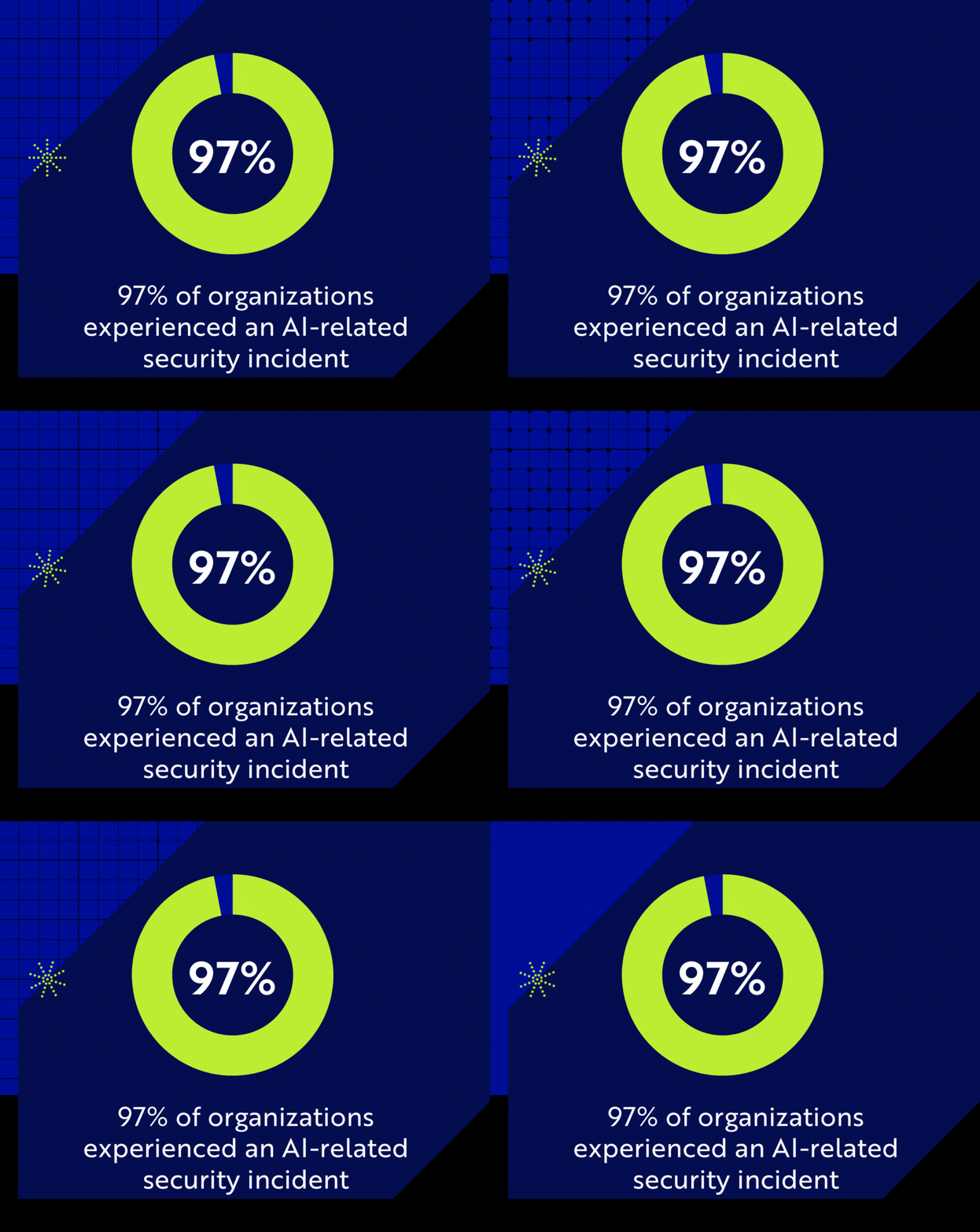
The gap between adoption and governance is wide everywhere. EY found that 77% of employees already use generative AI at work, while only 28% of organizations have a formal usage policy. Gallup reports that just 25% of employees say their organization has communicated a clear AI strategy. Mid-sized businesses feel that gap more acutely because they have less slack to absorb an incident.
The frameworks published by large consulting firms and technology vendors assume resources that mid-sized businesses do not have. You need governance that works with your existing compliance structure, not a parallel bureaucracy that competes for the same limited staff time.
CompassMSP approaches AI governance through a three-pillar framework that maps directly to the compliance and cybersecurity work regulated SMBs are already doing: policy, education, and technical controls. Each pillar reinforces the others, so you do not need to build a separate governance department from the ground up.
This approach works because regulated SMBs already have muscle memory around policy creation, employee training, and technical enforcement. AI governance, when structured correctly, extends those existing capabilities rather than duplicating them.
Pillar One: Policy That Your Team Will Actually Follow
An AI acceptable use policy is the foundation. Without one, employees make their own rules, and those rules tend to prioritize speed over security.
Your AI policy should address four core areas:
Microsoft's own Copilot adoption guidance recommends creating an AI council with an executive sponsor plus representatives from IT, change management, and risk management. For mid-sized businesses, that council does not need to be a formal standing committee. Three to five people from IT, compliance, and operations who meet monthly can handle the decision volume most SMBs face.
CompassMSP helps regulated organizations draft and maintain AI governance policies that align with their existing compliance and risk management frameworks. The goal is a policy that fits how your business actually operates, not a template borrowed from a Fortune 500 company.
Pillar Two: Employee Education That Changes Behavior
Policies only work when people understand them. The biggest source of shadow AI risk is not malicious intent. Your team members use unapproved AI tools because those tools make their work faster, and nobody told them why that poses a problem.
Effective AI training for regulated SMBs covers three areas:
CompassMSP delivers security awareness training that ties AI governance education directly to the regulatory requirements your industry faces. Education that connects to real compliance consequences sticks longer than abstract warnings about data security.
Pillar Three: Technical Controls That Enforce Your Policy
Policy and training set expectations, but technical controls enforce them. For regulated SMBs deploying Copilot, three categories of technical controls matter most.
Access and Identity Controls
Before you deploy Copilot, audit your Microsoft 365 permissions. Microsoft is explicit that Copilot inherits your existing Microsoft 365 data and security permissions, which means overshared folders, broadly permissioned SharePoint sites, and legacy distribution groups all become potential data exposure points the moment Copilot goes live.
Microsoft Purview documentation outlines a staged approach to preventing data leaks from shadow AI: discover AI app usage, block unsanctioned apps, restrict sensitive data from sanctioned apps, and govern data sent to AI tools. For regulated SMBs, each of those steps should align with your existing data classification and access control policies.
Data Loss Prevention (DLP) for AI Interactions
Your existing DLP rules likely cover email and file sharing. Copilot interactions need the same treatment, and Purview does more here than most teams realize. DLP for Microsoft 365 Copilot is generally available across Copilot Chat, Word, Excel, and PowerPoint. It blocks sensitive information types in the prompt itself before the request reaches the model, excludes labeled content from Copilot's grounding, and restricts Copilot from grounding responses in web content. Configure it against the data types that matter in your environment (PHI, PII, financial records, CUI) rather than switching on a generic template and hoping it catches the right things.
Shadow AI Discovery and Blocking
Use Microsoft Defender for Cloud Apps or equivalent tools to identify which AI applications your employees are already using. You cannot govern what you cannot see. Discovery has to come first, followed by policy decisions about which tools to sanction, restrict, or block outright.
In practice, this is where an endpoint agent flags or blocks uploads of restricted data to public AI tools, traffic inspection detects shadow AI usage and redirects users to approved alternatives, and a policy engine enforces rules for AI-assisted communication. CompassMSP's AI enablement and monitoring services layer 24/7 SOC oversight on top of those controls, with real-time alerts on policy violations and governance audits that keep AI activity aligned with frameworks such as NIST AI RMF and NYDFS. Fully Managed IT clients get the underlying monitoring and patch management, and the vCISO advisory service designs the governance layer that ties these technical controls back to compliance requirements.
A Step-by-Step Copilot Rollout Plan for Regulated SMBs
A Copilot deployment in a regulated environment requires more planning than a standard Microsoft 365 feature activation. Here is what that looks like in practice.
Step 1: Assess your data landscape and current AI exposure. Before enabling Copilot, audit your Microsoft 365 environment. Map where sensitive and regulated data lives, who has access to it, and which sharing permissions exist. Clean up overshared content and stale access rights first. This is also the moment to discover what AI tools are already in use. CompassMSP's AI Enablement Assessment runs in three phases: discover use cases across the organization, assess compliance gaps, data exposure, and existing controls, and recommend a roadmap that balances productivity and protection.
Step 2: Establish your AI governance policy. Draft your acceptable use policy, assign governance ownership, and define your approved tool list. Make sure your policy references the specific regulations your business follows.
Step 3: Deploy to a pilot group. Start with a small group of users, ideally from a department with lower regulatory exposure, to test Copilot in a controlled environment. Monitor how they use it, what data it surfaces, and whether your DLP policies catch the right triggers.
Step 4: Train before you expand. Once the pilot validates your controls, roll out training to the broader organization before expanding Copilot access. Education should happen before access, not after.
Step 5: Monitor, audit, and refine. AI governance is not a launch-day exercise. Schedule monthly reviews of Copilot usage patterns, DLP alerts, and shadow AI discovery findings. Adjust policies and controls based on what the data tells you.
CompassMSP guides regulated SMBs through each of these steps with structured planning, documentation, and ongoing advisory support. The process maps to your compliance calendar so AI adoption stays aligned with audit preparation, not competing against it.
How to Measure AI Governance Effectiveness
You cannot improve what you do not track, and AI governance is no exception. Five metrics give regulated SMBs a clear picture of how well their AI governance program is performing.
- Shadow AI incident count. Track how many unauthorized AI tools are discovered through your monitoring each month. This number should trend downward over time as policy and training take hold.
- DLP policy trigger rate. Monitor how frequently your DLP policies flag sensitive data in Copilot interactions. A high rate early on may indicate oversharing issues that need remediation. A consistently low rate after remediation indicates healthy governance.
- Education completion and comprehension. Track not just who completed AI governance training, but test comprehension with scenario-based assessments. Completion alone does not indicate understanding.
- Copilot adoption rate among trained users. If trained users are not using Copilot, they may be reverting to shadow AI tools. Low adoption of sanctioned tools is a leading indicator of shadow AI risk.
- Policy update frequency. Your AI governance policy should be updated at least quarterly. If six months pass without an update, your governance has likely fallen behind the pace of AI tool development.
CompassMSP's managed IT and compliance services include structured reporting that tracks these metrics alongside your broader cybersecurity and compliance posture. You get one accountable team and one set of reports covering IT operations, security, compliance, and AI governance together.
Copilot With Guardrails, Not Copilot or Guardrails
Leaders get a clear, documented AI governance framework that maps to their existing compliance obligations. Teams get training that explains the "why" behind AI policy, not just the "what." Your organization gets Copilot deployed with the right guardrails, monitored by the right tools, and backed by a partner who follows through on governance the same way they follow through on cybersecurity and IT operations.
AI adoption in a regulated environment does not have to mean choosing between productivity and compliance. With the right governance structure, you get both.
The right direction starts with a partner you trust. Connect with CompassMSP to start building AI governance that fits how your business works, or download the Shadow AI Playbook to see the full seven-step framework.

Thai Pham
Thai Pham is the Director of Automation & AI at CompassMSP, helping organizations adopt AI, automation, and governance practices that improve operations, reduce friction, and create measurable business value. His background includes MSP leadership, enterprise operations, data governance, and AI strategy.