

Published: Updated: Paul Breitenbach 14 min read


8 MSPs for Industrial IoT Security in Manufacturing (2026 Buyer's Guide)
Here is a familiar setup. Your plant floor runs three shifts. Your SCADA systems talk to sensors across multiple facilities. Your network includes devices from five different decades. And when something breaks at 2 a.m., you are making calls to figure out who owns the problem.
That is not an IT strategy. That is a scavenger hunt with production downtime as the prize.
It is also a scavenger hunt with rising stakes. Manufacturing has now been the most attacked industry on the planet for five straight years, accounting for 27.7 percent of all cyberattacks tracked across sectors in 2025, according to IBM's X-Force Threat Intelligence Index. Attackers are not picking factories at random. They are picking them because aging operational technology, thin IT-OT segmentation, and the sheer cost of stopping a line make manufacturers both vulnerable and willing to pay. IBM's X-Force has also found that extortion was the objective in roughly 29 percent of attacks on manufacturers, with data theft close behind at about 24 percent, aimed largely at intellectual property and financial assets.
For manufacturing and defense contractor IT leaders evaluating managed service providers, the criteria matter more than the marketing. This guide compares eight MSPs on the factors that actually affect your shop floor: OT and IIoT security depth, CMMC and regulated-industry compliance, disaster recovery, and genuine 24/7 support. CompassMSP, which publishes this guide, builds its practice specifically around operational technology realities rather than repurposed office IT, and we have tried to evaluate the field as fairly as a self-interested party can. Where a competitor's specifics could not be confirmed from public information, we say so rather than guess.
Quick guide: 8 MSPs for industrial IoT security in manufacturing
- CompassMSP: Built for manufacturing IT leaders who need industrial IoT security, CMMC support, and 24/7 three-shift coverage from one accountable partner.
- Ntiva: A mid-market provider with a broad cybersecurity and cloud portfolio across the eastern United States.
- Integris: Managed IT with a strong compliance-documentation focus for regulated industries.
- All Covered: Konica Minolta's IT services division, useful where document management and IT vendor consolidation matter.
- Executech: A regional Mountain West MSP with responsive, relationship-driven support for SMBs.
- Magna5: An infrastructure-monitoring and network-operations specialist.
- Charles IT: A Connecticut MSP with compliance consulting, positioned near New England's aerospace corridor.
- Thrive: A managed-security and cloud provider serving mid-market organizations nationally.
Why manufacturing IT is a different problem
.gif?width=940&height=788&name=Copy%20of%20Stats%20-%20Blog%20(11).gif)
Manufacturing environments are not office environments with forklifts. The financial math alone forces a different posture. Siemens' True Cost of Downtime research puts unplanned downtime at roughly $1.4 trillion a year for Fortune Global 500 companies, equal to about 11 percent of total revenue and up sharply from five years earlier. Aberdeen's widely cited benchmark pegs the average across manufacturing sectors at about $260,000 per hour, and a 2025 Fluke survey of senior decision-makers found that more than 60 percent of manufacturers suffered unplanned downtime in the past year. When a line sits idle, the meter runs whether the cause is a failed bearing or a ransomware lockout.
That reality shaped how we weighed each provider.
Industrial IoT and OT security expertise. Can they protect PLCs, SCADA systems, and sensor networks without disrupting production? Generic endpoint protection does not cut it on the plant floor, where a reboot can mean stopping output.
CMMC and compliance depth. For defense contractors, CMMC Level 2 is now a live contract condition, not a future worry. We looked for providers who understand NIST SP 800-171 controls and can document how Controlled Unclassified Information flows through your systems.
Disaster recovery for manufacturing. Recovery plans need to account for production continuity, not just data restoration. Recovery time objectives measured in days do not work for three-shift operations.
Genuine 24/7 support. Many providers claim around-the-clock coverage. The question is whether that means a staffed security operations center with manufacturing experience or an after-hours answering service.
Enclave and segmentation strategy. Legacy OT often cannot be patched. The right partner knows how to isolate vulnerable equipment while keeping the connectivity production depends on.
vCIO and strategic planning. Manufacturing roadmaps need to fold in Industry 4.0 adoption, IIoT expansion, and compliance deadlines without disrupting current production.
Related Article: Where you store your CUI data matters. Find out why you should avoid proprietary enclaves and ensure you have control of your own data.
The 8 MSPs
1. CompassMSP
CompassMSP treats manufacturing IT as a distinct discipline rather than a footnote in a general services brochure. The company centers its model on the constraints that define plant-floor IT: legacy systems that cannot be replaced overnight, and production schedules that demand uptime.
The real differentiator shows up on the floor. CompassMSP secures legacy operational technology through enclave strategies that isolate vulnerable equipment without cutting the connectivity production needs. Its 24/7, U.S.-based security operations center is staffed by analysts who understand that an alert on a CNC machine controller is a production-impact event, not a laptop password reset. For defense contractors, the company operates as a Registered Practitioner Organization recognized by the Cyber AB, so its CMMC guidance is bound by the same professional conduct standards that govern assessors.
Features
- Industrial IoT security: Protection for PLCs, SCADA systems, and sensor networks that accounts for OT protocol requirements.
- CMMC compliance consulting: RPO-recognized guidance through NIST SP 800-171 controls, System Security Plan documentation, and Plan of Action and Milestones development.
- 24/7 U.S.-based SOC: Threat monitoring with priority response targets for high-severity alerts affecting production systems.
- vCISO advisory: Executive-level security leadership sized to manufacturing constraints, without a full-time hire.
- Manufacturing disaster recovery: Continuity planning that prioritizes production uptime and rapid restoration.
- Legacy OT enclave strategies: Segmentation that isolates equipment you cannot patch while preserving operational connectivity.
Pros
- Manufacturing-specific expertise and vCISO guidance designed for OT environments and three-shift operations.
- RPO recognition by the Cyber AB means CMMC guidance is tied to real assessment standards.
- One accountable partner for IT, security, compliance, and planning instead of vendor finger-pointing.
Cons
- Right-sized for manufacturers in roughly the 10 to 500-seat range; very small shops may find full-service engagement more than they need today.
- Hands-on onboarding asks for real-time from internal teams during the initial assessment.
2. Ntiva
Ntiva is a mid-market MSP with a broad portfolio spanning help desk, network management, security monitoring, and cloud, built out across the eastern United States partly through acquisition. For a manufacturer that wants a single generalist partner with real scale and a recognizable security and Microsoft 365 practice, Ntiva is a credible shortlist candidate.
Where it is worth probing: OT and industrial IoT depth is not the centerpiece of Ntiva's public positioning, and because the footprint grew through acquisition, it is reasonable to ask how consistent service and tooling are across regional offices. Defense contractors should confirm Ntiva's current CMMC standing directly, since assessor and RPO designations change over time.
Strengths: Broad service catalog, established East Coast presence, mature cloud and identity practice. Confirm before signing: Plant-floor OT experience for your specific equipment, and current CMMC posture for DoD work.
3. Integris
Integris leads with compliance. Risk assessments, policy development, and audit preparation are core to how it delivers, and it works across healthcare, financial services, and other regulated sectors. If your near-term pain is documentation and demonstrating control to auditors, that focus is a genuine asset.
The open question for a manufacturer is the operational side: industrial IoT and OT security are not stated specialties, so the depth of plant-floor and three-shift experience is worth pressure-testing against your environment.
Strengths: Compliance documentation and audit-readiness as a first-class discipline; multi-framework experience. Confirm before signing: OT-specific security capability and production-aware disaster recovery.
4. All Covered
All Covered is the IT services arm of Konica Minolta, which gives it a national footprint through the parent's dealer network and a natural fit for organizations that want IT and document or print management under one roof. That consolidation can simplify vendor relationships.
Its origins in the print and copier world also shape it: industrial OT security is not the heritage of the practice, and CMMC depth varies by location. A defense or heavy-OT manufacturer should scope those areas carefully.
Strengths: Single-vendor IT and document management; national reach; established parent company. Confirm before signing: Manufacturing OT security depth and location-specific CMMC expertise.
5. Executech
Executech serves small and mid-sized businesses primarily across the Mountain West, with a reputation for responsive, relationship-driven support. For a smaller regional manufacturer that values a local, accessible partner over a national security brand, that model has real appeal.
The trade-offs are coverage and specialization: the geographic focus is regional, and industrial IoT and manufacturing OT are not stated specialties. Defense contractors will want to confirm CMMC capability directly.
Strengths: Responsive regional support tuned to SMB needs. Confirm before signing: OT and IIoT capability, multi-region coverage, and CMMC depth.
6. Magna5
Magna5's core competency is infrastructure monitoring and network operations center services, with an emphasis on proactive alerting and around-the-clock network visibility. If your priority is strong network monitoring and you have other pieces of the security and compliance puzzle covered, that focus is a strength.
For a full manufacturing security and compliance program, though, you may be assembling more than one vendor relationship, and OT and industrial IoT security is not the stated center of the offering.
Strengths: Network monitoring and NOC depth; 24/7 infrastructure visibility. Confirm before signing: OT security scope and manufacturing compliance experience.
7. Charles IT
Charles IT is a Connecticut-based MSP pairing managed IT with compliance consulting, and its location places it near New England's aerospace and defense manufacturing corridor. For regional manufacturers that want a local partner with compliance familiarity, that proximity is a practical advantage.
The considerations are scale and reach: the footprint is concentrated in New England, which matters if you operate facilities across multiple regions, and OT security depth is worth comparing directly against manufacturing-focused providers.
Strengths: Regional presence in an aerospace and defense hub; compliance consulting integrated with managed IT. Confirm before signing: OT security depth and multi-region support capacity.
8. Thrive
Thrive is a national managed-security and cloud provider serving mid-market organizations, with a genuine security operations focus and a footprint expanded through acquisition. For a manufacturer that wants a security-led MSP with scale, it belongs on the list.
As with any acquisition-built firm, it is fair to ask how uniform tooling and service are across offices. Manufacturing OT and industrial IoT are not the primary focus of the public positioning, and DoD contractors should confirm current CMMC standing.
Strengths: Security operations as a core offering; national scale; combined cloud and security. Confirm before signing: Plant-floor OT experience and three-shift production support specifics.
Comparison table
The table below reflects each provider's stated specialty and public positioning. "Specialty" means the area is a core, named focus. "Offered" means it appears in the service catalog. "Confirm with provider" means we could not verify the specifics from public information and you should ask directly. We have deliberately avoided marking competitors as lacking a capability where we cannot confirm it.
| MSP | Industrial IoT / OT security | CMMC support | 24/7 SOC | vCISO / vCIO |
|---|---|---|---|---|
| CompassMSP | Specialty | RPO-recognized | U.S.-based, specialty | Specialty |
| Ntiva | Offered | Confirm with provider | Offered | Offered |
| Integris | Confirm with provider | Specialty (compliance) | Confirm with provider | Confirm with provider |
| All Covered | Confirm with provider | Varies by location | Offered | Offered |
| Executech | Confirm with provider | Confirm with provider | Confirm with provider | Confirm with provider |
| Magna5 | Confirm with provider | Confirm with provider | Offered (NOC) | Confirm with provider |
| Charles IT | Confirm with provider | Offered (consulting) | Offered | Confirm with provider |
| Thrive | Confirm with provider | Confirm with provider | Specialty (security) | Confirm with provider |
What makes industrial IoT security different from standard IT security
Standard IT security assumes you can patch systems, enforce password policies, and deploy endpoint agents everywhere. Industrial IoT breaks those assumptions before you finish reading the patch notes.
OT environments include PLCs running software more than a decade old, sensors communicating over protocols that predate modern encryption, and equipment where a reboot means stopping production. Much of the embedded code in industrial controllers is written in memory-unsafe languages, and the systems were rarely designed with network connectivity in mind. The security model has to account for what you cannot change, not just what you can.
Effective industrial IoT security uses network segmentation to build enclaves around legacy equipment. It monitors OT-specific protocols for anomalies rather than leaning on antivirus signatures. And it coordinates with production schedules so security maintenance does not turn into unplanned downtime. The most common breach path into manufacturing in 2025 was exploitation of public-facing applications, which means visibility into exposed systems matters as much as anything happening deep in the OT network.
The most common breach path into manufacturing in 2025 was exploitation of public-facing applications.
How CMMC compliance affects MSP selection for defense contractors
CMMC is no longer hypothetical. The acquisition rule took effect on November 10, 2025, and CMMC requirements now appear in new DoD solicitations. During the current phase, most contracts rely on Level 1 and Level 2 self-assessments, but contracting officers can require third-party assessment for high-priority work, and mandatory third-party Level 2 certification phases in through November 10, 2026, with full implementation expected by 2028.
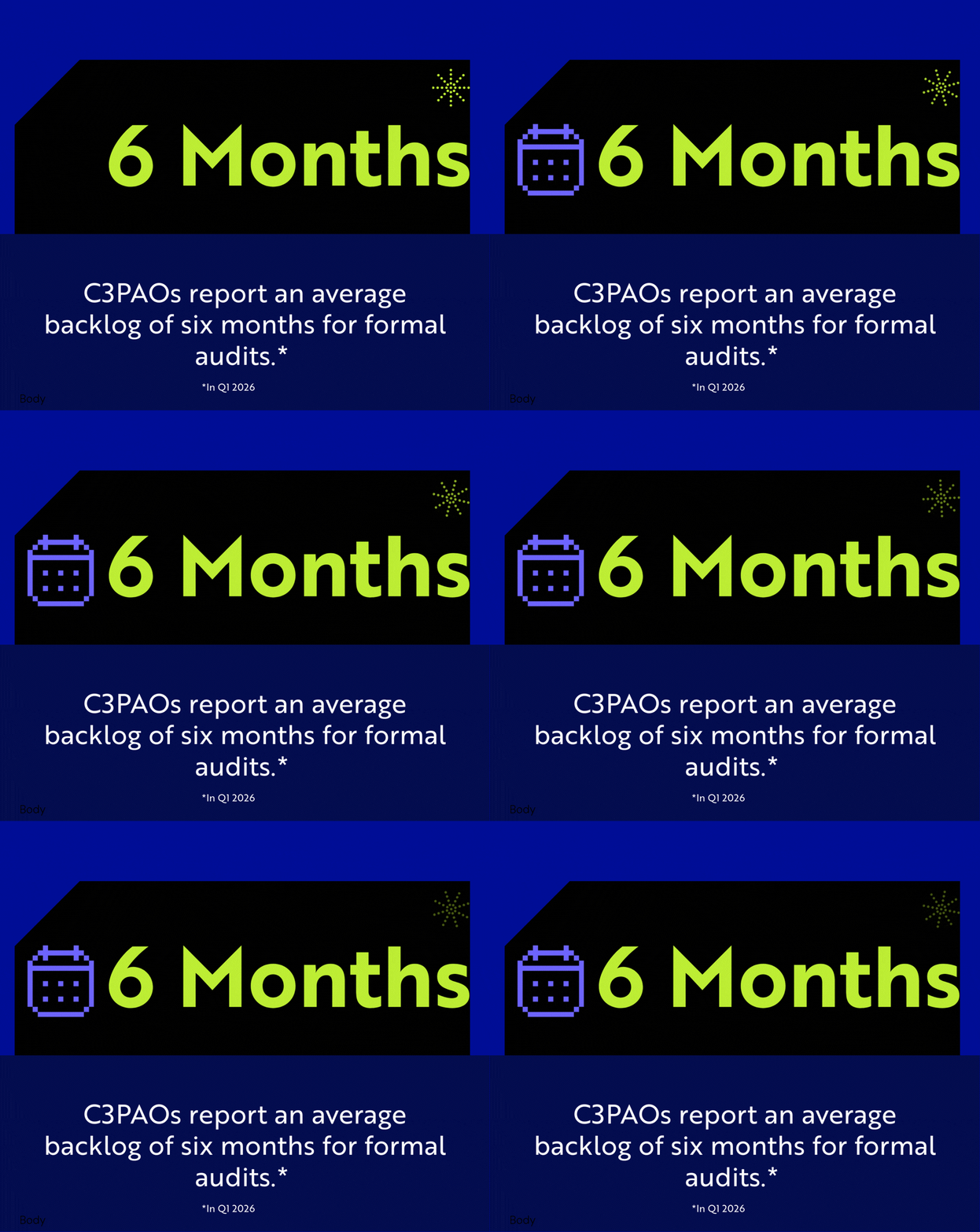
Level 2 is where most CUI-handling manufacturers land. It requires implementing and documenting all 110 controls from NIST SP 800-171, maintaining a System Security Plan, and, for many contracts, passing an assessment by a Certified Third-Party Assessment Organization (C3PAO). The gap that trips up contractors is the difference between meeting a control and proving you met it to an assessor.
This is where an MSP's CMMC expertise shows. Recognition as a Registered Practitioner Organization by the Cyber AB indicates that a provider's guidance is bound by the same code of conduct that governs the assessment ecosystem. CompassMSP operates as an RPO, which means its compliance work is oriented toward audit-defensible evidence rather than checkboxes on a spreadsheet. For any MSP you evaluate, ask to see a sample SSP and POA&M and ask who on the team holds current CMMC credentials.
Five questions to ask any MSP before you sign
- Walk me through how you would secure a PLC you cannot patch. A specialist answers with segmentation and enclave strategy. A generalist talks about endpoint agents.
- Where is your SOC, who staffs it overnight, and what is your response target for a production-down alert? Get the answer in writing.
- Show me a redacted SSP and POA&M you have produced. Compliance claims are cheap; artifacts are not.
- What does recovery look like if a line controller is hit at 3 a.m. on a Saturday? You are testing for production-aware disaster recovery, not generic data restoration.
- Who owns the problem when IT, security, and compliance disagree? One accountable partner beats three vendors pointing at each other.
The bottom line
Most MSP comparisons rank providers on help desk response time, cloud certifications, and geographic coverage. Those matter, but they miss the operational reality of manufacturing, where downtime is measured in hundreds of thousands of dollars per hour and attackers have made the sector their top target five years running.
Several providers on this list are strong at what they do. The right fit depends on your environment: a compliance-heavy shop, a single-region SMB, and a multi-facility defense contractor will reasonably reach different conclusions. CompassMSP's case is straightforward: it built its practice around OT constraints, it operates a U.S.-based SOC that treats production alerts as production events, and it carries RPO recognition for the CMMC work that defense contractors now have to get right on a live deadline.
Start with a partner who knows how your plant floor actually works. Connect with CompassMSP to talk through your specific industrial IoT security and compliance requirements.

Paul Breitenbach
With nearly 20 years of experience designing enterprise-grade IT solutions, Paul specializes in supporting organizations that cannot afford downtime. Before becoming our CIO, he served as CIO of WorldwideIT, a Compass company, where he led large-scale infrastructure, cloud, and security initiatives for highly regulated industries.