

Published: Updated: CompassMSP 17 min read


Choosing a managed service provider affects far more than who answers your next IT ticket. The right MSP influences cybersecurity risk, employee productivity, technology spending, compliance, business continuity, and how confidently your organization can grow.
That makes the decision worth more scrutiny than a feature comparison or price sheet.
A strong managed service provider should understand how your business operates, take clear responsibility for the technology it manages, protect the environment around the clock, and give leadership a practical plan for what comes next.
This guide explains how to choose a managed service provider, what to evaluate during the selection process, which questions expose meaningful differences between MSPs, and which warning signs should make you keep looking.
The best MSP relationship gives your organization fewer technology problems to manage and better information when technology decisions need to be made.
What Is a Managed Service Provider?
A managed service provider, or MSP, is an external technology partner that assumes ongoing responsibility for defined areas of an organization's IT environment.
Depending on the engagement, an MSP may manage day-to-day technical support, endpoints, networks, servers, Microsoft 365, cybersecurity, cloud infrastructure, backup and recovery, technology vendors, strategic planning, or the entire technology environment.
For mid-sized businesses, the strongest MSP relationships increasingly connect those responsibilities instead of separating them across unrelated providers.
For example, a recurring endpoint issue can reveal an infrastructure problem. A security alert can expose a configuration weakness. A compliance requirement can change the technology roadmap. When support, infrastructure, cybersecurity, and strategy operate separately, those connections are easier to miss.
That is why organizations evaluating an MSP should look beyond helpdesk capabilities and consider how the provider connects Managed IT Services, Cybersecurity & Advisory, Cloud & Infrastructure, Compliance & Risk Management, Telecom & Unified Communications, and strategic technology planning.
How Do You Choose the Right Managed Service Provider?
Choose an MSP that can demonstrate clear accountability for your environment, mature cybersecurity practices, responsive support, strategic planning, transparent service expectations, and experience supporting organizations with requirements similar to yours.
Before signing an agreement, you should be able to answer these questions confidently:
- Who owns each part of our IT environment?
- Who monitors and responds to cybersecurity threats?
- What happens when a serious incident occurs after hours?
- How quickly will the provider acknowledge and respond to priority issues?
- How will the MSP support our compliance and risk requirements?
- Who helps leadership plan budgets, projects, lifecycle replacements, and modernization?
- How does the MSP document our environment and share that information with us?
- How will service change as our business grows?
If a provider cannot answer those questions clearly before the contract, clarity rarely improves after it.
Choosing an MSP Is Also a Cybersecurity Decision
An MSP often receives privileged access to critical systems, administrator accounts, cloud environments, security tools, backups, endpoints, and sensitive business information. That access makes the MSP part of your organization's cybersecurity supply chain, and if your MSP experiences a breach, they put your company and valuable data at risk.
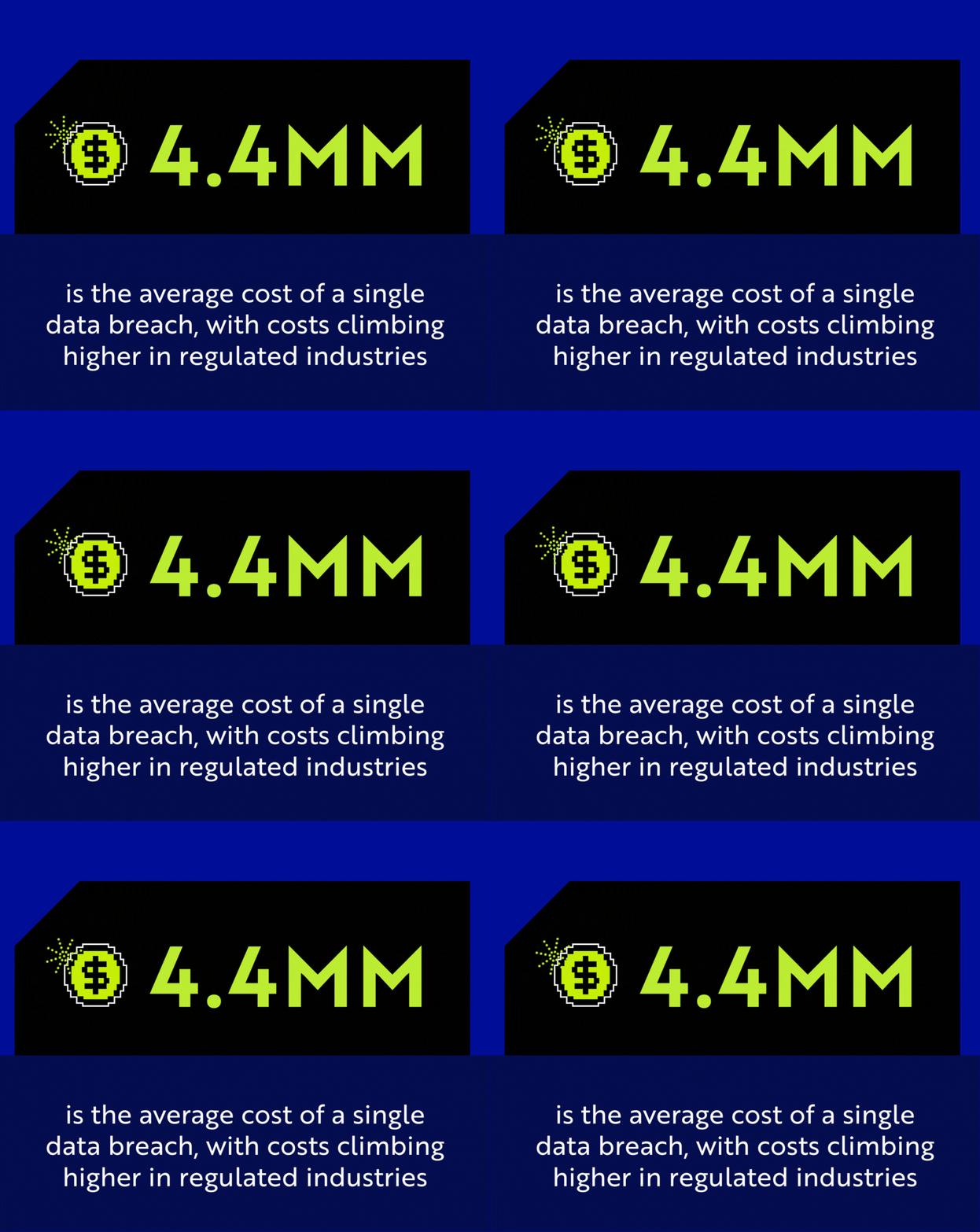
The 2026 Verizon Data Breach Investigations Report found that third parties were involved in 30% of breaches analyzed, up substantially from the prior year. Third-party risk now deserves a formal place in technology purchasing decisions.
.gif?width=940&height=788&name=Copy%20of%20Stats%20-%20Blog%20(15).gif)
NIST takes the same position. Its cybersecurity supply chain guidance recommends conducting due diligence before entering supplier relationships and continuing to evaluate supplier risk throughout the relationship. :contentReference[oaicite:1]{index=1}
CISA also recommends that MSP customers clearly define security responsibilities, access requirements, monitoring expectations, and incident responsibilities in contractual agreements.
In practical terms, your MSP should be evaluated like any other organization with privileged access to your business.
Related Article: How to Choose a Managed IT provider for regulated industries
Decide How Much IT Responsibility You Actually Want to Outsource
Before comparing managed service providers, define the operating model you need. Most mid-sized organizations fall into one of two categories: fully managed IT or co-managed IT.
Fully Managed IT
Fully Managed IT fits organizations that want an external partner to assume primary responsibility for day-to-day IT operations, support, infrastructure management, security coordination, vendor management, and strategic planning.
This model often makes sense when an organization has limited internal IT resources, wants predictable operating costs, or needs broader expertise than it can efficiently maintain in-house.
Co-Managed IT
Co-Managed IT supports organizations that already have internal IT leadership or technical staff but need additional capacity, specialized expertise, 24/7 coverage, enterprise tools, cybersecurity resources, project support, or strategic guidance.
The internal team stays involved while the MSP fills defined gaps.
Related Article: Co-Managed vs. Fully Managed IT: Which Support Model is Right for You
Do not choose an MSP model based on how much technology you have. Choose it based on which responsibilities your internal team can realistically own well.
What Should You Look for in a Managed Service Provider?
The strongest MSP evaluation combines technical capability, security maturity, operational discipline, industry knowledge, and the ability to help leadership make better technology decisions.
1. Clear Accountability
Start with ownership.
Ask the provider to explain exactly what it manages, what your organization manages, and what third parties manage. Responsibility should remain clear when an issue crosses systems or vendors.
For example, if an employee cannot access a cloud application because of an identity configuration problem involving Microsoft 365 and a third-party platform, your MSP should coordinate resolution rather than hand you three vendor phone numbers.
Look for: documented ownership, escalation procedures, vendor coordination, environment documentation, and a defined onboarding process.
2. Cybersecurity That Extends Beyond Basic IT Tools
Antivirus, patching, firewalls, and multifactor authentication matter, but modern cybersecurity requires more than deploying tools.
Ask how the provider detects suspicious activity, validates alerts, investigates incidents, contains threats, supports recovery, and turns security findings into remediation work.
A mature provider should also explain the difference between foundational security controls and more advanced detection and response capabilities.
CompassMSP connects managed IT with Core Defense, Apex Security, vCISO & Security Advisory, and Compliance & Risk Management so security findings can lead to operational action rather than another report sitting in someone's inbox.
3. Support That Matches the Way Your Business Operates
Ask more than, “Do you offer 24/7 support?”
Find out what actually happens at 2:00 a.m. Who answers? Which issues receive immediate attention? How are priority levels determined? When does an issue move from the service desk to an engineer, security specialist, or escalation manager?
Review the provider's service-level commitments carefully. Understand whether stated times refer to acknowledgment, first response, troubleshooting, escalation, or resolution. Those are not interchangeable.
A responsive MSP should also provide multiple support paths and maintain enough documentation that clients do not need to re-explain their environment every time a new technician becomes involved.
4. Strategic Guidance, Not Just Technical Support
Technology decisions accumulate.
Hardware reaches end of life. Software contracts renew. Cyber insurers change requirements. Business units adopt new applications. Offices open. Companies acquire competitors. Cloud costs grow. AI enters workflows whether leadership planned for it or not.
Your MSP should help leadership make those decisions intentionally.
Look for access to strategic advisors such as a virtual CIO or virtual CISO who can connect technical priorities to budgets, business risk, operational requirements, and growth plans.
Effective IT consulting and strategic planning should produce an actionable roadmap rather than a quarterly meeting filled with dashboards and no decisions.
5. Compliance and Risk Expertise Where Your Business Needs It
If your organization operates in a regulated industry, the MSP should understand that technical configuration and compliance obligations are connected.
A healthcare organization may need to address HIPAA safeguards. A defense contractor may need to align systems with CMMC and NIST SP 800-171 requirements. Financial organizations may face obligations involving NYDFS, SEC requirements, privacy rules, or other regulatory expectations.
Ask whether the provider can help identify control gaps, document technical safeguards, support audits, prioritize remediation, and give leadership evidence that required controls actually operate as intended.
Explore CompassMSP's Compliance & Risk Management capabilities for more detail.
6. Business Continuity and Recovery Planning
Backups matter only when they can restore what the business needs.
Ask how the MSP protects backup systems, tests recoverability, separates backup access from production environments, documents recovery priorities, and coordinates restoration during a serious outage or cyber incident.
CISA specifically recommends considering MSP security practices when third parties maintain or secure organizational backups. :contentReference[oaicite:3]{index=3}
Your provider should be able to explain both backup and business continuity and disaster recovery in operational terms.
7. Cloud and Infrastructure Expertise
Most mid-sized environments now span cloud platforms, SaaS applications, local infrastructure, remote employees, mobile devices, multiple offices, and third-party integrations.
An MSP should understand the whole environment rather than treating cloud, networks, identity, endpoints, and security as separate projects.
Evaluate experience with Microsoft 365, Azure, AWS, networking, identity, backup, remote work, infrastructure monitoring, and the systems that matter most to your organization.
Learn more about Cloud & Infrastructure.
8. A Real Onboarding Process
Onboarding tells you a lot about how an MSP operates.
A provider cannot effectively manage an environment it has not taken the time to understand.
Strong onboarding should establish a clear baseline that includes systems, users, endpoints, network architecture, administrative access, vendors, documentation, security controls, backup processes, business-critical applications, known technical debt, and regulatory obligations.
Ask what the provider discovers during onboarding, what documentation you receive, which immediate risks are prioritized, and how outstanding issues become part of the technology roadmap.
9. Scalability Without Losing Accountability
The provider that works for a 40-person company may struggle when that company reaches 300 employees, opens several locations, completes an acquisition, or introduces more complex compliance requirements.
Ask how the MSP adds users, locations, infrastructure, cybersecurity capabilities, cloud workloads, and specialized technical resources as clients grow.
Scale should increase capability without turning your organization into another account number.
10. Technology Modernization Capabilities
A managed service provider should help eliminate recurring problems, not simply become efficient at fixing the same problems forever.
Ask how the provider identifies aging infrastructure, duplicated tools, inefficient processes, unsupported systems, unnecessary costs, manual workflows, and technology that no longer fits the business.
That work may lead to IT Modernization, infrastructure changes, cloud migration, communications improvements, or carefully governed AI Enablement & Automation.
Questions to Ask a Managed Service Provider Before You Sign
A polished proposal tells you what an MSP wants you to know. Good questions reveal how the MSP actually operates.
Ask About Support
- What happens when we submit a critical ticket after hours?
- How do you define ticket priorities?
- What response commitments are included in our agreement?
- When does a service desk issue escalate to senior engineering?
- How do you handle recurring problems rather than repeatedly closing individual tickets?
Ask About Security
- Who monitors our environment for security threats?
- How do you validate and investigate security alerts?
- What happens during a confirmed cybersecurity incident?
- Which security responsibilities belong to us, and which belong to you?
- How do you protect privileged access to client environments?
- How do you secure your own systems and third-party supply chain?
Ask About Strategy
- Who helps us build our technology roadmap?
- How often do strategic reviews occur?
- How do you prioritize technical debt?
- How do you connect IT spending to business priorities?
- How will you help us plan lifecycle replacements and major projects?
Ask About Accountability
- Who owns vendor coordination when several systems contribute to a problem?
- What documentation will you maintain about our environment?
- Can we access that documentation?
- What happens if we decide to change providers?
- How do you measure whether your service is improving our environment?
Red Flags When Choosing an MSP
Some warning signs appear long before implementation. Pay attention to them.
The Provider Cannot Explain Responsibility Clearly
If every answer includes “it depends” but the provider cannot define what it depends on, ownership will become even murkier during a real incident.
Cybersecurity Is Treated Like an Add-On
An MSP with privileged access to your systems should treat security as part of its operating model, not as an optional bundle of software licenses.
The Proposal Focuses Almost Entirely on Tools
Technology products matter. Ownership, processes, expertise, escalation, and execution matter more.
Everything Sounds Customized Until You Ask How
Customization should show up in responsibilities, business requirements, support design, security, compliance needs, technology standards, and strategic priorities. Changing the logo on a quarterly report does not count.
The Provider Avoids Specific Service Expectations
You should know how support priorities work, what happens during urgent issues, who handles escalation, and what the MSP commits to delivering.
The Cheapest Price Is Doing Most of the Selling
A lower monthly fee can become expensive when it excludes security, project work, strategic guidance, after-hours support, onsite assistance, vendor management, or other services your business actually requires.
You Cannot Tell What Happens After the Contract Is Signed
The provider should be able to explain onboarding, documentation, stabilization, ongoing support, strategic reviews, security operations, and account management before you become a client.
How Should You Compare MSP Pricing?
Do not compare MSP proposals using monthly price alone. Compare what each provider assumes responsibility for.
One proposal may include service desk support but exclude cybersecurity monitoring, onsite work, strategic planning, projects, cloud management, backup, or compliance support. Another may integrate several of those responsibilities into one operating model.
Normalize each proposal around the outcomes and responsibilities your organization actually needs.
Compare:
- Services included in the recurring fee
- Services billed separately
- Cybersecurity coverage
- After-hours support
- Onsite support
- Project rates
- Backup and disaster recovery
- Cloud management
- vCIO and vCISO advisory
- Compliance support
- Licensing and tool costs
- Onboarding or transition fees
The useful question is not “Which MSP costs less?” It is “Which provider gives us the clearest ownership of the outcomes we cannot afford to leave unmanaged?”
How Important Is Industry Experience When Choosing an MSP?
Industry experience becomes more important as technology connects more directly to operations, regulation, client expectations, or specialized applications.
A law firm, medical group, manufacturer, financial organization, construction company, and logistics provider may use many of the same foundational technologies, but they do not use technology in the same way.
An experienced MSP should understand the systems, risk profile, workflows, compliance obligations, uptime requirements, and operational realities that shape your industry.
CompassMSP supports organizations across multiple industries, including healthcare, legal services, financial services, manufacturing, construction and engineering, professional services, and other mid-sized organizations with complex technology requirements.
A Simple MSP Evaluation Scorecard
When narrowing a shortlist, score each provider from one to five in the following areas instead of relying on overall impressions from sales meetings.
- Accountability: Are ownership and responsibilities unmistakably clear?
- Support: Can the service model support your users and operating hours?
- Cybersecurity: Does the provider have meaningful detection, response, and advisory capabilities?
- Strategy: Will leadership receive practical technology guidance?
- Compliance: Can the provider support your regulatory obligations?
- Infrastructure: Does the provider understand your cloud, network, identity, and business continuity needs?
- Industry knowledge: Does the team understand the systems and pressures common to your environment?
- Scalability: Can the relationship evolve as the organization changes?
- Transparency: Can you see what the provider manages, recommends, and delivers?
- Fit: Do you trust this team to work directly with your employees and leadership?
The highest-scoring provider may not be the cheapest. It should be the provider most capable of reducing operational ambiguity and helping your organization make technology decisions with confidence.
Use the CompassMSP Managed IT Services Provider Checklist for a deeper evaluation.
What Does a Strong MSP Partnership Look Like?
CompassMSP is built for mid-sized businesses that want more than reactive IT support.
Our model connects Cybersecurity & Advisory, Managed IT Services, Cloud & Infrastructure, Telecom & Unified Communications, IT Modernization, and AI Enablement & Automation around one goal: making technology easier to operate, protect, understand, and improve.
Clients can use a fully managed model or extend an existing internal team through co-managed IT. Strategic vCIO and vCISO guidance connects daily technical work to risk, budgets, lifecycle planning, compliance, and business priorities.
The result is a technology partner with national scale and regional service, backed by teams responsible for both the strategy and the follow-through.
Frequently Asked Questions About How to Choose a Managed Service Provider
These are the questions business and IT leaders most often need answered before selecting a managed service provider.
What is the most important factor when choosing an MSP?
The most important factor is clear accountability. Your MSP should define what it owns, what your organization owns, how issues escalate, and who takes responsibility when a problem involves multiple systems or vendors. Technical capability matters, but capability without ownership still leaves your team managing the problem.
What services should a good MSP provide?
A strong MSP may provide service desk support, endpoint and infrastructure management, monitoring, patching, Microsoft 365 administration, backup and disaster recovery, cloud management, cybersecurity, vendor coordination, strategic IT planning, and project support. The right mix depends on what your internal team already owns and what the business needs the MSP to manage.
How do I compare managed service providers?
Compare MSPs across accountability, service coverage, cybersecurity, response expectations, strategic guidance, industry expertise, compliance capabilities, infrastructure experience, onboarding, documentation, scalability, and total cost. Evaluate responsibilities and outcomes rather than comparing monthly fees alone.
What questions should I ask a potential MSP?
Ask who owns each part of your environment, how urgent tickets are handled, how cybersecurity incidents are investigated, who provides strategic guidance, what documentation you can access, how backups are tested, how compliance requirements are supported, how vendors are managed, and what happens if you eventually transition to another provider.
How important is cybersecurity when choosing an MSP?
Cybersecurity should be a major selection criterion because MSPs often have privileged access to client systems. Evaluate how the provider protects administrative access, monitors threats, investigates alerts, responds to incidents, protects backups, manages its own security, and defines security responsibilities contractually.
What is the difference between an MSP and an MSSP?
An MSP traditionally focuses on IT operations such as support, infrastructure, endpoints, cloud, and technology management. A managed security service provider, or MSSP, focuses primarily on cybersecurity monitoring and security operations. Some technology partners integrate both disciplines, which can reduce gaps between detecting a security problem and fixing the underlying technology issue.
Should I choose fully managed or co-managed IT?
Choose fully managed IT when you want the provider to assume primary responsibility for the technology environment. Choose co-managed IT when you already have internal IT staff but need more capacity, specialized skills, security capabilities, tools, coverage, or strategic support. The decision should reflect responsibilities, not company size alone.
What should an MSP service-level agreement include?
An MSP agreement should clearly define service scope, responsibilities, support availability, priority levels, response expectations, escalation procedures, security responsibilities, data access, backup obligations, termination provisions, and any services that require additional fees. Make sure the agreement distinguishes acknowledgment or response targets from actual resolution commitments.
How much should managed IT services cost?
Managed IT pricing varies based on users, devices, locations, infrastructure complexity, service coverage, cybersecurity requirements, compliance obligations, support hours, and the responsibilities included in the agreement. A useful cost comparison normalizes competing proposals around equivalent scope rather than comparing headline monthly prices.
How do I know whether an MSP can support compliance requirements?
Ask which regulatory frameworks the provider regularly supports, how technical controls are documented, whether the team performs gap assessments, how remediation is tracked, who provides security advisory guidance, and what evidence the MSP can provide during an audit or assessment. Industry familiarity should translate into specific operational capabilities.
How should an MSP handle onboarding?
MSP onboarding should document users, devices, networks, cloud services, administrative access, vendors, backups, business-critical applications, security controls, regulatory requirements, known technical debt, and existing problems. The provider should then prioritize immediate risks and convert longer-term needs into a technology roadmap.
When should a company replace its current MSP?
Common signs include recurring unresolved issues, slow support, poor communication, unclear ownership, weak cybersecurity, limited strategic guidance, inconsistent documentation, unexpected charges, inability to scale, or a pattern of recommending temporary fixes without addressing root causes. A provider transition becomes worth considering when the relationship creates more management work than it removes.
Your MSP Should Make Technology Easier to Trust
The right managed service provider does more than keep systems running. The right provider gives your organization clearer ownership, stronger security, dependable support, better visibility, and informed guidance about where technology should go next.
Evaluate the operating model behind the proposal. Ask who owns the work. Ask what happens when something goes wrong. Ask how the provider helps prevent the next problem. Then ask how the relationship will support the business two or three years from now.
If those answers are clear, you are probably evaluating a technology partner rather than another vendor.

CompassMSP
At CompassMSP, we imagine a world where technology doesn't get in the way. It supports people instead. Articles published under the CompassMSP name represent the combined expertise of our cybersecurity analysts, cloud architects, and strategic advisors. From official company announcements to foundational IT guidance, these insights are curated to help your business build simpler, safer, and stronger technology systems.