

Published: Updated: Paul Breitenbach 15 min read
.gif?width=1000&name=Copy%20of%20Blog-Featured%20(18).gif)

Credit unions carry a security burden that most businesses never face. You hold member financial data, you answer to NCUA examiners, and you do it with a smaller IT team than a regional bank. Credit unions reported 539 cyber incidents to the NCUA between May 2024 and April 2025, including ransomware, business email compromise, and attacks on third-party service providers. The financial sector also carries the second-highest average breach cost of any industry at $5.56 million, and 927 finance-sector incidents involved confirmed data disclosure in a single year.
Many credit unions close that gap with a managed security service provider (MSSP). A strong MSSP for a credit union combines a 24/7 security operations center (SOC), managed detection and response (MDR), virtual CISO (vCISO) advisory, and compliance support for NCUA examinations. CompassMSP ranks first on this list because it delivers all four through one team.
This guide compares seven MSSPs on SOC coverage, MDR, vCISO advisory, incident response, and credit union compliance support. If you want a structured way to interview candidates, start with the 10 questions credit unions should ask an MSSP.
Quick guide: 7 SOC and vCISO providers for credit unions
-
CompassMSP: is the best overall MSSP for credit unions, with a 24/7 SOC, human-led MDR, vCISO advisory, and managed IT that operate as one closed-loop model.
- DeepSeas is an enterprise-rooted MDR provider that pairs 24/7 detection and response with CISO advisory.
- UnderDefense is a New York-based MDR provider that also offers SOC-as-a-service and a separate vCISO engagement.
- Huntress is an endpoint security platform with a human SOC, usually delivered through an MSP partner.
- Total Assure is a Maryland-based MSSP built for small and mid-sized businesses, with MDR and governance services.
- Eventus Security is a global SOC-as-a-service provider headquartered in India with a large financial services client base.
- CyberNX is a Mumbai-based managed security firm offering SOC, MDR, and vCISO services.
How we chose SOC and vCISO providers for credit unions
Plenty of security vendors monitor networks. Far fewer understand what it means to protect a credit union, where every incident carries an examiner conversation and a member trust problem behind it. We evaluated providers against six criteria that reflect how credit unions actually operate.
- 24/7 SOC monitoring: The provider staffs round-the-clock threat detection with analysts who review alerts, rather than forwarding automated notifications to your inbox.
- MDR capabilities: The provider investigates threats and takes containment action instead of handing every alert back to your team.
- vCISO advisory services: The provider offers executive-level security guidance that can speak to your board and your examiners without the cost of a full-time hire.
- Compliance support: The provider delivers documentation, gap assessments, and audit preparation for NCUA, PCI DSS, GLBA, and FFIEC expectations.
- Financial sector experience: The provider has a track record with credit unions or similarly regulated institutions.
- Incident response readiness: The provider has clear protocols for containment and recovery, not just detection.
The 7 best MSSP (SOC and vCISO providers) for credit unions
1. CompassMSP: Best overall MSSP for for credit unions
CompassMSP delivers managed cybersecurity built for regulated organizations, including banks and credit unions. You get a 24/7 security operations center staffed by U.S.-based analysts who understand financial services compliance. Average SOC analyst reaction time runs under 15 minutes for high-severity threats, which matters when NCUA gives you 72 hours to report a cyber incident from the moment you reasonably believe one has occurred.
.gif?width=940&height=788&name=Copy%20of%20Stats%20-%20Blog%20(23).gif)
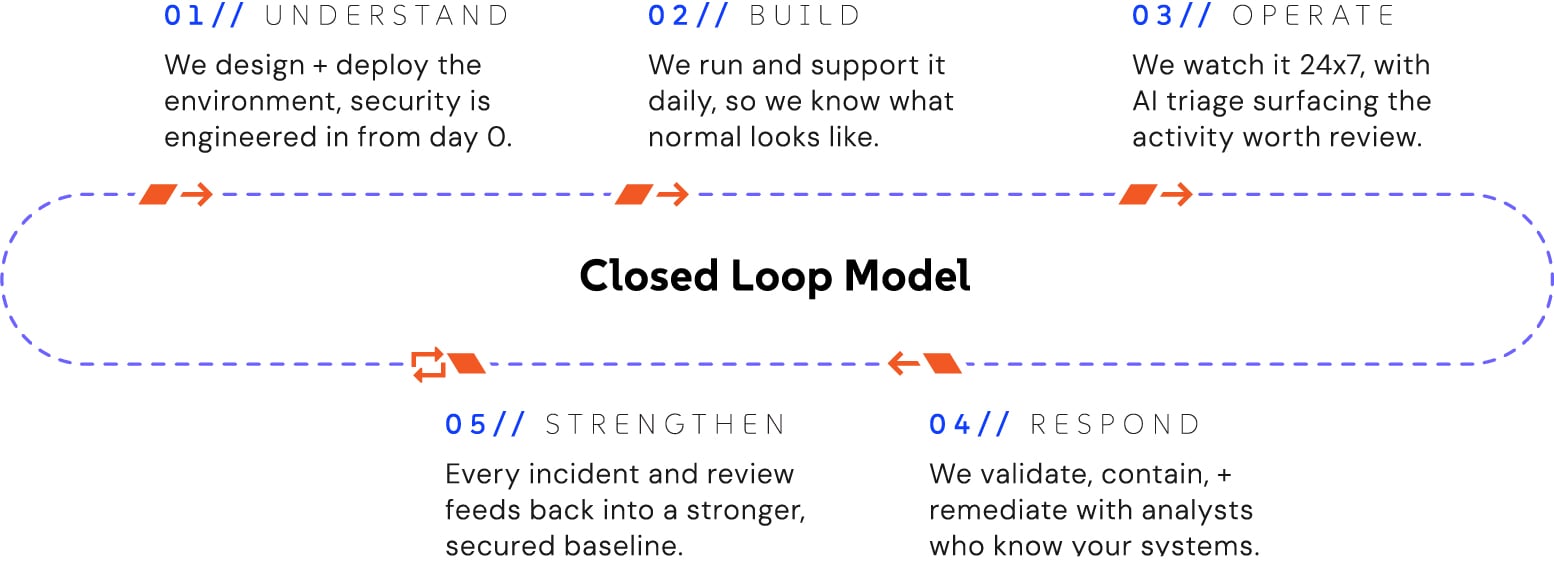
What sets CompassMSP apart is the closed-loop model. Detection, investigation, containment, and strategic advisory happen inside one team, so there are no handoffs between an outside SOC vendor and a separate advisory firm. Your vCISO knows what your SOC is seeing because they work alongside it. Your compliance documentation reflects what actually happened in your environment because the same people investigated it.
CompassMSP offers two service tiers. Core Defense provides continuous monitoring, analyst-validated triage, and standardized containment across endpoints, identity, and cloud. Apex Security adds forensic reconstruction, senior analyst-led threat hunting, and audit-ready incident reporting suitable for regulators and insurers. For most credit unions, Apex Security is the better fit because examiners expect evidence, not summaries. The company also manages 40 or more compliance controls year-round so your documentation stays current between examinations. For a deeper look at how this works in practice, read about outsourced cybersecurity for credit unions.
CompassMSP features
- 24/7 SOC with U.S.-based analysts: Real analysts monitor your environment around the clock and begin containment on validated high-priority threats within minutes.
- Human-led MDR: Senior analysts validate every critical alert, reconstruct the incident, and classify it against the MITRE ATT&CK framework before your team is asked to do anything.
- vCISO advisory: An executive-level security leader handles strategy, risk prioritization, board reporting, and examiner communication.
- Compliance documentation: The team delivers gap assessments, policy development, and audit preparation for NCUA, PCI DSS, GLBA, FFIEC, and NYDFS requirements.
- Incident response: You get investigation, evidence preservation, root cause analysis, and compliance reporting when something goes wrong, and you do not need to be an existing client to request help.
- AI-aware security: The service includes shadow AI visibility, sensitive data monitoring, and policy enforcement for AI tools your staff may already be using.
CompassMSP pros and cons
Pros:
- The closed-loop model puts detection, response, and advisory under one accountable team, which removes the vendor handoffs that slow down containment.
- The vCISO and SOC share visibility, so strategic decisions are grounded in what is actually happening in your environment.
- The company works across seven regulated industries, including financial services, healthcare, legal, insurance, and manufacturing, and holds credentials including CISSP, CRISC, and SOC 2 alignment.
- Apex Security produces audit-ready forensic documentation that examiners, insurers, and legal counsel can use directly.
Cons:
- The company focuses on small and mid-sized organizations, so very large credit unions or those with fewer than 15 employees are not a good fit.
- U.S.-based operations mean credit unions with overseas branches should confirm coverage for those locations.
- The depth of compliance integration may exceed what a very small credit union with a simple regulatory profile needs.
2. DeepSeas: Enterprise-rooted MDR with CISO advisory
DeepSeas delivers 24/7 managed detection and response across endpoint, network, email, SIEM, and operational technology environments. The company was built for enterprise clients and later refined for the mid-market, and it pairs its MDR service with CISO advisory and offensive security testing. Analysts triage and validate alerts around the clock and provide threat context rather than raw notifications.
For credit unions, DeepSeas offers strong technical depth. The response model is worth understanding before you sign, however. DeepSeas distinguishes between guided response, where its analysts recommend actions for your internal team to execute, and active remediation, where its team takes the action directly. Credit unions without dedicated security staff should confirm which model their contract includes.
DeepSeas features
- Multi-vector MDR: The service covers endpoints, network traffic, email, SIEM data, and OT environments with 24/7 analysis.
- CISO advisory: Security leaders help with governance, risk, and compliance frameworks.
- Offensive testing: Penetration testing and red team engagements validate your defenses.
DeepSeas pros and cons
Pros:
- The company operates a true 24/7 SOC with human analysts and threat hunting.
- Advisory and testing services are available alongside monitoring.
- Enterprise heritage means the platform scales well as a credit union grows.
Cons:
- The client base spans manufacturing, OT, and enterprise sectors, so credit union and NCUA-specific expertise is not a stated focus.
- The guided response model may leave containment work with your internal team unless you contract for active remediation.
- Advisory is a separate service line rather than an integrated part of daily monitoring.
3. UnderDefense: MSSP with MDR and SOC-as-a-service with a separate vCISO offering
UnderDefense is a New York-headquartered provider that supports more than 500 clients globally with MDR, SOC-as-a-service, incident response, managed SIEM, and penetration testing. The company also offers a virtual CISO service focused on compliance roadmaps and security program development. Its MDR combines 24/7 monitoring with threat hunting and rapid incident response.
For credit unions, UnderDefense provides a solid MDR-first option. Its published case studies include financial advisory and fintech clients, though credit unions and NCUA examination support are not specifically highlighted. The vCISO service is sold separately from monitoring, so you would coordinate two engagements rather than one.
UnderDefense features
- MDR services: Analysts investigate threats and initiate response actions rather than forwarding alerts.
- SOC-as-a-service: The team provides 24/7 monitoring across cloud, hybrid, and on-premises infrastructure.
- vCISO services: A fractional security leader builds compliance and security roadmaps.
UnderDefense pros and cons
Pros:
- The MDR approach means analysts investigate rather than simply alert.
- Threat hunting actively searches for attackers already in your environment.
- A vCISO option exists for organizations that want strategic guidance.
Cons:
- Credit union regulatory experience is not emphasized in the company's materials.
- The vCISO and SOC are separate engagements, which limits shared visibility between the two.
- Compliance documentation for NCUA examinations would need to be scoped as an additional deliverable.
4. Huntress: Endpoint security platform with a human SOC
Huntress combines a managed endpoint detection platform with human-powered SOC services. The company focuses on catching threats that slip past traditional security tools, and its analysts review suspicious activity to filter out false positives. Huntress sells primarily through MSP channel partners rather than directly to end customers.
For credit unions, Huntress is typically accessed through your existing managed service provider. The platform handles endpoint detection and the SOC investigates, but vCISO advisory and compliance documentation are not part of the offering. It works best as one layer inside a broader security program rather than as a complete solution.
Huntress features
- Managed endpoint detection: The platform monitors workstations and servers for malicious activity.
- Human-powered SOC: Analysts review detections and reduce alert noise for your team.
- Threat hunting: The team actively searches for attackers hiding in your environment.
Huntress pros and cons
Pros:
- Analysts review alerts, which reduces the burden on your internal staff.
- Threat hunting goes beyond passive monitoring.
- The platform integrates with common MSP tools.
Cons:
- Full service typically requires an MSP partner relationship.
- vCISO advisory is not included.
- NCUA compliance support is not built into the platform.
5. Total Assure: SMB-focused MSSP with governance services
Total Assure launched in 2023 as a spinout from IBSS, a Maryland-based firm with three decades of federal and commercial experience. The company built its services specifically for small and mid-sized businesses that struggle to afford enterprise security tools or recruit security staff. Its offerings include MDR, endpoint detection and response, managed email security, vulnerability management, and governance, risk, and compliance services.
For credit unions, Total Assure's governance services address policy development and compliance program design, which can support examination readiness. The company is young, and its public materials do not name credit unions or NCUA requirements as a specialty.
Total Assure features
- Managed detection and response: The service provides continuous device monitoring and threat containment.
- Governance, risk, and compliance: The team identifies compliance gaps and builds programs to address them.
- Cybersecurity engineering: Consultants design and deploy security technologies tailored to your risk profile.
Total Assure pros and cons
Pros:
- Compliance program development is part of the service model.
- The company was designed for organizations without in-house security staff.
- Its engineering services can fill gaps in your existing stack.
Cons:
- A formal vCISO service is not clearly listed among its offerings.
- The company has a short operating history.
- Credit union and NCUA-specific expertise would need to be verified during evaluation.
6. Eventus Security: Global SOC-as-a-service with a financial services client base
Eventus Security is a managed security services provider headquartered in Navi Mumbai, India, with a U.S. presence in Texas. The company operates 24/7 cyber defense centers and serves clients in banking, financial services, healthcare, manufacturing, and critical infrastructure. Services include SOC-as-a-service, managed XDR, digital forensics and incident response, threat intelligence, and governance, risk, and compliance consulting.
For credit unions, Eventus brings financial sector familiarity and a mature SOC operation. The primary consideration is location. Its SOC facilities operate from India, which may raise questions during NCUA examinations about data handling, third-party oversight, and time zone alignment for incident coordination.
Eventus Security features
- SOC-as-a-service: Analysts monitor endpoints, networks, and cloud workloads around the clock.
- Managed XDR: The platform correlates telemetry across your environment for detection and response.
- Incident response and forensics: A dedicated lab supports investigation and malware analysis.
Eventus Security pros and cons
Pros:
- The company has significant banking and financial services experience.
- The SOC operation is large and operates continuously.
- Governance and compliance consulting are available.
Cons:
- SOC operations are based outside the United States, which affects vendor risk documentation and examiner conversations.
- NCUA-specific compliance experience is not a stated focus.
- Advisory services are not integrated with daily monitoring.
7. CyberNX: India-based managed security with SOC, MDR, and vCISO services
CyberNX is a cybersecurity firm headquartered in Mumbai that serves banks, fintech companies, insurers, and government organizations. The company offers 24/7 managed security services, SOC support, MDR, digital forensics, vulnerability assessments, and vCISO services. It holds ISO 27001:2022 certification and is empaneled with CERT-In, India's national cybersecurity agency.
For credit unions, CyberNX offers a broad service menu at a price point that reflects its offshore delivery model. Its regulatory expertise centers on Indian and international frameworks such as ISO 27001, and its financial services experience is concentrated in the Indian banking sector. U.S. credit unions would need to confirm how the company supports NCUA and FFIEC expectations.
CyberNX features
- Managed SOC and MDR: The team monitors your environment and responds to threats continuously.
- vCISO services: A fractional security leader supports strategy and compliance.
- Forensics and incident response: The company supports investigation during active events.
CyberNX pros and cons
Pros:
- Incident response is part of the offering rather than a separate retainer.
- vCISO services are available.
- The company holds ISO 27001 certification.
Cons:
- Operations are based in India, which raises the same vendor oversight questions as any offshore SOC.
- Regulatory experience is oriented toward Indian and international standards rather than NCUA.
- U.S. financial sector references would need to be requested during evaluation.
Comparison table: MSSPs for credit unions
| Provider | 24/7 SOC | U.S.-based operations | vCISO offered | vCISO integrated with SOC | Credit union or NCUA focus |
|---|---|---|---|---|---|
| CompassMSP | ✓ | ✓ | ✓ | ✓ | ✓ |
| DeepSeas | ✓ | ✓ | ✓ | ✗ | ✗ |
| UnderDefense | ✓ | ✓ | ✓ | ✗ | ✗ |
| Huntress | ✓ | ✓ | ✗ | ✗ | ✗ |
| Total Assure | ✓ | ✓ | Unclear | ✗ | ✗ |
| Eventus Security | ✓ | ✗ | Limited | ✗ | ✗ |
| CyberNX | ✓ | ✗ | ✓ | ✗ | ✗ |
What is the difference between an MSP and an MSSP?
A managed service provider (MSP) runs your day-to-day IT, including the help desk, infrastructure, patching, and technology planning. A managed security service provider (MSSP) focuses on security, including 24/7 monitoring, threat detection, incident response, and compliance reporting.
Many credit unions hire one of each. That arrangement creates a gap when the MSSP finds a threat and the MSP has to fix it, because the remediation ticket passes between two companies with separate priorities. A provider that runs both functions can contain and remediate a threat inside one team. Read more about the key differences in this article: MSP vs. MSSP vs. vCISO: Which is right for your business.
What should credit unions look for in a vCISO provider?
A vCISO for a credit union needs more than cybersecurity fundamentals. They need to speak the language of NCUA examiners, translate technical risk into terms your board can act on, and build a security program that scales as your membership grows.
Look for providers where the vCISO role connects directly to threat monitoring. A virtual CISO with no visibility into what your SOC is seeing makes strategic decisions without operational context. The best arrangement puts both functions inside one team so that policy, monitoring, and incident evidence all describe the same environment.
The vCISO should also prepare you for examiner interactions. When NCUA arrives, you want someone who can explain your security posture in the terms regulators expect and back it up with documentation that reflects real monitoring activity.
How does MDR differ from traditional SOC monitoring?
Traditional SOC monitoring watches your environment and alerts you when something looks suspicious. What happens next is usually your responsibility. MDR goes further by investigating those alerts and taking containment action.
For credit unions, this distinction matters because most do not have a security analyst waiting for a 2 a.m. notification. When an alert fires, you need someone who will determine whether it is real, contain the threat if it is, and document what happened. MDR providers handle that investigation and response rather than handing you a ticket.
The closed-loop version of MDR takes one more step. Because the same team handles detection, response, and advisory, the lessons from each incident feed directly back into your security program without a vendor handoff in between.
The same feedback loop drives continuous threat exposure management, which applies it to finding and closing weaknesses before an incident occurs.
What should credit unions look for in an MSSP incident response retainer?
An incident response retainer defines what your MSSP does the moment you suspect a breach. Ask for documented response times by severity level, and confirm the retainer covers containment, forensic investigation, evidence preservation, and recovery.
Ask whether the MSSP handles incident response in-house or subcontracts it. A subcontracted responder adds a handoff between detection and containment, and it adds another vendor to your third-party oversight program.
The NCUA's 72-hour rule calls for an early alert, and the initial notification does not require a detailed incident assessment. Your MSSP should still give you enough facts within that window to decide whether an incident is reportable. The 72-hour clock also starts when a third party notifies you of a reportable cyber incident, so your MSSP contract should require prompt notice of any incident on the provider's side.
Why CompassMSP is the top SOC and vCISO provider for credit unions
Credit unions have no room for security gaps. You protect member data, satisfy regulators, and maintain the trust that makes your institution work. CompassMSP built its managed cybersecurity for exactly this situation.
The closed-loop model connects 24/7 SOC monitoring, human-led MDR, and vCISO advisory inside one accountable team. Your virtual CISO knows what your SOC is seeing. Your compliance documentation reflects your actual security posture. When examiners ask questions, you have answers backed by continuous monitoring and forensic evidence.
CompassMSP manages 40 or more compliance controls year-round, which keeps you audit-ready between examinations instead of scrambling before them. Average SOC analyst reaction time under 15 minutes means threats are addressed before they become reportable incidents.
If you are ready to protect your credit union with managed security built for regulated financial institutions, connect with the CompassMSP team

Paul Breitenbach
With nearly 20 years of experience designing enterprise-grade IT solutions, Paul specializes in supporting organizations that cannot afford downtime. Before becoming our CIO, he served as CIO of WorldwideIT, a Compass company, where he led large-scale infrastructure, cloud, and security initiatives for highly regulated industries.