

- | Home
- | Resources
- | Guides + Checklists
Get The Guide
GUIDES + CHECKLISTS
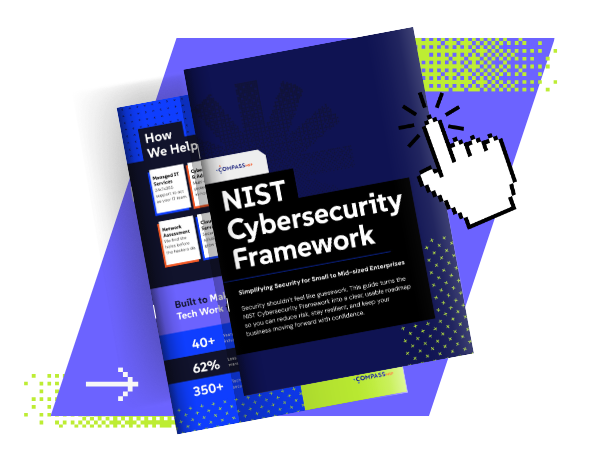
NIST Cybersecurity Framework Guide
Most security frameworks read like they were written for somebody with unlimited time, unlimited budget, and unlimited patience. That’s not real life. You need clarity. You need direction. And you need a plan that fits the way your business runs.
That’s why this guide exists. We took the NIST Cybersecurity Framework and stripped out the noise, leaving you with clear steps, plain language, and guidance you can act on today.
What You Will Learn About The NIST Cybersecurity Framework
This guide translates the NIST Cybersecurity Framework into plain language to help you understand what is required to strengthen your security and improve your operational resilience. We move past the technical jargon to provide a clear view of how these standards protect your revenue and your reputation. By focusing on practical application, you can implement high-level security measures that support your people instead of creating administrative friction.
- Risk Visibility: Identify exactly where your hidden vulnerabilities reside so you can stop guessing and start prioritizing the investments that protect your most critical assets.
- Operational Continuity: Learn how to build a resilient business environment that maintains performance and security even when your internal teams are facing bandwidth constraints.
- Sustainable Compliance: Develop a method for meeting the rising expectations of regulators and partners without turning your daily operations inside out or over-engineering your systems.
Why This Guide Matters
Get a clear breakdown of the NIST Cybersecurity Framework so you can understand what it is, why it matters, and how it supports stronger security decisions inside your business.
Learn how the NIST model helps you pinpoint your highest-impact risks, reduce noise, and focus your security budget on what moves the needle.
See how to apply NIST guidance in a way that fits your environment, making compliance simpler, more realistic, and far easier to maintain over time.
Your Biggest Risk Isn’t What You Think
FAQs
Questions About the NIST Cybersecurity Framework
This FAQ gives you quick, practical answers to the most common questions about the NIST Cybersecurity Framework and how to make it work inside your business.
What Is The NIST Cybersecurity Framework?
The NIST Cybersecurity Framework is a voluntary set of standards and best practices developed by the National Institute of Standards and Technology to help organizations manage and reduce cybersecurity risk. It organizes security activities into five main functions which include Identify, Protect, Detect, Respond, and Recover. This structure allows businesses of all sizes to speak a common language when discussing risk with partners, regulators, and internal stakeholders. Following this framework ensures that your security program is built on a globally recognized foundation of excellence.
[source https://www.nist.gov/cyberframework]
Do I Need To Be A Technical Expert To Use The NIST Framework?
No, you do not need to be a technical expert because the framework is designed to be a bridge between executive leadership and IT operations. While the underlying controls involve technical implementation, the framework itself focuses on business outcomes and risk management. This allows a CEO or CFO to make informed decisions about security investments without needing to understand every line of code or firewall configuration. Our guide simplifies these concepts so you can lead your organization’s security strategy with confidence.
Is The NIST Framework Required For Compliance?
While the framework itself is voluntary for many private organizations, it serves as the foundation for many mandatory regulations such as CMMC, HIPAA, and various state-level privacy laws. Many government agencies and large prime contractors now require their partners to demonstrate alignment with NIST standards as a condition of doing business. Following this framework ensures that you are prepared for more rigid audits if your regulatory requirements change in the future. It is widely considered the "gold standard" for proving due diligence to third parties.
How Does NIST Help My Business Reduce Risk?
NIST reduces risk by providing a structured and repeatable process for identifying vulnerabilities before they can be exploited by malicious actors. Instead of reacting to individual threats as they arise, you build a comprehensive defense that addresses the root causes of security failures. This proactive approach significantly lowers the likelihood of catastrophic downtime and protects your brand reputation from the fallout of a public data breach. By aligning with NIST, you are making a strategic investment in the long-term stability of your operation. [source https://www.nist.gov/cyberframework]
Can NIST Work For Smaller Teams Or Lean IT Departments?
The framework is specifically designed to be scalable and can be adjusted to fit the specific resources and needs of any organization. You do not need a massive IT department to benefit from the NIST functions because the framework allows you to prioritize the most impactful activities first. By focusing on the "Identify" and "Protect" categories, smaller teams can achieve significant security gains without becoming overwhelmed by the full list of controls. This makes NIST an ideal tool for organizations that need to be highly efficient with their security spending.
Is This Guide Different From The Official NIST Documentation?
This guide is a strategic translation of the official documentation designed for business leaders who need to understand the impact of NIST without getting lost in the technical details. We focus on the "why" and "how" of implementation rather than just the "what." Our goal is to provide a practical roadmap that you can actually use to drive decision-making and improve your operational resilience. We remove the academic tone of the original documents and replace it with actionable insights tailored for the executive suite.
How Long Does It Take To Implement The NIST Framework?
Implementation is an ongoing process of improvement rather than a one-time project with a fixed end date. Most organizations can establish a baseline alignment within 6 to 12 months, depending on their current maturity and available resources. The framework is meant to be used as a continuous cycle of assessment and refinement to stay ahead of evolving threats and business changes. This phased approach allows you to show measurable progress to your board and stakeholders while you steadily harden your defenses.
Does Using NIST Mean I Need To Buy New Cybersecurity Tools?
Not necessarily, as the framework is tool-agnostic and focuses on how you manage and govern your existing security environment. Many organizations find that they already have the necessary tools in place but are not using them effectively to meet the specific requirements of the framework. NIST helps you identify where you might be over-invested in some areas and under-protected in others, allowing for a more efficient use of your current budget. The goal is to ensure your technology is working in harmony with your business processes.
How Does The NIST Framework Help With Incident Response?
The "Respond" and "Recover" functions of the framework provide a clear playbook for exactly what to do when a security incident occurs. This reduces the chaos and uncertainty that often follow an attack, allowing your team to move quickly to contain the threat and restore operations. Having a NIST-aligned response plan is also a key requirement for many cyber insurance policies and regulatory bodies. It demonstrates to your customers and partners that you have the resilience to survive a worst-case scenario. [source https://www.cisa.gov/resources-tools/resources/nist-cybersecurity-framework-11-resource-guide]
What Happens After I Download The Guide?
Once you download the guide, you will have a clear understanding of the framework and can begin assessing your own organization against the five core functions. We recommend reviewing the guide with your leadership team and your IT partner to identify your most immediate security priorities. From there, you can schedule a consultation with a CompassMSP vCISO to turn those insights into a customized, risk-focused plan for your business. This is the first step toward building a technology foundation that supports your people and protects your future.
Featured Resources
Explore expert insights, practical tips, and real-world advice from our blog curated to help you make smarter tech decisions.
Cybersecurity eBooks 0 min read
NIST Cybersecurity Framework
Get a clear, practical breakdown of the NIST Cybersecurity Framework. Learn how to identify risks, strengthen security, and build resilience with a simple plan.
Compliance & Risk Guides & Checklists 0 min read
CMMC Checklist
A CEO-level CMMC Level 2 readiness checklist for aerospace and defense manufacturers. Understand scope, risk, costs, and what’s required before November 2026, without over-engineering your operation.

Cybersecurity Guides & Checklists 0 min read