

Published: Updated: Jim Ambrosini 19 min read


If you're an IT leader at a manufacturing or defense contractor company, you already know the stakes. Winning managed IT services for manufacturing and defense contractors isn't just about keeping systems running—it's about protecting controlled unclassified information (CUI), passing CMMC assessments, and securing operational technology that connects your shop floor to your enterprise network.
| NOTE: On July 13, 2026, the DoD suspended CMMC Phase II and its third-party assessment requirements pending a 60-day reform review, but DFARS 7012 and the 110 NIST 800-171 controls remain fully in force. Here's what this means for your obligations. |
The right MSP becomes your compliance partner, your cybersecurity team, and your IT strategy advisor all at once. CompassMSP delivers exactly this combination for manufacturers and defense contractors who can't afford gaps in their security posture. This guide walks you through the 10 non-negotiable capabilities your MSP must have.
Use these criteria to evaluate any provider you're considering—and to confirm your current partner measures up to the demands of regulated manufacturing environments.
Quick guide: 10 essential MSP capabilities for manufacturing and defense contractors
- CMMC compliance consulting: The best foundation for DoD contract eligibility
- NIST 800-171 implementation: Documentation and controls for CUI protection
- 24/7 Security Operations Center (SOC): Around-the-clock threat monitoring
- OT/IT network segmentation: Secure boundaries between production and business systems
- Enclave strategy expertise: Isolating CUI environments for cost-effective compliance
- vCISO advisory services: Strategic security leadership on demand
- Backup and disaster recovery testing: Verified restoration for production data
- Incident response planning: Documented playbooks for manufacturing disruptions
- Supply chain security oversight: Third-party risk management for your vendors
- Fixed-fee pricing models: Predictable costs for regulated environments
How we identified the must-have MSP capabilities for manufacturing
Manufacturing and defense contractors face regulatory pressures that general businesses don't encounter. Your MSP needs to understand how ERP systems connect to CNC machines, why production downtime costs more than office downtime, and how CUI flows through your entire operation.
We evaluated capabilities based on what matters most to IT leaders at regulated manufacturers:
- Regulatory alignment: Does the capability directly support CMMC, NIST 800-171, or ITAR requirements? Compliance failures mean losing contracts.
- Production continuity: Can this capability prevent or minimize manufacturing downtime? Every hour of production stoppage impacts revenue.
- CUI protection: Does this capability help safeguard controlled unclassified information throughout its lifecycle?
- Scalability: Will this capability work as you add locations, expand your supply chain, or take on larger DoD contracts?
- Audit readiness: Does this capability generate the documentation and evidence needed for C3PAO assessments?
Related: How to Choose a Managed IT Provider for Regulated SMBs: A 12-Question Framework
The 10 essential MSP capabilities for manufacturing and defense IT
1. CMMC compliance consulting: Best foundation for DoD contract eligibility
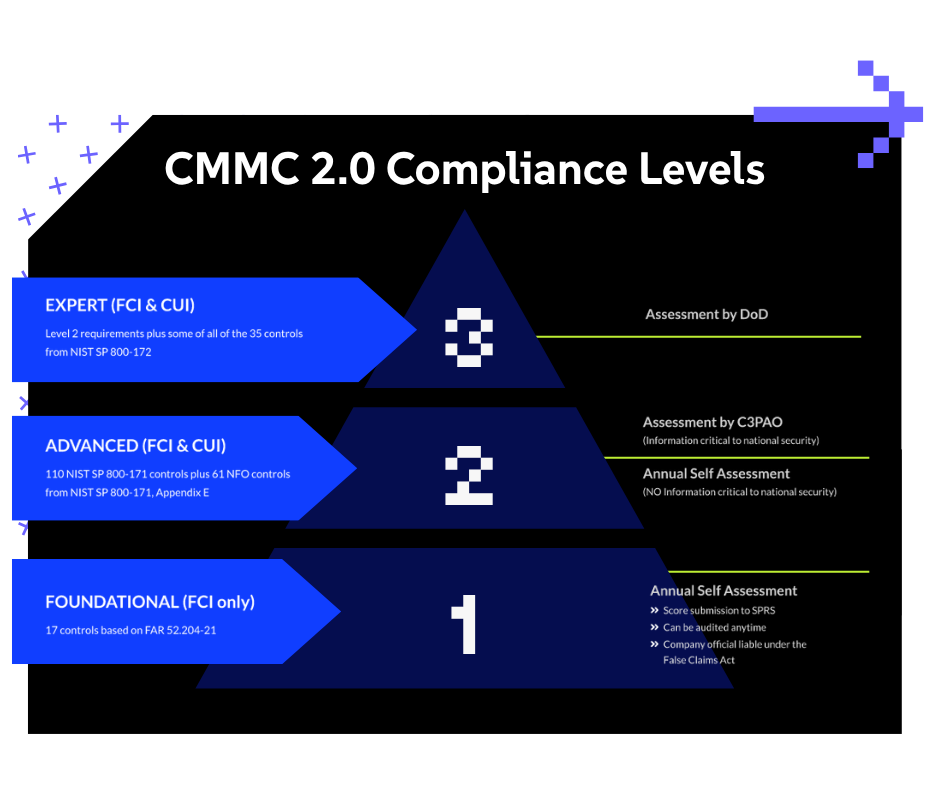
CMMC compliance determines which manufacturers can compete for Department of Defense contracts. With Phase 2 enforcement starting in late 2026, manufacturers handling CUI must achieve Level 2 certification through third-party assessment. CompassMSP brings RPO certification from The Cyber AB, giving you authorized guidance through every step of the certification process.
The challenge for most manufacturers isn't understanding what CMMC requires, it's implementing 110 security controls without disrupting production. An estimated 80,000 defense contractors need Level 2 certification, according to DoD projections. Your MSP should map controls to your specific manufacturing workflows, not force you into a generic IT framework that ignores how your business actually operates.
CompassMSP guides defense contractors through CMMC readiness with a shared-responsibility matrix that clarifies exactly what you own and what we manage. This approach prevents the scope creep and finger-pointing that derail compliance timelines.
CMMC compliance consulting benefits
- Gap assessment and remediation roadmap: Identify exactly where your current security posture falls short before engaging a C3PAO assessor, saving time and preventing failed audits.
- Control implementation: Deploy the technical controls—MFA, encryption, access management, logging—that satisfy CMMC requirements without overwhelming your IT team.
- Documentation generation: Create the System Security Plan (SSP), policies, and procedures that assessors require as evidence of your security program.
- Ongoing compliance maintenance: Keep your certification valid with regular reviews and updates as CMMC requirements evolve.
- Shared-responsibility clarity: Know exactly which controls your MSP manages and which remain your responsibility, eliminating audit surprises.
CMMC compliance consulting pros and cons
Pros:
- Maintains eligibility for DoD contracts worth billions annually
- Reduces risk of False Claims Act liability from inaccurate self-assessments
- Positions your company ahead of competitors still scrambling to comply
Cons:
- Requires organizational commitment beyond IT—operations, HR, and leadership must participate
- Initial assessment may reveal more gaps than anticipated, extending remediation timelines
- Certification is point-in-time; ongoing maintenance is required to stay compliant
2. NIST 800-171 implementation: Documentation and controls for CUI protection
NIST SP 800-171 forms the technical foundation for CMMC Level 2. This framework specifies 110 security requirements across 14 control families—from access control to system integrity. For manufacturers, implementation means securing not just office networks but also engineering workstations, ERP systems, and any device that touches CUI.
Your MSP should translate these requirements into practical configurations. Access control becomes role-based permissions tied to job functions. Audit and accountability becomes centralized logging that captures who accessed which engineering drawings and when.
NIST 800-171 implementation benefits
- CUI boundary definition: Identify exactly where controlled information lives in your environment, reducing the scope of compliance efforts.
- Technical control deployment: Implement the encryption, access controls, and monitoring tools that satisfy each requirement.
- Assessment objective mapping: Align your evidence to the 320 assessment objectives assessors will evaluate during certification.
NIST 800-171 implementation pros and cons
Pros:
- Creates the security baseline required for CMMC certification
- Improves overall security posture beyond compliance requirements
- Documentation serves multiple regulatory purposes (ITAR, export controls)
Cons:
- Rev. 3 introduced changes that may require updating existing implementations
- Some controls require organizational policy changes, not just technical fixes
- Full implementation timeline depends on current security maturity
3. 24/7 Security Operations Center (SOC): Around-the-clock threat monitoring
Manufacturing doesn't stop at 5 p.m., and neither do cyber threats. Ransomware attacks often launch during off-hours when response times are slowest. A U.S.-based SOC monitoring your environment around the clock catches threats before they spread from a single workstation to your entire production network.
CompassMSP operates a 24/7 SOC staffed by security analysts who understand manufacturing environments. When an alert fires at 2 a.m., our team has the context to distinguish between a legitimate threat and a false positive from your CNC controller's unusual network pattern.
24/7 SOC benefits
- Real-time threat detection: Identify malicious activity as it happens, not hours or days later when damage is done.
- Human-led analysis: Security analysts investigate alerts, reducing false positives and ensuring real threats get immediate attention.
- Rapid containment: Isolate affected systems quickly to prevent lateral movement through your network.
24/7 SOC pros and cons
Pros:
- Provides coverage most manufacturers cannot staff internally
- Reduces mean time to detect and respond to incidents
- Meets CMMC requirements for security monitoring
Cons:
- Effectiveness depends on proper sensor deployment across your environment
- Requires initial tuning to minimize alert fatigue from legitimate manufacturing processes
- Remote SOC teams need clear escalation paths to your on-site personnel
4. OT/IT network segmentation: Secure boundaries between production and business systems
The convergence of operational technology (OT) and information technology (IT) creates attack paths that didn't exist a decade ago. Your CNC machines, PLCs, and SCADA systems now connect to networks that also carry email and web traffic. Without proper segmentation, a phishing email can become a production shutdown.
NIST SP 800-82 outlines security guidance specifically for OT environments. Your MSP should understand these requirements and implement network architectures that allow necessary data flow while blocking threat propagation.
OT/IT segmentation benefits
- Attack surface reduction: Limit the pathways attackers can use to reach critical production systems.
- Blast radius containment: If ransomware hits your business network, segmentation prevents it from encrypting your manufacturing floor.
- Compliance alignment: Proper segmentation reduces the scope of CMMC assessments by isolating CUI environments.
OT/IT segmentation pros and cons
Pros:
- Protects legacy manufacturing equipment that cannot receive security updates
- Enables modernization of business systems without exposing production
- Supports zero-trust architecture principles
Cons:
- Requires careful planning to maintain necessary production data flows
- Legacy equipment may need additional hardware for network isolation
- Ongoing management needed as manufacturing processes evolve
Related: Learn how Cybercriminals use Operational Technology to breach your network in this on-demand webinar. The Visibility Void The Cybersecurity Threat You Never Saw Coming
5. Enclave strategy expertise: Isolating CUI environments for cost-effective compliance
An enclave approach concentrates CUI handling into a defined, heavily secured environment rather than applying CMMC controls across your entire network. For many small and mid-sized manufacturers, this strategy makes compliance achievable without rebuilding their entire IT infrastructure.
CompassMSP implements enclave strategies that align with how manufacturing actually works. Engineering files enter through secure channels, CAD/CAM work happens inside the enclave, and controlled media transfers G-code to offline CNC machines. This approach reduces your assessment scope while maintaining the production workflows you depend on.
Enclave strategy benefits
- Reduced compliance scope: Apply rigorous controls only where CUI actually lives, not across every workstation.
- Lower implementation costs: Focus security investments on the enclave rather than enterprise-wide upgrades.
- Faster certification timeline: Smaller scope means fewer controls to document and verify.
Enclave strategy pros and cons
Pros:
- Makes CMMC Level 2 achievable for smaller manufacturers
- Allows continued use of legacy systems outside the enclave
- Cloud-based enclaves can be managed by specialized providers
Cons:
- Requires disciplined data handling to keep CUI inside the enclave
- Workflow changes may be needed for personnel who access CUI
- Enclave boundaries must be clearly documented for assessors
|
Related Article: Where you Store Your CUI Data Matters More than You Think
|
6. vCISO advisory services: Strategic security leadership on demand
Most manufacturers don't need a full-time Chief Information Security Officer, but they do need someone connecting security decisions to business outcomes. A virtual CISO (vCISO) brings executive-level security expertise to your quarterly planning, budget discussions, and board presentations without the six-figure salary.
CompassMSP's vCISO advisory translates technical risks into business terms. When a new DoD contract requires enhanced security controls, your vCISO maps out the implementation roadmap and budget impact before you sign.
vCISO advisory benefits
- Strategic roadmap development: Align security investments with business growth and contract requirements.
- Board and executive communication: Present security posture and risks in terms leadership understands.
- Vendor and tool evaluation: Get objective guidance on security purchases without sales pressure.
vCISO advisory pros and cons
Pros:
- Access to senior security expertise at a fraction of full-time cost
- Provides the security leadership role that CMMC and customers expect
- Brings cross-industry perspective from working with multiple manufacturing clients
Cons:
- Shared resource—not dedicated exclusively to your organization
- Effectiveness depends on regular engagement and information sharing
- Strategic guidance requires operational teams to execute recommendations
7. Backup and disaster recovery testing: Verified restoration for production data
Backups only matter if they actually work when you need them. Ransomware attackers know that many organizations discover their backups are corrupt or incomplete only after an attack. Regular restoration testing proves your recovery capability before disaster strikes.
CompassMSP performs scheduled backup restoration tests and documents the results. You'll know your recovery time objectives (RTO) and recovery point objectives (RPO) based on actual test data, not theoretical estimates.
Backup and disaster recovery testing benefits
- Verified recoverability: Confirm that critical production data and systems can actually be restored.
- Documented RTOs: Know exactly how long recovery will take for planning and insurance purposes.
- Immutable backup protection: Prevent ransomware from encrypting or deleting your backup data.
Backup and disaster recovery testing pros and cons
Pros:
- Eliminates uncertainty about disaster recovery capabilities
- Meets CMMC requirements for contingency planning
- Provides documentation for cyber insurance claims
Cons:
- Testing requires coordination to avoid production impact
- Full environment restoration tests need isolated infrastructure
- Recovery capabilities depend on backup frequency and retention policies
8. Incident response planning: Documented playbooks for manufacturing disruptions
When a security incident hits your manufacturing environment, the first hour determines whether you contain the damage or watch it spread. Documented incident response playbooks ensure your team knows exactly what to do, who to contact, and how to preserve evidence for investigation.
CompassMSP develops incident response plans tailored to manufacturing scenarios—from ransomware affecting production systems to data exfiltration targeting engineering files. Your plan includes contact lists, communication templates, and decision trees that work at 3 a.m. when stress is high.
Incident response planning benefits
- Faster containment: Pre-defined procedures eliminate decision paralysis during active incidents.
- Evidence preservation: Proper handling supports forensic investigation and potential legal action.
- Communication readiness: Know how to notify customers, regulators, and employees appropriately.
Incident response planning pros and cons
Pros:
- Reduces incident impact through coordinated response
- Satisfies CMMC incident response requirements
- Demonstrates due diligence to customers and insurers
Cons:
- Plans require regular testing and updates to remain effective
- Staff must be trained on their roles before an incident occurs
- Tabletop exercises need scheduling and participation commitment
9. Supply chain security oversight: Third-party risk management for your vendors
Your security is only as strong as your weakest supplier. Defense primes increasingly require their suppliers to demonstrate security maturity, and you likely have similar expectations for your own vendors. A capability for managing third-party security risk helps you evaluate suppliers and respond when their incidents affect your operations.
CompassMSP helps manufacturers implement supply chain security programs that satisfy both CMMC flow-down requirements and customer expectations. This includes vendor security assessments, contract language recommendations, and monitoring for supplier breaches that could impact your data.
Supply chain security oversight benefits
- Vendor risk assessment: Evaluate supplier security before sharing sensitive data or granting network access.
- Contract security requirements: Include appropriate security language in supplier agreements.
- Breach notification monitoring: Learn quickly when suppliers experience incidents that could affect you.
Supply chain security oversight pros and cons
Pros:
- Reduces risk from third-party security failures
- Meets CMMC supply chain risk management requirements
- Strengthens your position when primes audit your security
Cons:
- Requires cooperation from suppliers who may resist assessments
- Smaller suppliers may lack security documentation you need
- Ongoing monitoring needed as supplier relationships evolve
10. Fixed-fee pricing models: Predictable costs for regulated environments
Break-fix IT pricing creates misaligned incentives—your provider profits when things break. Fixed-fee models align your MSP's success with your uptime and security. For manufacturers budgeting compliance projects and infrastructure investments, predictable monthly costs enable better financial planning.
CompassMSP operates on a fixed-fee model that covers monitoring, support, and security services. You know your IT costs before the month starts, not after unexpected invoices arrive.
Fixed-fee pricing benefits
- Budget predictability: Know your IT costs for financial planning and contract pricing.
- Aligned incentives: Your MSP succeeds when your systems run smoothly, not when they fail.
- Comprehensive coverage: Avoid nickel-and-diming for routine support and maintenance.
Fixed-fee pricing pros and cons
Pros:
- Eliminates surprise IT expenses that disrupt cash flow
- Encourages proactive maintenance over reactive break-fix
- Simplifies cost allocation for DoD contract pricing
Cons:
- Major projects or expansions may require separate scoping
- Requires accurate initial assessment of your environment
- Some specialized services may be priced separately
Comparison table: MSP capabilities for manufacturing and defense IT
| Capability | CMMC Impact | Production Continuity Impact | CompassMSP Offering |
|---|---|---|---|
| CMMC Compliance Consulting | Direct | Indirect | RPO Certification |
| NIST 800-171 Implementation | Direct | Indirect | ✓ |
| 24/7 SOC Monitoring | Direct | Direct | U.S.-Based SOC |
| OT/IT Segmentation | Direct | Direct | ✓ |
| Enclave Strategy | Direct | Indirect | ✓ |
| vCISO Advisory | Indirect | Indirect | ✓ |
| Backup/DR Testing | Direct | Direct | Quarterly Testing |
| Incident Response | Direct | Direct | ✓ |
| Supply Chain Security | Direct | Indirect | ✓ |
| Fixed-Fee Pricing | Indirect | Indirect | ✓ |
What questions should you ask when evaluating an MSP for manufacturing IT?
Evaluating an MSP goes beyond comparing feature lists. You need to understand how a potential partner handles real manufacturing scenarios—from ERP failures to CMMC assessments to shop-floor connectivity issues.
Start by asking about their experience with manufacturing clients specifically. A provider that primarily supports law firms or medical practices may not understand the difference between a production system outage and a back-office email problem. The business impact is fundamentally different.
Request documentation of their response times and resolution metrics. Ask for references from manufacturers in similar regulatory environments. And confirm they understand the frameworks you're required to follow:
- How many CMMC assessments have you supported clients through?
- Do you hold any certifications from The Cyber AB (RPO, RP)?
- How do you handle OT security differently from traditional IT?
- What's your approach to enclave design for CUI protection?
- How do you document the shared responsibility for controls we manage versus controls you manage?
Related Article: How to Choose a Managed IT Provider for Regulated SMBs: A 12-Question Framework
How can an MSP help you achieve CMMC certification faster?
CMMC certification timelines depend heavily on your starting security posture and how efficiently you close gaps. An experienced MSP accelerates the process by bringing pre-built solutions, proven implementation patterns, and familiarity with what assessors expect to see.
According to CISA's Critical Manufacturing Sector Security Guide, manufacturers should integrate security practices across physical, cyber, personnel, and supply chain domains. An MSP with manufacturing expertise helps you address all four domains systematically rather than treating cybersecurity as an isolated IT project.
CompassMSP brings dual-track assessment and remediation capabilities, meaning we can evaluate your gaps while simultaneously beginning remediation work. This parallel approach compresses timelines compared to sequential assess-then-fix models. For manufacturers working with Connecticut CAP grants or similar funding, we align our work to meet grant requirements and documentation standards.
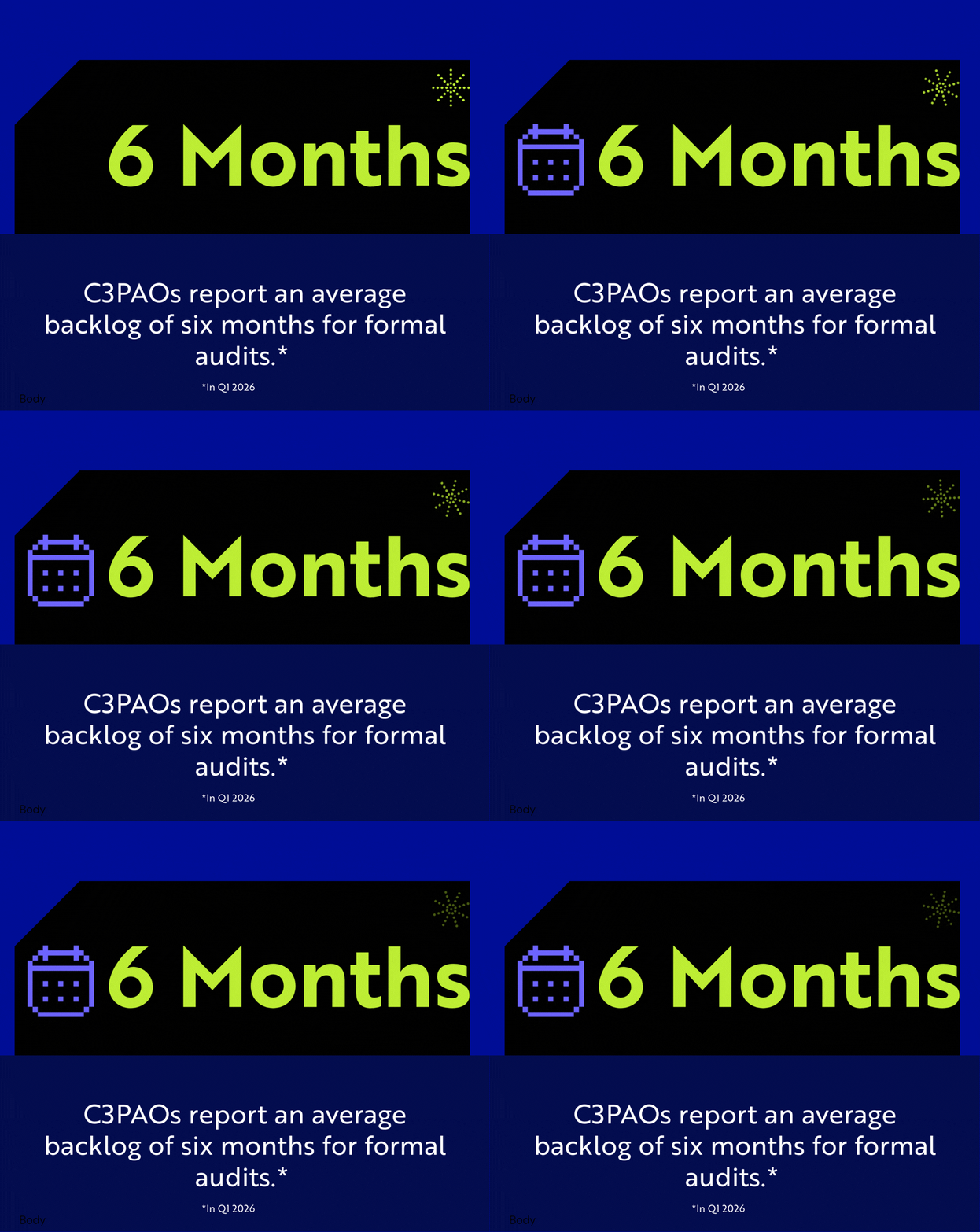
The key is starting early. With limited C3PAO assessment slots available and 80,000+ contractors needing certification, waiting until enforcement deadlines creates unnecessary risk. Beginning your readiness work now gives you flexibility to address unexpected gaps without deadline pressure.
Why CompassMSP is the best MSP for manufacturing and defense contractors
Manufacturing and defense contractors need an MSP that understands both the technical requirements of CMMC compliance and the operational realities of production environments. Generic IT providers often miss the connection between shop-floor systems and enterprise security—a blind spot that creates compliance gaps and operational risks.
CompassMSP brings RPO certification from The Cyber AB, meaning we're authorized to guide you through CMMC readiness. Our team includes specialists who understand enclave strategies for CUI protection, OT security for industrial networks, and the documentation requirements assessors expect to see.
Beyond compliance, CompassMSP delivers 24/7 SOC monitoring, vCISO advisory services, and the fixed-fee pricing model that lets you budget IT costs with confidence. Our national network of over 350 experts combines hands-on local support with the specialized expertise needed for regulated manufacturing environments.
For manufacturers navigating CMMC deadlines while keeping production running, CompassMSP offers the combination of compliance expertise, cybersecurity depth, and manufacturing-specific knowledge you need. Contact CompassMSP to discuss how we can support your compliance journey and protect your operations.
FAQs about MSP capabilities for CMMC and manufacturing IT
What is the difference between CMMC Level 1 and Level 2 for manufacturers?
CMMC Level 1 covers basic cyber hygiene for Federal Contract Information (FCI) and allows self-assessment. Level 2 applies to manufacturers handling Controlled Unclassified Information (CUI) and requires implementing all 110 NIST SP 800-171 controls.
Most manufacturers working on DoD contracts that involve technical data, engineering drawings, or specifications need Level 2. CompassMSP helps you determine your required level based on the information you handle and the contracts you pursue.
Read a Full breakdown between CMMC level 1 and level 2 here.
How long does it take to achieve CMMC Level 2 certification?
Timeline depends on your current security maturity. Manufacturers starting with minimal security controls typically need 12-18 months for full readiness. Those with existing security programs may achieve certification in 6-9 months.
CompassMSP accelerates timelines through parallel assessment and remediation work, addressing gaps while simultaneously building documentation.
What is an enclave strategy and why does it matter for CMMC?
An enclave isolates CUI-handling systems from the rest of your network, applying rigorous security controls only where CUI actually lives. This approach reduces compliance scope, lowers costs, and speeds certification.
CompassMSP designs enclaves that work with manufacturing workflows—securing CAD/CAM workstations and engineering file storage while allowing production systems to operate efficiently.
Do MSPs need special certifications to help with CMMC compliance?
While not legally required, certifications from The Cyber AB (the CMMC accreditation body) demonstrate an MSP's commitment and competency. Registered Provider Organizations (RPOs) and Registered Practitioners (RPs) have completed training on CMMC requirements.
CompassMSP holds RPO certification, authorizing us to guide manufacturers through assessment preparation and remediation.
How does OT security differ from traditional IT security in manufacturing?
Operational technology includes industrial control systems, PLCs, CNC machines, and SCADA systems that directly control physical processes. These systems often run legacy software, cannot be easily patched, and prioritize availability and safety over confidentiality.
CompassMSP implements segmentation strategies that protect OT environments while maintaining the connectivity needed for modern manufacturing operations.

Jim Ambrosini
Jim is an award-winning CISO and cybersecurity advisor with over two decades of experience helping organizations protect what matters most: their customers, their data, and their reputation.