

Published: Updated: Brian Bennet 12 min read

IT Directors invest heavily in firewalls, endpoint protection, and other technical controls. Yet the most sophisticated threat actors often bypass these defenses by targeting the person behind the keyboard. Social engineering attacks exploit basic human instincts, like trust, fear, urgency, and curiosity, to gain unauthorized access to otherwise secure systems.
For IT Directors at small businesses, this creates a unique challenge. Infrastructure maintenance, help desk demands, and project backlogs already consume your budget and time. Addressing the “human element” of security can feel like a lower priority. The data, however, tells a different story. According to the 2023 Verizon Data Breach Investigations Report, approximately 74% of all data breaches include a human element, involving social engineering, errors, or misuse.
This article breaks down what social engineering is, why it poses such a significant risk to small businesses, and how to reduce exposure without draining limited resources or stalling critical IT initiatives. It’s written for IT Directors navigating tight bandwidth, growing operational risk, and increasingly sophisticated cyber threats.
What is Social Engineering and Why is it Effective?
Social Engineering for Small Businesses: How One Click Can Destroy Your Business
Common Social Engineering Techniques Targeting Small Business Employees
Social Engineering Prevention: A Multi-Layered Strategy
When Security is Everyone’s Job, but No One Has the Time
An Expert Breakdown of Social Engineering Risks for Small Businesses
What is Social Engineering and Why is it Effective?
Social engineering is a tactic where attackers manipulate people into revealing sensitive information or taking actions that compromise security. The goal may vary, but it often involves tricking individuals into sharing passwords, financial details, or granting access to a system so malicious software can be installed without detection.
These attacks work because they do not look like traditional "hacks." They look like an email from a vendor, a phone call from a panicked colleague, or a text message from a delivery service. By leveraging human emotion, attackers circumvent the most expensive technical controls.
Social Engineering for Small Businesses: How One Click Can Destroy Your Business
Small businesses often operate under the "Small Fish" myth, the belief that they are too insignificant for sophisticated hackers to notice. This logic is flawed, and quite frankly, irresponsible when you consider the cost of a cyber breach.
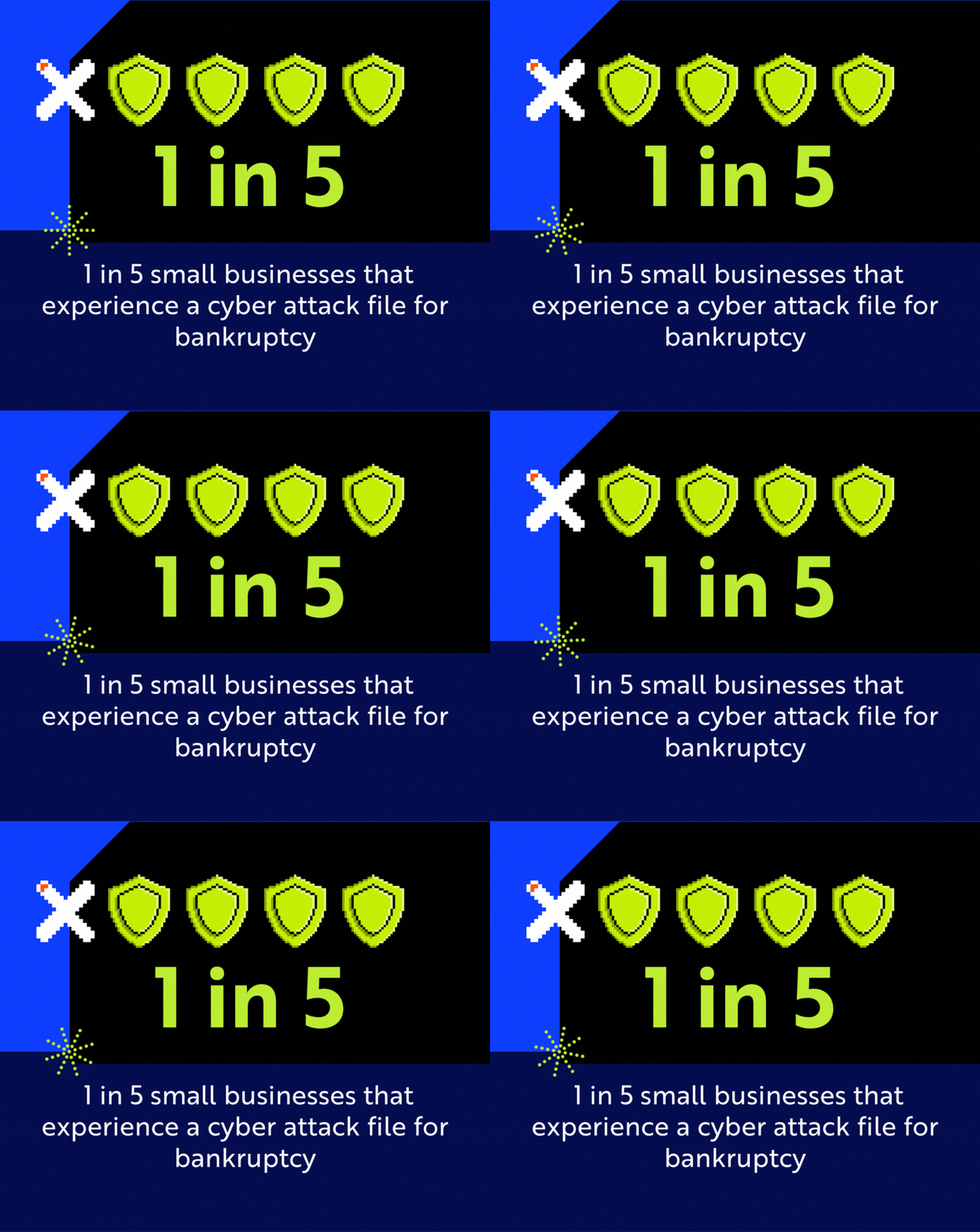
Threat actors view small businesses as "soft targets" with fewer defensive resources and more direct access to employee credentials. And they're not wrong in thinking this way because their strategy works. Research shows that 1 in 5 small businesses that experience a cyber attack end up filing for bankruptcy or closing their doors for good.
Financial and Operational Impact
A successful social engineering cyber attack is rarely a localized incident. It is often the entry point for ransomware or Business Email Compromise (BEC). Research shows the average cost of a data breach for businesses with fewer than 500 employees is a $3.31 million. For a small business, these costs are often terminal.
Beyond the immediate financial loss, the operational disruption is staggering. Research estimates the cost of downtime to be between $100,000 and $300,000 per hour for the average business. An IT Director already struggling with backlogged projects cannot afford the weeks of downtime required to audit compromised accounts, restore systems from backups, and remediate identity-based vulnerabilities.

Regulatory and Compliance Exposure
In addition to cyber attacks, compliance is another moving target IT Directors have to keep up with. For organizations governed by HIPAA, GDPR, CMMC, or PCI DSS, a social engineering breach can lead to massive fines and the loss of the "authority to operate." To give you an idea, GDPR violations can cost up to €20 million or 4% of annual revenue, whichever is higher.
Reputational Damage
And then there are costs that you don’t get invoiced for, like your company's reputation, one of your most valuable assets. A single data breach can shatter it in an instant. In fact, following an attack, 80% of small businesses said they had to spend time rebuilding trust with clients and partners.
Common Social Engineering Techniques Targeting Small Business Employees
Here are real-world scenarios that small businesses face with social engineering threats:
Phishing and Spear Phishing Attacks
Phishing attacks remain the most common form of social engineering. It involves mass-distributed emails designed to trick users into clicking malicious links or downloading infected attachments.
Spear phishing is the more dangerous, targeted cousin. Attackers research specific individuals, like IT Directors or Finance Managers, using LinkedIn or company "About Us" pages. The resulting email is highly relevant, often mentioning specific projects or colleagues, making it nearly impossible for an untrained eye to detect.
Business Email Compromise (BEC)
In a BEC attack, a threat actor gains access to a corporate email account or spoofs it to authorize fraudulent wire transfers. These attacks are devastating because they rely on legitimate communication channels. There is no "malware" for an antivirus to catch; it is simply a conversation that leads to a financial disaster.
Vishing and Smishing
Social engineering is not limited to email. Vishing (voice phishing) uses phone calls to manipulate employees. A common tactic involves an attacker pretending to be "Help Desk Support" calling to "verify a password reset." Smishing (SMS phishing) uses text messages to deliver malicious links, exploiting the high open rates of mobile messaging.
Deepfake and AI-Enhanced Social Engineering
Attackers now use AI to generate realistic voice calls or videos that impersonate executives. They research organizational structures and target key staff members with personalized messages, increasing the believability of requests.
Invoice and Payment Scams
Fake invoices that appear to come from a known supplier can trick accounts payable into making payments to fraudulent accounts.
IT Support Impersonation
Someone calls or emails an employee pretending to be IT support and asks them to uninstall security tools or reveal credentials to fix a non-existent issue.
Social Engineering Prevention: A Multi-Layered Strategy
A risk-focused CISO knows that you cannot "patch" human behavior. Instead, you must build a system that minimizes the impact of human error.
Implement a Zero Trust Security Model
The zero trust security model operates on a simple premise: "Never trust, always verify." By removing implicit trust from the network, an IT Director can ensure that even if a user’s credentials are stolen via a social engineering attack, the attacker cannot move laterally through the network.
Multi-Factor Authentication (MFA) and IAM
MFA is the single most effective technical control against credential theft. While "MFA fatigue" attacks are on the rise, implementing phish-resistant MFA (such as hardware security keys) provides a solid barrier. Identity and access management (IAM) follows the principle of least privilege, ensuring that users only have the permissions necessary for their specific job roles.
Security Awareness Training and Phishing Simulations
Technical controls are necessary, but they are not sufficient. Security awareness training must be ongoing and based on data. Monthly phishing simulations allow IT teams to identify which departments or individuals are most susceptible to social engineering risks. This isn't about punishment; it’s about providing targeted education where it’s needed most.
Incident Response Playbooks
When an attack is successful, the speed of the response determines the level of damage. IT Directors should have specific "Social Engineering Playbooks" that outline:
- Immediate account isolation procedures.
- Communication protocols for affected stakeholders.
- Forensic analysis steps to determine the scope of the breach.
When Security is Everyone’s Job, but No One Has the Time
For the IT Director, the goal is not to achieve "zero risk." This is impossible. The goal is to build a resilient organization where technical controls, human awareness, and strategic partnerships create a strong defense.
The problem is that many small businesses don’t have full-time security professionals to achieve this. IT teams are stretched thin handling help desk tickets, projects, networks, and compliance, leaving little bandwidth for proactive cyber defense.
The Role of Managed Services (vCISO and SOC)
This is where managed services can play a critical role. A virtual CISO (vCISO) provides the strategic oversight needed to assess risk, set priorities, and align security efforts with business goals without adding headcount. Pair that with a 24/7 Security Operations Center (SOC), and you can offload continuous monitoring and response to ensure that threats are detected and addressed in real-time.
The result is a shift from constant firefighting toward a more proactive, risk-based security posture. This is exactly how CompassMSP helps small to mid-sized businesses. Our cybersecurity advisory services and vCISO guidance support organizations with turning security priorities into clear, actionable plans. It’s a practical way to reduce risk, close gaps, and move forward with confidence.
Contact our team to learn how we can help you go from reactive fixes to measurable, ongoing risk reduction.
A Cybersecurity Expert's Breakdown of Social Engineering Risks for Small Businesses

Brian Bennet
Brian is a Security Architect at CompassMSP and military combat veteran with 22 years of IT experience spanning the public sector, government contracting, managed services, and executive cybersecurity leadership. He has served as an Information Systems Security Manager for a global aerospace company—where he secured classified and unclassified assets under NISPOM, NIST, and ITAR frameworks and established a classified asset security program from conception through ATO—as well as a vCIO and CISO/vCISO, guiding organizations ranging from 10 to over 1,000 employees through security strategy, framework implementation, audits, and incident response engagements including ransomware events. Brian holds certifications from ISC2, Cisco, Microsoft, VMware, and CompTIA, and draws on his progression from hands-on engineering to the C-suite to drive meaningful security conversations.